

A friend who works in hotel housekeeping in LA said, "I heard the minimum wage would be $30 by 2028, but it got pushed to 2030." They sounded disappointed.
They had high hopes, and their disappointment was evident in their voice.
News reports suggest that the city council has gone back on its promise.
However, looking deeper, the situation is not that simple.
In 2025, the LA City Council passed an ordinance commonly referred to as the Olympic Wage.
It aimed to raise the minimum wage for hotel and airport workers to $30 an hour before the 2028 Olympics.
The original plan was to start at $22.50 in July 2025 and increase it to $30 by July 2028.
This applies to hotels with 60 or more rooms, and designated areas around airports include hotels with 50 or more rooms.
However, at the end of May this year, the city council revised this schedule.
They pushed the timeline for reaching $30 to 2030. The amended ordinance took effect on June 29.
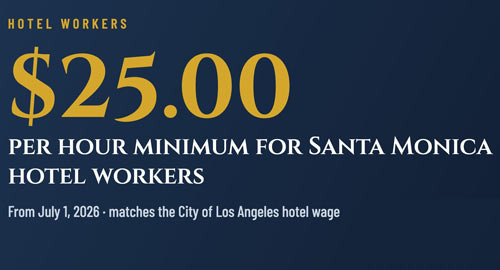
So, how much are workers currently earning? According to the official poster from the city's wage department, the minimum wage for hotel workers starting July 1, 2026, will be $25 an hour.
This means that the planned increase for this year is still on track.
The issue lies in the intermediate steps from 2027 to 2029.
Now, let's explore the real question: why was it delayed? The key factor is taxes.
More specifically, it's the gross receipts tax imposed by the city of LA, which is a sales tax on business revenue.
The hotel industry and business groups have gathered signatures for a ballot initiative to abolish this sales tax.
Reports indicate that they have secured enough signatures to put it on the ballot in November.
This tax contributes over $800 million annually to the city's finances. City finance officials have warned that abolishing it would severely impact the city's budget.
Ultimately, a sort of deal was struck. The city council slowed down the wage increase, and the industry withdrew the tax repeal initiative.
The city council also processed a resolution to confirm the withdrawal of the initiative.
The hotel industry argued that if labor costs rise too quickly, they will have to reduce hiring or cut services.
On the other hand, there was significant opposition. Members of the hotel union, Unite Here Local 11, called this decision a betrayal.
Many people had planned their lives based on the expectation of $30, so their feelings are understandable.
Conversely, there are also small business owners near hotels or airports. This ordinance only applies to the specified hotels and airport areas, so it doesn't affect all industries.
I believe the original plan was too rushed. Raising the minimum wage this much in just three years is a pace that the market may struggle to handle.
Wages should ultimately align with the value created by the work and the market conditions to be sustainable.
If numbers are set according to political schedules, the burden often falls on the most vulnerable workers in the form of reduced employment.
That said, I don't think this decision was clean-cut either.
The process of changing the wage schedule using the tax repeal initiative as leverage is frankly more of a political deal.
When policies fluctuate like this, it becomes difficult for both workers and employers to plan.
In summary, the $30 goal hasn't disappeared; it has simply been pushed to 2030.
The $25 minimum wage has already been in effect since July of this year. The negotiations surrounding the sales tax, which exceeds $800 million annually, are at the heart of this issue.
The intermediate amounts may vary by source, so those affected should definitely check the city's official materials for confirmation.
 ToastSkiJump





 Swift Falcon |
 Tonky |

 My NYC |

 coloradoman |

 Living Economy Information Blog |

 Weekend Movie Blog |

 Beauty, Health, Lifestyle Blog |

 Victory 1988 |

 Superman Cat Blog |

 pet dog |
 toodin |
 rosed |
 DeArizona Blog |
 river9 |
 ollege Mom |
 Pronunciation Yo |
 nuvex11 |
 Living in Florida |
 axelon47 |
 lumbus |
 Texas Migration Story |
 Scade Studio |
 love ya |
 biscuit90 |
 chicpo |
 Helpful Life Stories |
 Kitchen Ideas |
 Diana Blues |
 Agenda Center |