

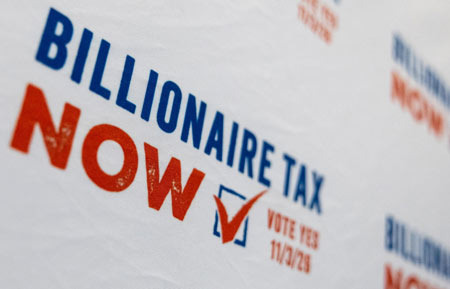
California is now looking to impose a tax based not on billionaires' income, but on their 'wealth.'
This is about Proposition 40, which California voters will decide on November 3.
If passed, starting January 1, 2026, California residents with a net worth exceeding $1 billion will face a one-time tax of up to 5% based on their assets.
For the average worker, the figure of $1 billion is already a story from another world. $1 billion is roughly over 1 trillion won.
Thus, for most residents, this election is less about "Will my taxes go up?" and more about "Is it okay to collect this level of tax from such wealthy individuals?"
The taxable assets include stocks, business ownership, art, collectibles, and intellectual property. However, real estate and some pensions and retirement accounts are generally excluded. The tax will be imposed in 2027, and if one prefers not to pay it all at once, they can incur additional costs and pay it over five years.
The intended use of the funds is already determined. 90% of the revenue will be used for resident healthcare services, while the remaining 10% will go towards food assistance or education-related programs.
In simple terms, the structure is "Let's collect from billionaires once and use it for healthcare and welfare."
So, how much will be collected?
The California Legislative Analyst's Office (LAO) has not specified an exact amount, but they analyzed that there is a possibility of hundreds of billions of dollars in revenue over the years.
That's a significant amount for taxes collected from a few billionaires. However, taxes are simple when calculated on a calculator.
The problem is that billionaires have enough money to hire a moving company.
LAO also believes that some billionaires may leave California or find other ways to reduce their taxable income in response to the tax burden.
If that happens, the California income tax they used to pay annually could decrease. The estimated reduction by LAO is less than $1 billion annually. So, the calculations become complicated.
There exists both the calculation of "We can collect hundreds of billions at once" and the calculation of "If wealthy people leave, the annual tax revenue will decrease."
Proponents argue that most of the billionaires' wealth is tied up in assets like stocks and business shares that have not yet been sold, making it difficult to tax the massive increase in wealth with regular income tax. Opponents counter that taxing business shares, which fluctuate in value daily based on stock prices, complicates asset valuation and could ultimately encourage the wealthy to move to other states.
In fact, LAO points out that accurately calculating wealth due to stock price fluctuations is not easy.
However, there is another interesting reason for this vote.
Propositions 41 and 42 will also appear on the same ballot.
In particular, Proposition 42 prohibits imposing a new state tax on the 'ownership itself' of personal property, including financial assets like stocks or investment accounts.
In other words, one side is asking, "Should we tax billionaire wealth?" while the other side on the same ballot is asking, "Let's not create that kind of new property tax."
What complicates matters further is the vote count. According to LAO, if Proposition 42 passes and receives more votes than Proposition 40, there is a possibility that Proposition 40 may not be enacted even if it receives a majority vote, if the court determines that the two measures conflict. Proposition 41 also contains separate tax-related restrictions that could conflict with Proposition 40.
Ultimately, California voters will not simply be asked this November, "Should we collect more taxes from billionaires?"
They will have to decide on both the proposal to impose a wealth tax on billionaires and the proposal to prevent a new property tax on the same day.
The tax laws are complicated, and the voting has been made into a puzzle.
One thing is certain. If Proposition 40 passes, California will embark on a rather unusual experiment targeting the massive assets held by billionaires rather than income.
Conversely, if the related restriction measures receive more votes, that experiment may go to court before it even begins.
Will we collect 5% from billionaires, or will we prevent such a tax from being collected at all?
It's time for voters to crunch the numbers on November 3. Ulpianus
 SolidValley99



 NEXT ROUND |
 Encyclopedia of New York and Surrounding Areas |
 washington mom |
 California Dreamer |

 Study Abroad Life Know-How Tips |
 Sunny's Travel in America |
  novapixel |

 There Are Such Things in the World |
  Enjoying Samba at Home |
  Once in a Lifetime |
  Korea Tiger News |
  Banana |
  rouge88 |
  toffee |
  King County |
  DREAM BIG |
  Good News Good Thoughts |
  peelynew |
  Helpful Life Stories |
  chicpo |
  monorama tone |
  Kentucky Fried Chicken |
  bloomberg |
  morninpo |
  my town K blog |
  bravik31 |
  Various Knowledge and Information in the USA |