
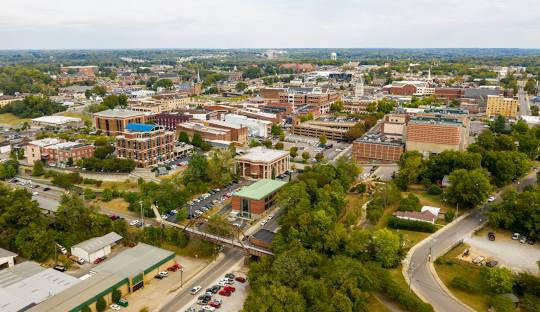
Clarksville is a city located in north-central Tennessee, known as the fifth largest city in the state and for its growing population.
It is situated along the Cumberland River's tributary, the Red River, and is close to Kentucky, making it a transportation hub.
Nearby is Fort Campbell, which plays a significant economic role related to military activities.
Clarksville was founded in 1784 by George Clark. Initially, it developed as a center for commerce and trade, functioning as an important base during the westward expansion era after the American Revolutionary War.
From the late 19th century to the early 20th century, it grew rapidly based on the railroad industry and agriculture, particularly in tobacco production and agricultural output. Subsequently, the development of Fort Campbell and the military industry became a crucial foundation for Clarksville's economy.
Clarksville's economy shows balanced growth across various sectors, including military, industry, education, and healthcare.
- Fort Campbell: The most important economic driver in Clarksville is the military base located at Fort Campbell. It is home to the U.S. Army's 101st Airborne Division, playing a very significant economic role. The base and surrounding military industries contribute significantly to employment and the local economy.
- Manufacturing plays a large role in Clarksville's economy. There are companies active in automotive parts manufacturing, food processing, and chemical and metal processing, as well as some related to the aviation industry, including helicopter parts.
- Clarksville is home to educational institutions such as Austin Peay State University, which plays an important role in connecting the local economy and education. Additionally, education and research are significant parts of the economy.
- Clarksville is also actively growing in the healthcare industry, with major medical institutions like Clarksville Medical Center serving as key employers in the area. Industries related to medical services also have a significant impact on the local economy.
Climate of Clarksville
Clarksville has a humid subtropical climate, with distinct four seasons, hot and humid summers, and mild winters.
Summer (June to August)
- Temperature: Summer temperatures are very hot and humid, averaging between 25°C and 35°C, with very high humidity. Summer is a time of heat waves and increased precipitation, especially in July and August when the hottest weather persists.
- Precipitation: Summer often sees frequent showers and thunderstorms, with significant rainfall. Summer accounts for about 40% of the annual precipitation.
Winter (December to February)
- Temperature: Winter is relatively mild, with temperatures ranging from 1°C to 10°C, occasionally dropping below -5°C.
- Precipitation: Winter precipitation is relatively low, and snow is rare. However, snowstorms or ice storms can occasionally occur.
Spring and Fall (March to May, September to November)
- Temperature: Spring and fall are mild and can see rapid temperature changes. In spring, temperatures rise between 10°C and 20°C, while fall temperatures fluctuate between 15°C and 25°C.
- Precipitation: Spring and fall have relatively low precipitation, but strong thunderstorms and tornadoes can frequently occur in spring.
Natural Disaster Records in Clarksville
Clarksville is an area affected by natural disasters, particularly vulnerable to tornadoes, floods, and strong winds. The region is close to the Mississippi River and the Cahaba River, making it at high risk for flooding.
Tornadoes
- Clarksville is located near Tornado Alley, where tornadoes frequently occur in spring and summer. On April 27, 2011, an EF4 tornado struck Tennessee and surrounding areas, causing some damage in Clarksville.
- Characteristics: Particularly in spring, powerful tornadoes can occur frequently, causing severe damage with strong winds.
Flooding
- Located near the Mississippi River and the Red River, Clarksville can experience frequent flooding. Especially during summer heavy rains or sudden increases in precipitation, river flooding can occur. Clarksville also suffered some damage during the major flood in 2010.
Strong Winds and Storms
- Summer Storms: In summer, storms accompanied by strong winds and showers frequently occur. Clarksville can be affected by hurricanes or tropical storms, which can cause damage with strong winds and heavy rainfall.
Clarksville has a humid subtropical climate characterized by hot summer weather and mild winters. This area can be affected by various natural disasters such as tornadoes, floods, and strong winds. Particularly in spring, the likelihood of powerful tornadoes and storms is high, making preparedness for weather changes important.





 novapixel |

 mintlogic |
 U.S. Weather Bureau News |
 Tonky |
  viroma |
  cookie |
  Live and that's it |
  Alright Twain |
  eatontown blog |
  HAWAII Korean Church News |
  Amore |
  linex |
  Balancework |
  laro90 |
  MEDBIO American Doctor Blog |
  SWAT TEAM BLK |
  DREAM BIG |
  frostbite |
  330 Forever My Love |
  El Dorado |
  dralix58 |
  Gorama Round |
  Skydiving |