
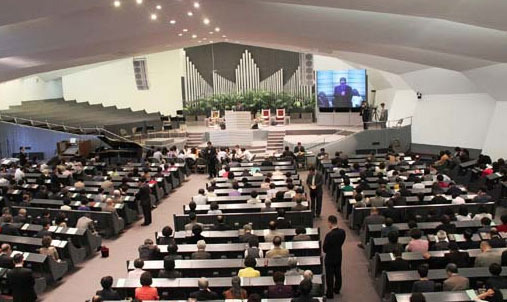
When discussing the Korean community in New York, it's hard to overlook the role of the church.
In the early 1970s, the Korean church held a much greater significance for the first generation of immigrants than it does today.
As Koreans began to settle in New York after moving to the U.S. in the 1970s, Korean churches started to emerge one by one.
Initially, they gathered around Manhattan, but as Koreans moved to Queens, Flushing, Bayside, Long Island, and New Jersey, the churches naturally followed.
Among them, there were quite a few Presbyterian churches.
Since Korea has a large number of Presbyterian believers, immigrants continued their familiar faith traditions upon arriving in the U.S. Today, there are still many Korean Presbyterian churches affiliated with various denominations in the New York and New Jersey area.
However, considering the role that Korean churches played in the past, it's hard to view them simply as places to worship on Sundays.
When they first arrived in the U.S., unable to speak English and knowing no one, where would they have gotten information?
At church, there were always people who had come to America before them.
"Where can I get my driver's license?"
"Which apartments are good?"
"Where should I send my kids to school?"
"Where can I buy Korean food?"
They asked all these questions to the church members.
They received job referrals, bought and sold used cars, and were introduced to lawyers and accountants.
In today's terms, the church served a role similar to that of Korean community websites and KakaoTalk group chats.
Especially in a city like New York, where settling down is not easy, this role was even more significant.
Even now, larger Korean churches have separate ministries for youth, college students, children, and adults, and they also hold English services for second-generation members who are comfortable with English.
There are gatherings and meal programs for seniors, Bible studies, and some churches offer programs like English education, counseling, and community service.
Interestingly, from a Korean perspective, the church often becomes the center of social relationships.
People meet friends at church, connect with business contacts, children become friends, and some even find marriage partners there. For the first generation who had to live in the U.S. without family or relatives, church members often played the role of relatives.
Of course, in a place where many people gather, not everything was positive.
There were frustrations due to interpersonal issues, divisions, and various rumors even within the church. In a place where Koreans gather, how could there not be such occurrences?
Still, looking back at the history of Korean immigration, it's hard to deny the role that churches have played.
Especially in places like Flushing and Bayside, you can still easily spot churches with Korean signs.
On Sunday mornings, you can see seniors dressed in suits carrying Bibles as they enter.
Seeing that makes me realize that the Korean community in New York was not built overnight.
 DrSleepy



 Tesla X |
 Another Eden Channel BLOG |
 Victory 1988 |
 Smile Face |
 Helpful Life Stories |
 newyorker 101 |
 Things to Do to Buy a House |
 Lunch and Dinner Mexican Taco |
 Poppin News |
 Living in the Eastern United States |
  Nando Raldo |
  American Man in a Mask |
  wendra |
  silver |
  bada2002 |
  horizon |
  Nanana Nanana Nanana |
  victoria jung |
  Kkikki Ppappa Shout Out Loud |
  Lululala |
  Toaster Pizza Magic Show |
  Utah, the Most Livable State |
  nortrix |
  Mau Nui |
  novapixel |
  fixed |
  AL ALASKA |
  amola |
  History Repeats Itself |