

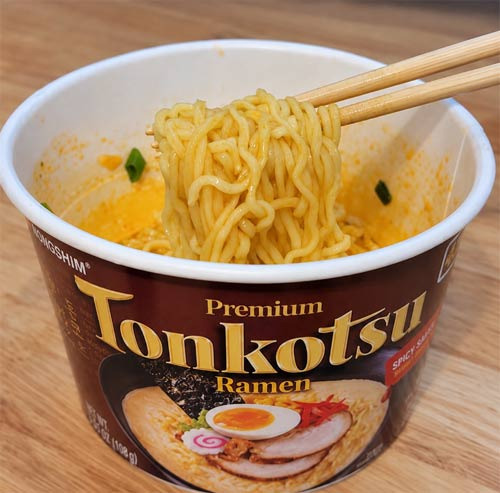
Last week, I stopped by the ramen section at Costco.
Usually, I buy a pack of 10, but next to the Shin Ramyeon, I saw a cup ramen from Nongshim that I had never seen before.
It was called 'Tonkotsu Ramen.'
I still didn't really know what tonkotsu was in Japanese cuisine.
Just by the name, I thought, "Tonkotsu? Is it ramen with pork cutlet?"
Looking back, it's kind of funny that I really thought that.
Since the word 'ton' is in the name, I immediately thought of pork cutlet, and since it was cup ramen, I figured it might have some small pork cutlet pieces in it.
When I got home, I added water and tried it, but there was no pork cutlet, and the broth was completely different from what I knew ramen to be.
It wasn't spicy and didn't have that strong chili powder flavor like Shin Ramyeon.
The broth was milky and rich, with a slightly greasy taste and a distinct pork aroma.
After the first bite, my honest thought was, "Is this supposed to be good?"
But strangely, after two or three bites, I started to get used to it.
I found myself wanting to take another sip of the broth and kept eating the noodles. As I ate, I thought it tasted familiar, and then I realized it was similar to the flavor from a Japanese ramen shop.
At first, it was a bit unfamiliar, but the more I ate, the more enjoyable it became.
So, I finally looked up what tonkotsu meant.
It turned out it had nothing to do with the pork cutlet I imagined.
In Japanese, tonkotsu (豚骨) literally means pork bone.
The broth is made by simmering pork bones for a long time, allowing the fat and collagen from the bones to mix into the broth, creating a milky and rich flavor.
It is especially related to the ramen culture in the Kyushu region, centered around Fukuoka.
I found the history of ramen to be quite interesting.
While it's easy to think of Japanese ramen as an ancient traditional food, the ramen we know today actually developed in Japan under the influence of Chinese noodle dishes.
In the 20th century, Chinese-style noodles spread in urban areas, and later, each region developed its own style of broth and noodles, fully adapting to Japanese tastes.
So, when you go to Japan, it's not just about ramen.
There are soy sauce-based shoyu ramen, miso ramen, which is a type of fermented soybean paste, and shio ramen, which is seasoned with salt, as well as tonkotsu ramen, which is made with a rich pork bone broth.
Each region has different noodle thickness, broth, and toppings.
Particularly, Hakata, famous for tonkotsu ramen, often uses thin noodles and has a culture of ordering extra noodles called 'kaedama' when you finish your bowl.
This means if you finish the noodles but still have broth left, you can order another serving of noodles to add in.
Knowing this made me see that cup ramen in a whole new light.
Korean ramen usually has a spiciness that hits you first.
When you eat Shin Ramyeon, you immediately think, "Ah, this is the flavor." But tonkotsu goes in a different direction.
Instead of starting with spiciness, it leads with the rich and savory flavor of the pork bone broth.
So, for someone like me, who is used to Korean ramen, the first bite might feel a bit bland or greasy.
But by the time I was halfway through, my thoughts changed.
"Oh? This is surprisingly good." In the end, I almost finished the broth.
When I first saw it at Costco, I thought it was a unique cup ramen with pork cutlet, but thanks to it, I learned at 45 that tonkotsu means pork bone and even looked up the history of Japanese ramen.
Will I buy it again next time I go to Costco?
At first, I would have said, "I don't know," but now I think I would buy it again.
Strangely, tonkotsu is a ramen that has a better second impression than the first.
 ThornValley
 Trail85






 Smile Face |
 Helpful Life Stories |
 Casa Mia |
 Study Abroad Life Know-How Tips |
 pravix22 |
 Anjollinya Blog |
 Weekend Movie Blog |
 Good News Good Thoughts |
 Victory 1988 |
 Sunny's Travel in America |
  bongo |
  savannah choi |
  Successful Manager Kim's Team |
  crystalo |
  Canvas Pro Blog |
  Time Management Enthusiast |
  Cap Com |
  nixxon |
  kevin Kim |
  beerdreamer |
  Kims Spring |
  White bunny |
  Kansas City Representative Singer |
  shadow 007 |
  sun walker |
  Choco Choco Star |
  midnight blue |
  honeypot |
  summer |
  adventure77 |