
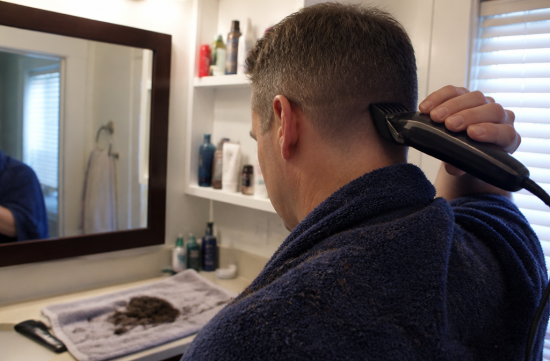
Recently, I went to my usual barbershop and paused for a moment when I saw the price list at the register. I thought prices had been creeping up over the years, but the actual increase was much more significant than I realized.
Since it was my regular place, I handed over my card without much thought, but when I got home, I started to wonder how much that money would add up to over a year. So, I decided to look into how much haircut prices in the U.S. have actually risen.
The national average for men's haircuts is around $41. In the past, you could get a decent cut for just over $20, so that difference feels quite substantial now.
Price ranges vary significantly depending on the type of barbershop. Large chains like Supercuts charge around $23 to $28, which is relatively more affordable.
Local barbershops range from $20 to $45, and if you move to salons, men's haircuts can go up to $50 to $85. This means that the same short haircut can cost more than double depending on where you go.
There are also significant regional differences; some places are as low as $19, while others can reach up to $110. Areas with a higher cost of living, like New York, California, and Hawaii, tend to have higher haircut prices as well.
Women's haircuts are definitely more expensive than men's, averaging around $69. When you add in the customary tip, the total cost for a visit is not insignificant.
Looking at a longer time frame, the increase becomes even clearer. In 2000, the average haircut cost $20, but by 2025, it is projected to rise to $39.50, nearly doubling in 25 years.
Given this situation, it's no surprise that more people are noticeably cutting their hair at home these days. I, too, joined that group a few years ago.
The price of a home clipper set typically ranges from $30 to $50. A full set with all the necessary components averages around $89, while simpler kits can be found for about $24.
When you look at it this way, the cost of a couple of trips to the barbershop is already covered by the price of a clipper set. After that, it's all savings.
If you assume you cut your hair once a month, research shows you could save between $300 and $720 a year. This means you could spend that money on something else instead of at the barbershop, which is not a small amount.
When calculated for a family, the difference becomes even larger. A household with two adults and two children could spend over $1,500 a year if everyone goes to the barbershop.
There are even cases where people reported saving over $1,300 a year by cutting their hair entirely at home. Seeing the numbers, it doesn't seem exaggerated at all.
From my personal experience, I remember being really clumsy the first time I picked up the clippers. I had uneven lengths on the sides and can still vividly recall chuckling at myself in front of the mirror.
However, after a few tries, I got the hang of it and now I don't struggle much. I realized that the human hand adapts more quickly than you might think.
The trickiest part is getting the back hairline right. You need to position two mirrors to check the angles while cutting to avoid making mistakes with the back of your head.
Even if it's slightly uneven, it won't be noticeable after a few days. Letting go of the pressure to be perfect from the start makes it easier and often leads to better results.
However, not all hairstyles are suitable for self-cutting. Long hairstyles for women or layered cuts and perms are too risky to attempt at home.
So, the most manageable area for self-cutting seems to be short men's hair or children's hair. The style changes are minimal, and mistakes are less noticeable.
If you have an important event like a wedding, interview, or crucial meeting coming up, I would recommend leaving it to a professional for that day. While saving money is great, there's no need to take risks for important moments.
I suggest taking a moment to calculate how much you spend at the barbershop each month. When you add it all up, you might be surprised at how significant the total is.
If you save that amount for a year, it quickly adds up to enough to buy a clipper. The rest can be saved or used for other expenses.
Of course, buying a clipper doesn't eliminate all haircut costs. There will still be times when you need a professional's touch for trimming or styling.
Still, I believe that if you can handle half of your trips to the barbershop at home, you'll save a decent amount by the end of the year.
I've often seen people buy clippers and then leave them in a drawer for months. Most give up after a few initial mistakes.
However, if you can push through the first few tries, it eventually feels easier than making a barbershop appointment.
I'm not saying you should insist on self-cutting all the time. I think the most realistic approach is to mix visits to the barbershop with self-cutting based on your hairstyle and lifestyle.
What started as a concern over a price list led me to conclude that the monthly haircut expense is a manageable part of my budget.
 SunnyGarden86


 Silent Sea |
 Pointy |
 Idaho's Sumi's House |
 holy cheese |
 Michigan Enthusiast |
 Plastic Rose |
 Trot King News |

 golfmaster |

 Smile Face |
  anchor |
  stalion |
  The Long Shot |
  Investment Beginner Company Information Encyclopedia |
  sweetfox |
  ceporta |
  H Leader |
  My tracks |
  Yes Dorian |
  novent |
  calviro |
  Enjoying Samba at Home |
  Once in a Lifetime |
  novapixel |
  Korea Tiger News |
  Banana |
  rouge88 |
  toffee |
  King County |