
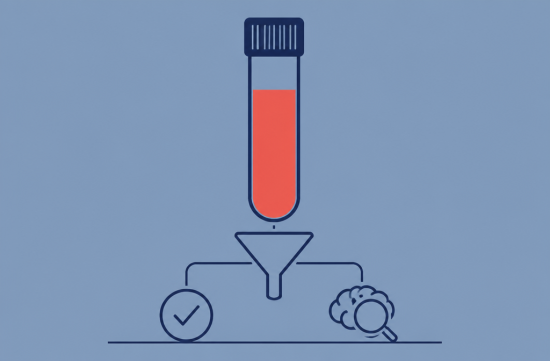
Recently, a friend I hike with cautiously asked me if it's true that you can find out if you have Alzheimer's just by getting a blood test.
Given that they lost both parents to dementia, the question was not taken lightly. So, I looked up FDA materials and guidelines from medical associations one by one.
To put it simply, part of it is true and part of it is not. The tests have indeed been developed, but the scope of what the blood test reveals is narrower than expected.
The first test received FDA approval on May 16, 2025. It is the Fujirebio Lumipulse G pTau217/beta-Amyloid 1-42 plasma ratio test.
This test calculates the ratio of two proteins in the blood. It estimates the likelihood of amyloid plaque accumulation in the brain based on that ratio.
Until now, confirming amyloid required a PET scan or a lumbar puncture for cerebrospinal fluid testing. The blood test is significant in that it lowers the threshold for testing.
There are specific criteria for the subjects. Adults over 55 who already show signs of cognitive decline are the target group.
The clinical data reviewed by the FDA included plasma samples from 499 adults with cognitive impairment. Among those who tested positive, 91.7% had confirmed amyloid presence through PET scans or cerebrospinal fluid tests.
Among those who tested negative, 97.3% showed no signs of amyloid. Just looking at the numbers, it seems quite reliable.
However, there is an easy-to-miss detail here. Less than 20% of the 499 individuals received inconclusive results, meaning they were neither positive nor negative.
This means that nearly one in five people may not receive an answer even after having their blood drawn. In such cases, they would ultimately need to proceed to a PET scan or cerebrospinal fluid test.
The second test is the Roche Elecsys pTau181 test, which was approved on October 13, 2025. It is the first blood test approved for use at the primary care level, meaning it can be used by local doctors.
The purpose of this test is not diagnosis but exclusion. If the result is negative, it suggests a low likelihood of Alzheimer's-related lesions, prompting the search for other causes.
Roche has stated that the negative predictive value is 97.9%. Conversely, a positive result does not confirm Alzheimer's on its own.
Having worked in IT for a long time, I'm familiar with this kind of structure. Systems are designed with a primary filter to eliminate false alarms and a secondary stage for detailed analysis.
The Alzheimer's Association's clinical guidelines released in July 2025 follow the same trend. They set standards for blood tests used in specialized memory clinics.
To be used for screening, tests must exceed 90% sensitivity and 75% specificity. To be used for definitive diagnosis, both sensitivity and specificity must exceed 90%.
The guidelines warned that many blood tests available on the market do not meet these standards. Some tests are sold without FDA approval, so it's risky to choose based solely on their names.
Another point to note is that having amyloid does not mean that everyone will develop dementia symptoms. These tests look for traces of lesions but do not predict future outcomes.
This is why the FDA approval is conditional on the presence of symptoms. It is not approved for screening in asymptomatic individuals who are anxious.
There is also the issue of cost. Medicare does not cover screening tests for asymptomatic individuals.
If symptoms are present and a healthcare provider deems it medically necessary, it may be processed as a Part B diagnostic test. However, the handling can vary by insurance company and lab, so it's wise to check in advance.
There is a bipartisan bill in Congress proposing that Medicare should cover FDA-approved blood tests as screening tests. However, it has not yet passed into law.
I explained to my friend that if they are experiencing more frequent memory lapses, it's better to first describe their symptoms to their primary care physician rather than seeking a blood test.
If the primary care physician finds it necessary, they can conduct exclusion tests like pTau181. Depending on the results, the process may lead to a referral to a neurologist.
When you receive the test results, first check whether they are positive, negative, or inconclusive. If the result is inconclusive, it's not a failure but a signal that further testing is needed.
Interpretation may vary based on personal medical history and medications, so it's essential to consult with a doctor or pharmacist. Relying solely on internet reviews to draw conclusions can be risky.
Just as you wouldn't rely on a single map when hiking, you shouldn't make decisions at a fork in the road without considering signs, GPS, and terrain.
I believe that Alzheimer's blood tests should be viewed as just one of those signposts. Personally, I would discuss exclusion tests with my primary care physician when symptoms arise and proceed to more detailed testing if necessary.
 VelvetGarden99


 Old English |
 nixxon |
 LIZ Legal Information Blog |
 Karina's Blog |
 Jimbeam 88 |
 Hani 1977 |

 Hawaii Maui Kahului |

 nortrix |
  Mau Nui |
  novapixel |
  fixed |
  AL ALASKA |
  amola |
  History Repeats Itself |
  Doori Ark |
  Rainbow Bridge to the Sky |
  Sunny Fullerton |
  U.S. Weather Bureau News |
  GOGO SING |
  Gold Bar |
  Banana Style Life |
  Tesla X |
  urbanmint |
  forestcloud |
  forever young |