
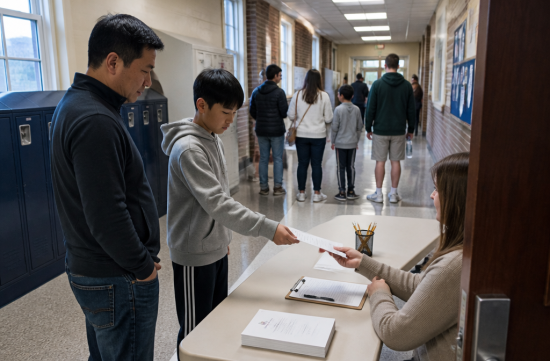
Last week during lunch at work, a colleague at the next desk sighed. Their child is applying to private school for 9th grade next year, and they still haven't decided whether to take the ISEE or the SSAT.
Since this is not just someone else's issue, I spent that evening looking through school admission pages and materials from the testing organizations. There are more confusing aspects than I expected, so I'm putting together a summary.
First, let's address the most pressing question. The prominent private schools in St. Louis, John Burroughs and MICDS, only require one of either the ISEE or SSAT. Both schools clearly state on their admission pages that they do not prefer one test over the other.
This means that it's not up to the school; parents need to choose the test that fits their child best. This can be quite a burden.
Looking at the deadlines is eye-opening. The application deadline for 9th grade at Burroughs is December 11, 2026, and for 7th grade, it's January 12, 2027.
Burroughs will only accept scores from tests taken between August 1, 2025, and January 9, 2027. There's also a date set for students to take the SSAT on campus on November 14.
MICDS also has a 9th grade application deadline of December 11, and 9th grade applicants must complete their tests by January 10, 2027. Applicants for grades 10-12 have a bit more time, with a deadline of February 13.
Since it's early October now, there isn't a lot of time left. If a student takes the test once and isn't satisfied with their score, they need to factor in the opportunity to retake it.
So, what are the differences between the two tests? The biggest difference is the penalty for incorrect answers.
For the SSAT upper-level, a correct answer earns 1 point, an incorrect answer loses 0.25 points, and unanswered questions score 0 points. The handbook from the testing organization advises not to guess recklessly, but to make educated guesses when two out of five answer choices can be eliminated.
In contrast, the ISEE does not penalize for incorrect answers. Therefore, if time is short, the best strategy is to fill in all answers without leaving any blank.
If your child is cautious and tends not to answer questions they are unsure about, the SSAT might feel less stressful. Conversely, if your child feels more comfortable answering all questions, even if they have to guess, the ISEE might be a better fit.
The structure of the tests is also quite different. The ISEE upper-level consists of 40 verbal reasoning questions in 20 minutes, 37 quantitative reasoning questions in 35 minutes, 36 reading comprehension questions in 35 minutes, and 47 math achievement questions in 40 minutes, plus a non-scored essay section lasting 30 minutes.
Excluding the two breaks, the pure testing time is 2 hours and 40 minutes. With 40 questions in verbal reasoning and only 20 minutes, that's about 30 seconds per question, which is really tight.
The SSAT upper-level includes a non-scored writing section lasting 25 minutes, math for 30 minutes, reading comprehension for 40 minutes, verbal for 30 minutes, and another math section for 30 minutes, plus a 15-minute experimental section that does not count toward the score. Including the two breaks, the total time is 3 hours and 10 minutes.
One important aspect to note is the weight of the math sections. The ISEE provides separate scores for two math-related sections, while the SSAT combines the scores from its two math sections into one.
The verbal sections also differ in style. Both tests include synonym questions, but the SSAT has analogy questions, while the ISEE includes sentence completion questions.
As a result, it's often said that students strong in math should consider the ISEE, while those with strong vocabulary and analogy skills should lean toward the SSAT. However, this is just a trend, so it's best to try out free sample questions from both tests before making a decision.
The rules for the number of test attempts also vary. The ISEE is divided into three seasons: fall, winter, and spring/summer, and you can only take it once per season.
The fall season runs from August to November, and the winter season from December to March, so you can take it once this fall and once more in December. This is the maximum if you want to meet the early January deadline.
The SSAT allows for up to six regular paper-and-pencil tests per year, plus one Flex test on a separate date. The SSAT at Home can only be taken once a year.
I also checked the costs, and they are higher than I expected. The ISEE costs $170 if taken at a member school, $225 for a small group at a testing office, and $250 for a Prometric center or ISEE-supervised at-home test.
The SSAT costs $177 for both the regular and Flex tests, $250 for Prometric, and $263 for at-home testing. Just taking the regular test twice will cost $354, so it's better for your wallet to focus on one test from the start.
If finances are tight, you can request a fee waiver from the school you are applying to. The ISEE provides information that you can use a waiver code to access paid packages for free.
There's also an interesting update. The ERB, which created the ISEE, and the EMA, which created the SSAT, have merged, and now a single nonprofit organization called E3n operates both tests.
However, this doesn't mean the tests have merged into one. According to this year's materials, the formats and scoring methods remain distinct.
Additionally, deadlines and requirements can change from year to year, so be sure to check each school's admission page before applying. Some Catholic schools also have a separate test called the HSPT.
My conclusion is this: if time is tight this season, I would choose the ISEE. You can fill in all answers without worrying about penalties, and you have opportunities in both the fall and winter seasons.
Of course, if your child is more confident in vocabulary than in math, that changes the conversation. Ultimately, the answer lies not with the school but with the child, which is the biggest takeaway I felt while researching this information.
 BasilaHouse





 Magic Cabbage School of Martial Arts |
 Vacation on Hawaii |
 morvex37 |
 Ari Songhan American Immigration Life |
 Bearded Strawberry Smoothie |
 calvorn |
 Lim Ario |
 mortrix |
 norvexi |
 Utah, the Most Livable State |
  nortrix |
  Mau Nui |
  novapixel |
  fixed |
  AL ALASKA |
  amola |
  History Repeats Itself |
  Doori Ark |
  Rainbow Bridge to the Sky |
  Sunny Fullerton |
  U.S. Weather Bureau News |
  GOGO SING |
  Gold Bar |
  Banana Style Life |
  Tesla X |
  Old English |
  urbanmint |
  forestcloud |