
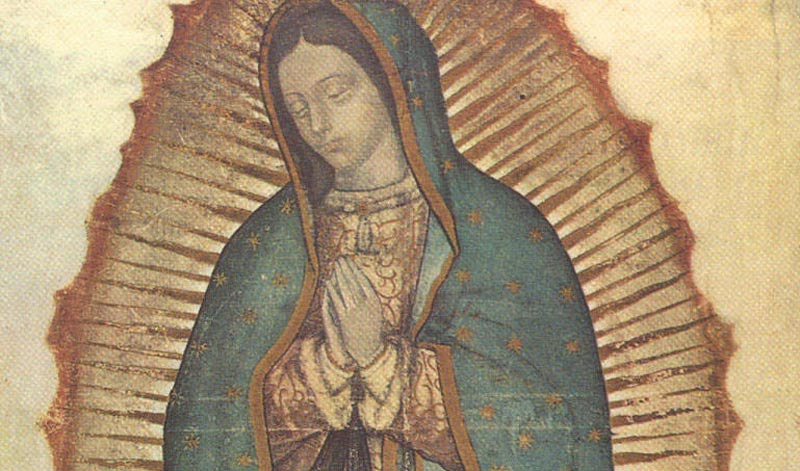
Those who have visited Mexico may have heard this saying.
"La Virgen de Guadalupe está en el corazón de México."
(The Virgin of Guadalupe is in the hearts of Mexicans.)
And that saying is not just a metaphor.
The image of the Virgin of Guadalupe is present throughout all of Mexico, from the Mexico City airport to street murals, on buses, and in restaurant corners...
So who is this Virgin that captivates not only Mexico but all of Latin America?
In the winter of 1531, on the hill of Tepeyac in Mexico, the Virgin Mary appeared to Juan Diego, a native convert.
And she is said to have spoken these words.
"Build a sanctuary for me on this hill.
There, I will convey love and comfort to my children."
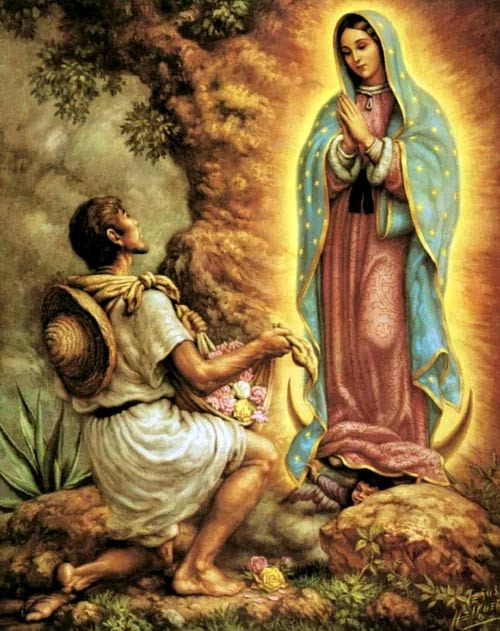
She spoke in Nahuatl, the language of the natives, and her skin tone was a brownish hue, neither fully Spanish nor fully indigenous. This was a significant symbol of her appearing as "the mother of all nations."
The archbishop Juan de Zumárraga initially did not believe this message.
"It could just be your own vision. If she is the mother of heaven, shouldn't she provide a clear sign for you to believe?"
In sorrow, Cuauhtlatoatzin climbed the hill of Tepeyac again and explained his situation to the Virgin Mary.
"Mother, the bishop does not believe me..."
In response to his desperate confession, the Virgin Mary said:
"At the top of the hill, roses are blooming. Go and pick them to bring to him."
The problem was that it was December, and the hill was a rocky, barren terrain. It was impossible for flowers to bloom under such conditions.
However, Cuauhtlatoatzin believed the Virgin's words and ascended the hill. When he saw the beautiful roses blooming, a variety that could not grow in the highlands of Mexico, he was left speechless.
He carefully picked the roses one by one and wrapped them in his tilma (cloak) with great care.
Then he returned to the Virgin Mary at the bottom of the hill.
He tried to unfold his cloak to show her, but the Virgin Mary quietly smiled and rearranged the flowers on his cloak herself, as if preparing a planned artwork on it.
And she said:
"Juan, these flowers are the sign I entrust to you.
You must take these flowers to the bishop and convey that my will is sincere and a hope from heaven.
Do not unfold the tilma.
Show it only in front of the bishop. And say:
'The Virgin gave me these flowers from the hill and instructed me to deliver them.'
You are my messenger. Keep your faith and do not waver."
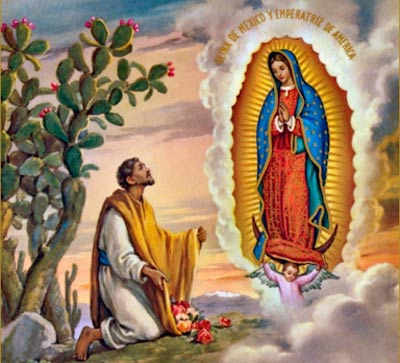
Juan Diego entered the bishop's residence with a trembling heart.
Before the gathered priests, enduring their skeptical gazes, he slowly unfolded his tilma.
In that moment, as the tilma opened, countless Castilian roses cascaded to the floor, revealing the remarkably intricate and vivid image of the Virgin Mary etched on the tilma.
Seeing this, the bishop knelt down and wept in prayer before the tilma.
"Forgive my foolishness for not believing such a clear miracle...
May your will be fulfilled through me, Mother."
At that moment, the bishop promised to build the church requested by the Virgin, and it was indeed executed immediately.
Notably, this church was built on the site of the Aztec goddess 'Tonantzin's' temple.
Thus, it became a symbolic place that embraced the existing faith and transitioned to a new belief, beyond mere construction.
A place that carried the message of the miracle, and the beginning of a new center of Christian faith.
Juan Diego dedicated his life to sharing this story.
After being baptized and formally converted, Juan Diego spent his life guarding the small church on the hill of Tepeyac.
He shared the story of the Virgin he had seen with visitors, and many natives who heard his testimony converted to Catholicism.
In just ten years, about 9 million natives converted, demonstrating the tremendous influence of the Virgin's apparition event.
But It Wasn't Welcomed from the Start
Now, everyone knows it as a 'miracle,' but the Virgin's apparition event was not accepted without controversy from the beginning.
The place where the Virgin appeared was originally the temple site of the Aztec goddess 'Tonantzin.'
Thus, doubts arose: "Could this be a demon disguised as the Virgin?"
There was fierce debate within the church at the time. Was this miracle real? Was the image on the tilma painted by a human? Ultimately, in the 18th century, after numerous investigations, the Vatican officially approved this event.
The 'Mystery' Revealed by Scientific Investigation
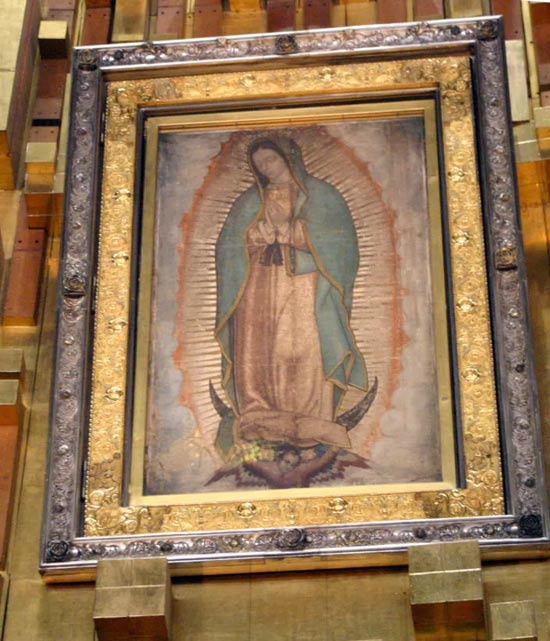
Numerous scientific investigations and verifications have been conducted regarding the image of the Virgin etched on Juan Diego's tilma.
18th-century investigation: It was concluded that it was impossible to paint such an image on fabric with the technology of the time.
1979 infrared photo analysis by NASA consultant Philip Callahan: No underdrawing traces were found, nor brush strokes. In other words, there were no signs that it was painted by a human.
Chemical analysis results: It was revealed that the pigments used on the tilma were components not extracted from animal, plant, or mineral sources. Moreover, it is astonishing that it has not decayed despite nearly 500 years without preservatives.
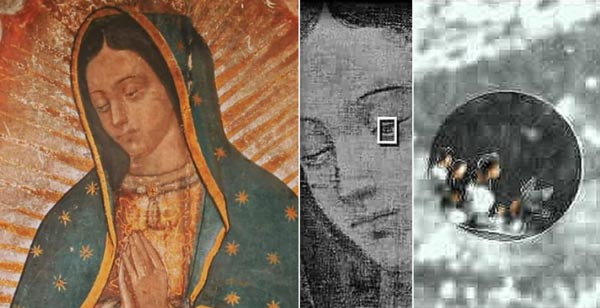
The Eye Mystery: High-resolution digital image analysis claims that at least 13 figures are reflected in the Virgin's eyes, as if capturing the moment Juan Diego unfolded the tilma.
Of course, none of this has been scientifically proven to be 100% 'miraculous.'
However, the existence of phenomena that are extremely difficult to explain has undeniably led many to faith.
Subsequently, the Virgin of Guadalupe was declared the protector of Mexico, and her image began to hang in the homes of countless Mexicans.
The Miracle Officially Recognized by the Vatican and Admired by the Pope
The apparition of the Virgin of Guadalupe is the first Virgin apparition officially recognized by the Vatican. The Vatican's recognition of an event as a 'miracle' is not taken lightly.
This process involves not just faith or emotional impact, but a very strict procedure of scientific verification and theological review.
Although the apparition of the Virgin of Guadalupe occurred in 1531, it was not officially recognized by the church until the 18th century.
When the Vatican recognizes a miracle, it is not merely an expression of belief but a careful result of complex judgments encompassing both science and theology.
Therefore, once an event is declared a miracle, it remains a powerful testament of faith for countless believers even hundreds of years later.
Many popes have devoted their devotion to this Virgin, and particularly, Pope John Paul II declared her in 1999 as "the protector of the Americas, the Empress of Latin America, and the patron saint of the unborn."
Pope John Paul II made four pilgrimages to the shrine of Guadalupe in 1979, 1990, 1999, and 2002.
And on July 31, 2002, he personally officiated the canonization ceremony at the Basilica of Tepeyac, declaring the witness of the Virgin's apparition, Juan Diego, as a 'saint.'
This shows how important the Vatican considers this apparition.
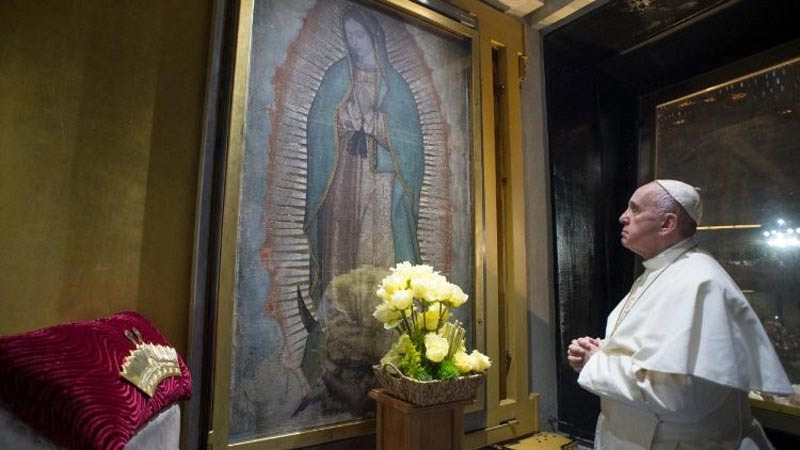
Annual visitors exceed ten million. On December 12, the anniversary of the Virgin's apparition, many people crawl on their knees to reach it.
On the hill of Tepeyac, two churches now stand side by side.
Old Basilica (completed in 1709)
This is the first church built after the apparition, a charming Baroque-style building.
New Basilica (completed in 1976)
Constructed to accommodate more pilgrims, the Virgin's tilma is specially preserved inside this new church.
How to Get There?
-
Subway: Mexico City Metro Line 6 → Get off at La Villa-Basílica station
-
Metrobus: Use Line 6 or Line 7 Reforma line and get off at in front of the Guadalupe Church
After exiting the subway station, a five-minute walk will lead you to the dome of the basilica and the statue of the Virgin visible from afar.
Why is it a 'Miracle'? — Analysis from Scientific, Theological, and Historical Perspectives
Abnormal Natural Phenomenon
Roses blooming on the rocky hill in December
→ Conditions in the area and season make it impossible for flowers to bloom
→ Moreover, these roses are a variety from Spain's Castile, which cannot grow in the highlands of Mexico
The Image of the Virgin Etched on the Tilma
No brush strokes, underdrawing, or pigment components can be scientifically explained
→ Analysis by NASA consultant Philip Callahan concluded that there are no underdrawings or brush touches visible
→ The colors were revealed to be pigments that cannot be extracted from nature
→ It has been preserved for nearly 500 years without any signs of preservatives
The Mystery of the Eyes in the Tilma
High-resolution scans revealed that at least 13 figures are reflected in the Virgin Mary's eyes, suggesting that it captures the moment when the tilma was unfolded
→ It appears to reflect the scene of Juan Diego unfolding the tilma
→ Although not visible to the naked eye, patterns revealed by advanced technology
Social and Religious Influence
Following the event, 9 million natives converted to Catholicism
→ An unprecedented transition in world history for a single religious event
→ Overcoming conflicts between traditional religions and new faith through the miracle
All these elements are too structured as a narrative of miracles to be seen merely as coincidence or subjective experience.
I grew up seeing the Virgin Mary statue in the church and sometimes wondered, "Why does the Virgin always stand quietly?"
But upon encountering the story of the 'Virgin of Guadalupe,' I realized.
The Virgin has existed quietly, yet profoundly and firmly, transforming the world.
The fact that a single painting, a person's testimony, and the ensuing faith changed a nation's religion, culture, and identity shows that faith can be a tremendous force that moves history, not just a personal emotion.
Even at this moment, countless people in Mexico stand quietly before the Virgin of Guadalupe, offering their lives, seeking comfort, and searching for hope, and I can only bow my head in respect.





 Helpful Life Stories |
 American Man in a Mask |
 Make My Day |
 Texas Migration Story |
 USA Pharmacy Pharmacist |
  road98 |
  Churros Train Conductor |
  gleeful |
  Burbank Lee |
  Olivia's Blog |
  Bushing Around Life |
  Active |
  Cherokee Rose |
  Kor. Master |
  Holey Moley |
  Conflite Teacher |
  Hodong Prince Over Flex |
  Mist inn |
  citrus pop |
  Onion Ring |
  phoenixia |
  viewtop |
  loverun |
  Kim Do Sun |
  SEVEN SEVEN |