

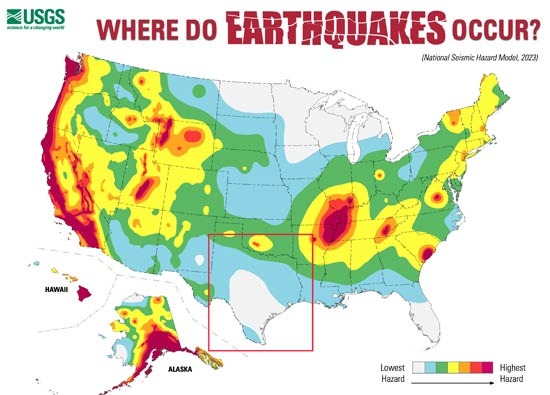
When living in San Antonio, Texas after moving from San Jose, California, you hear that Texas is a state where earthquakes rarely occur, except near El Paso. After living in Texas for a few years, I realize that this statement is quite accurate. Compared to areas like California, Washington, or Alaska, where ground shaking is a daily experience, discussions about earthquakes in Texas feel like stories from another country.
Looking at the geography of Texas, most of the state is deeply situated within the North American Plate. Because it is far from the boundaries where plates collide or separate, tectonic deformation hardly occurs. The regions we commonly see in the news as earthquake-prone are mostly near plate boundaries, while central Texas, including San Antonio, is well away from such risk factors.
However, El Paso is an exception. The area near El Paso, at the western edge of Texas, bordering New Mexico and Mexico, is influenced by a geological structure known as the Rio Grande Rift. This area experiences very slow tectonic movement, so minor seismic activity is observed. Therefore, when news of an earthquake in Texas arises, it is usually around El Paso. In fact, for people in San Antonio, El Paso feels quite far away, and the time zone difference makes it feel like a different state altogether.
The reason El Paso's time zone differs from San Antonio's is due to its geographical location. San Antonio is closer to the eastern part of Texas and uses Central Standard Time, while El Paso, located at the western edge of Texas, uses Mountain Standard Time. Texas is so vast that the difference in sunrise and sunset times is too great to group the entire state under one time zone. El Paso overlaps with New Mexico in terms of lifestyle, and commuting and commercial activities align with the Mountain Standard Time region, so the time zones were separated for administrative and convenience purposes.
For those living in San Antonio, frequent earthquakes like those in California are not a consideration. When buying a house, very few people consider single-story structures or seismic design. Even in insurance consultations, mentioning earthquake insurance is rare. Instead, natural disasters unique to Texas, such as floods, hail, tornadoes, and extreme heat, are more realistic concerns. The extreme heat exceeding 100 degrees every summer, sudden downpours, and hail damage in spring are more pressing issues.
Thanks to this stability without earthquake worries, San Antonio is particularly regarded as an attractive city for retirees and long-term residents. There are almost no extreme disaster risks like earthquakes, volcanoes, or large wildfires, and land and housing costs are less burdensome compared to other major cities. As a result, many people move from California or the West Coast, and a significant number often say, "It's comforting here because the ground doesn't shake."
Of course, Texas is not completely safe. In recent years, minor earthquakes have been observed in some areas of North Texas due to oil drilling and wastewater injection. However, these are also very small in magnitude and do not affect daily life. In San Antonio, such induced earthquakes are hardly felt.
Ultimately, one of the biggest advantages of living in San Antonio is the geological stability of Texas.
Being able to sleep without worrying about the ground shaking and living without a Ditch bag to grab in case of an emergency is a significant factor in quality of life that I feel while living here.







 El Dorado |
 lightyear |
 Moscow Kim |
 coloradoman |
 Montgomery Mom |
 Helpful Life Stories |
 American Man in a Mask |
 Hajiwon Blog Hair Salon |
 Make My Day |
 TEXAS Fishing Boat |
  DREAM BIG |
  frostbite |
  330 Forever My Love |
  dralix58 |
  Gorama Round |
  Skydiving |
  dreamport |
  Yellow Snowman |
  Toaster Pizza Magic Show |
  velvetnom |
  Anytime Journey |
  Mrs. Duluth |
  jaxter |
  Atlanta Mama |
  Baguette Blog |
  Tan Sol |
  US Embassy |
  Korean Mom |
  My NYC |