
During the Thanksgiving holiday, I walked along the downtown riverbank with a guest. While looking down at the water from the bridge, they asked, "That's a lake, but why is the water flowing toward the opposite side of the lake?"
Good question. If it's a river, it should flow into the lake. The Chicago River originally did just that.
Officially, this river changed direction on January 2, 1900. It wasn't nature that changed it; it was humans who dug into the ground to make the change.
The story begins with a glass of water. In the 19th century, Chicago dumped its sewage into the river, and that river water flowed into Lake Michigan. However, drinking water was also drawn from that lake.
This meant that the water we discarded was making its way back to our tables. It would be strange if there were no issues.
In 1891, the number of people who died from typhoid fever in Chicago was recorded at 1,997. I was momentarily speechless upon seeing that number.
Let's correct one thing here. There's a story that after heavy rains in 1885, an epidemic caused 90,000 citizens to die, which led to the river being reversed.
This is not true. There are no records of cholera deaths that year, and even though there were years in the 1880s when typhoid deaths exceeded 1,000, it was not that year.
If that many people had died, there would have been piles of records left behind. This is true when looking at health information; the more plausible the number, the more you should check the source.
However, it is true that the heavy rains in August 1885 frightened people. The fear that something terrible might happen drove political action.
In 1889, the Illinois legislature passed a law to establish the Chicago Sanitary District. The results of the referendum were 70,958 in favor and 242 against.
Can you imagine such a difference in votes today? It seems there were no party lines when it came to clean water.
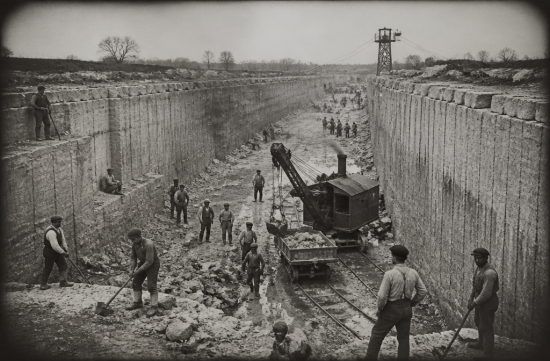
The construction began in 1892. It involved digging 28 miles from the southern branch of the Chicago River to connect it to the Des Plaines River.
The principle was surprisingly simple. To the west of Chicago, there is a low divide that separates the water flows. Water to the east flowed into Lake Michigan, while water to the west flowed toward the Mississippi River.
If you dig deep enough into that divide, the lake water will flow down to the lower side. It wasn't forcing the river; it was creating a new downhill path.
It sounds easy, but the work was tough. The canal was 24 feet deep, and the last 15 miles were solid rock, requiring dynamite and steam shovels to break through.
At times, there were as many as 8,500 workers on site. There were Polish stonemasons and many Black laborers. In 1893, a strike over wages led to the loss of lives.
Behind the phrase "great construction" are always these nameless individuals. This is a point that cannot be overlooked as an immigrant.
The opening scene was even more dramatic. The downstream city of St. Louis was not going to stay quiet. They must have been upset, thinking, "Why should we have to take your sewage?"
Before the court could intervene, they decided to let the water flow. On January 2, the Sanitary District put water into the canal without any ceremony. The dam at Lockport was opened on January 17.
Missouri eventually filed a lawsuit in the Supreme Court. The experiment presented in this trial was astonishing.
The Missouri side dumped 107 containers filled with harmless bacteria into the canal and monitored whether they reached the St. Louis intake. The waterway was 357 miles long, and about a month later, those bacteria appeared.
Still, in 1906, Justice Holmes dismissed the case. He believed there was insufficient evidence to prove that the typhoid in St. Louis was due to Chicago's sewage. He noted that the Illinois River became clearer as lake water mixed in, and fish returned.
Many engineers who gained experience here later went on to work on the Panama Canal. Chief engineer Isham Randolph was among them, and this canal was listed as one of the seven wonders of American engineering by the American Society of Civil Engineers in 1955.
I hold this construction in high regard. Although I support a small government, spending money on such a clear goal for a problem that cannot be solved alone, like clean water, is something the government should do.
However, it's not without flaws. To be honest, there was a part where I let my home issues flow into my neighbor's yard. Eventually, in the 1920s, a separate sewage treatment plant had to be built.
Lake water cannot be used freely either. In 1967, a federal court order limited the amount Illinois could draw to an average of 3,200 cubic feet per second.
There are days when the river returns to its old habits. On July 2, 2023, during heavy rains, the river level rose above that of the lake, prompting the opening of the dam, and the next morning, the river water flowed into the lake.
Still, the water has improved significantly. In the early 1970s, there were 10 species of fish, and now there are 77. In September 2025, 263 people swam in a river swimming competition held for the first time in 98 years.
After hearing my explanation, my guest smiled and said, "So this river has been working backward for over a hundred years." I believe this river is more remarkable than any skyscraper in Chicago.
 AcornQueen







 Illinois Mom |

 Electricity Field Certification Collector |
 Rice Shop Uncle BLOG |

 Hodong Prince Over Flex |

 American General Knowledge Expert |








 happy 9 |

 aloeverame |

 some fame |

 Yo Lock Me Up |

 moodansa 77 |
 Wang Ga Nae |
 Life in the US |
 Alright Twain |
 cloud0 |
 Allaston New Yorker Notebook |
 MBTI Detective Agency |
 Cool Beach Freeway |
 biscuitz |
 John Denver |
 Iri Jori Missouri |
 road98 |
 American Airlines Mileage |
 Whoever It Is, I Don't Know |
 meloncat |
 kimchi warrior |
 Angeles Choi |
 nutnew |
 ringwinds |
 United States National Administrative Organization Stories |