
Have you ever woken up in the morning with a feeling like a cloud is blocking one ear? It feels stuffy, like after getting off a plane, and even swallowing doesn't relieve it.
Usually, we brush it off. Maybe water got in while showering, or it's just a cold, or perhaps I overdid it during the holiday.
I tend to hesitate to call the doctor, thinking I'll just wait it out for a day, but after researching, I completely changed my mind. There are times when you can't afford to delay with ear issues.
This condition is called sudden sensorineural hearing loss, or SSHL for short. It's also referred to as sudden deafness.
The National Institute on Deafness and Other Communication Disorders (NIDCD) considers this a medical emergency and advises seeing a doctor immediately. I was a bit surprised to hear that a blocked ear is an emergency.
It can present suddenly, either all at once or rapidly over a few days. It usually affects only one ear.
Many people notice it upon waking up, or they realize something is wrong when they hold the phone to that ear and think, "Why can't I hear?" Some even report hearing a popping sound just before losing their hearing.
A feeling of fullness in the ear, dizziness, and tinnitus can accompany it, which adds to the confusion.
According to the NIDCD, some people delay seeing a doctor thinking it's due to allergies, sinus issues, or earwax. Honestly, I completely understand that hesitation.
Statistically, it's estimated that 1 to 6 people out of every 5,000 experience this condition each year. There are likely more cases that go undiagnosed.
It's most common in people in their late 40s to early 50s, but anyone can experience it regardless of age. Being young doesn't mean you're safe from it.
So how can you distinguish whether it's earwax blocking the ear or a nerve issue? A simple test you can do at home is humming.
This method is introduced in health materials from Harvard Medical School. You hum a sound. Normally, it should sound similar in both ears.
If it sounds louder in the blocked ear, it might indicate a blockage from a cold or earwax. Conversely, if it's louder in the unaffected ear, it suggests possible nerve damage, and you should seek medical attention quickly.
However, this is just a reference. Even if the humming test seems fine, if you still can't hear, definitely consult a doctor.
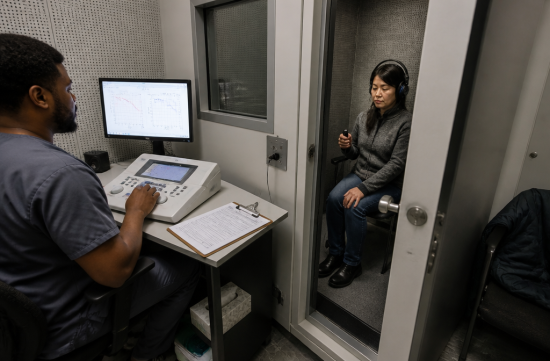
At the hospital, they first check for earwax or fluid buildup. If no clear cause is found, they perform a pure-tone audiometry test, which is best done within a few days of symptom onset.
If there's a drop of 30 decibels or more across three consecutive frequencies within 72 hours, sudden hearing loss is suspected. A 30-decibel loss means normal conversation sounds like a whisper.
If necessary, they may conduct blood tests, MRIs, or balance tests. Only about 10 percent of cases reveal a cause, which can be a bit disheartening.
Treatment typically involves steroids. There are oral medications and injections placed behind the eardrum, and a clinical trial supported by the NIDCD in 2011 found that the injection was as effective as the oral medication.
For those who can't take oral steroids or are concerned about side effects, the injection is an option. The choice depends on the patient's medical history and medications, which the doctor will evaluate.
The most important factor is time. The NIDCD explains that if treatment is delayed beyond 2 to 4 weeks, it becomes difficult to reverse permanent hearing loss.
Guidelines from the American Academy of Otolaryngology recommend starting steroid treatment within two weeks of symptom onset. UCSF is even stricter, suggesting that starting within 72 hours is ideal.
According to UCSF, it's common to begin steroids before test results are available, likely to save time.
Of course, about half of the cases show some recovery within 1 to 2 weeks. But there's no way to know in advance if you're one of those lucky ones.
If hearing loss is significant and there's no response to treatment, or if it occurs in both ears, hearing aids or cochlear implants may be recommended. So waiting it out, hoping it will resolve on its own, is a risky gamble.
So here's what I would do: During the day on a weekday, I would call my primary care physician or an ENT and say, "I'm experiencing sudden hearing loss in one ear; I need to be seen today."
If it's a holiday weekend like Thanksgiving and the office is closed or unreachable, I would go to the emergency room. UCSF also advises going to the nearest ER if it's outside of regular office hours.
Before going, it's helpful to note when the symptoms started, which ear is affected, and whether there's dizziness or tinnitus. Avoid inserting cotton swabs into your ear or trying home remedies, and steer clear of loud noises.
One more thing: if you suddenly lose strength on one side of your face or limbs, or if you have slurred speech and severe dizziness, that could be a sign of a stroke. In that case, don't drive yourself and call 911 immediately.
It might feel excessive to go to the ER for a stuffy ear, and you might feel embarrassed. But I'd rather choose to be a little embarrassed; if it turns out to be earwax, I can just laugh it off.
 InsuredHaha


 forestcloud |

 springw |

 Lemon Kim |


 shaket |








 Cool Beach Freeway |

 Sammy Beach |

 molten |

 Joyce 77 |

 zestorbit |
 cloud0 |
 Allaston New Yorker Notebook |
 MBTI Detective Agency |
 biscuitz |
 Iri Jori Missouri |
 road98 |
 American Airlines Mileage |
 Whoever It Is, I Don't Know |
 meloncat |
 kimchi warrior |
 Angeles Choi |
 nutnew |
 ringwinds |
 happy 9 |
 United States National Administrative Organization Stories |
 upbeat |
 silents |
 Korean American National Foundation Promotion Blog |
 PETRO Vatican Shrine |