
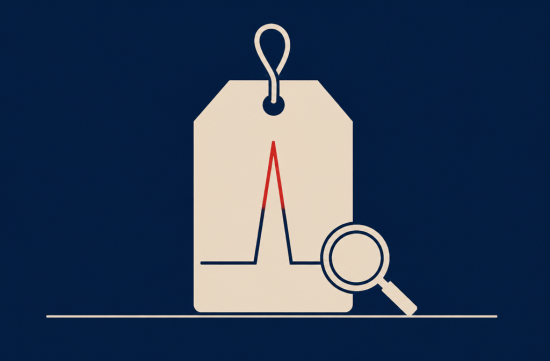
It's Thanksgiving morning, and my phone notifications are already going crazy. Phrases like "up to 70% off" and "last chance doorbuster" have hit the table before the turkey.
But whenever I see that 70% figure, I reflexively ask one question: Who determined that original price?
Last year, I bought an air fryer that was advertised as "half off the regular price," and I was thrilled. Later, when I checked the price history, I found out that the "half off" was just the usual price. It wasn't half off; it was a reason to regret.
It turns out I wasn't the only one caught in this trap. Groundwork Collaborative, a progressive think tank in the U.S., analyzed 351 products listed on Amazon's Black Friday and Cyber Monday deal pages.
When comparing the prices for events in 2024 and 2025 to the lowest prices recorded by Keepa in the previous 30 days, they found that 29.1% were the same as or even more expensive than the lowest price. 9.4% were actually more expensive.
Of course, Amazon strongly refuted this report, stating that their internal checks showed that most promotional items were priced the same as or lower than the previous 30 days.
In fact, both sides have different definitions of what a "deal" is. It's a matter of whether you consider the same price as a discount or not. Still, from a consumer's perspective, isn't it a bit embarrassing to call it a discount if it's the "same price"?
The British consumer organization Which? conducts similar investigations every year. In their November 2025 report, they found that 83% of the Black Friday deal items in 2024 were sold at the same or lower prices at least once outside of the four-week sale period.
While we can't directly apply the UK findings here, it's clear that Black Friday prices are not the only lowest prices of the year.
So, can retailers set the original price however they want? There are guidelines from the Federal Trade Commission (FTC) called Guides Against Deceptive Pricing, specifically 16 CFR 233.1.
The gist is this: the previous price used for comparison must be a genuine price that has been regularly presented to consumers for a significant period.
However, these guidelines are not laws; they are instructions showing how the FTC views price advertising. They don't specify how many days constitute a "significant period." Honestly, I wish this part were more strictly defined.
Texas has its own regulations as well. The Texas Deceptive Trade Practices Act (DTPA) 17.46(b)(11) defines false or misleading statements about the reasons, existence, or amount of price reductions as deceptive acts.
That said, we can't sue every time we see something misleading. So ultimately, developing a habit of filtering out deals before heading to the checkout is the most practical approach.
The first step is to check price history. If it's an Amazon product, try linking it to Keepa or CamelCamelCamel. Both are free and show price fluctuation graphs for products.
What you want to look for in the graph is simple: where the price has been in the last month or two. This is much more honest than the displayed original price.
The second step is to watch for price jumps right before sales. If the price suddenly goes up in early November and then drops back down for Black Friday, that's not a discount; it's a rollercoaster ride.
The third step is to check if the original price has actually been sold at that price before. According to Amazon's description, they verify the List Price based on their own and competing retailers' prices, usually over the last 90 days.
This means that if you compare prices directly with other sites, it becomes obvious. Try searching for the same model number at Walmart, Target, or Best Buy.
The fourth step is to check the model number itself. Sometimes, a slightly downgraded model is released specifically for Black Friday, so it's essential to confirm that it matches the model with many reviews.
The fifth step is to look at the final amount instead of just the percentage. Even if it's a 70% discount, if it's something you weren't going to buy anyway, that's 100% spending. This isn't just math; it's a life lesson.
Lastly, pay attention to the return policy. Many stores set specific return deadlines during the holiday season, so checking the deadline on your receipt or order page before payment can give you peace of mind.
This year, I've only set three items I plan to buy in advance and have set price alerts. If the price drops below my target, I'll buy it; otherwise, I'll just eat more turkey.
Personally, I find it a bit unfair that consumers have to play detective to catch these inflated prices. If the rules were clearer, everyone could cut their shopping time in half.
However, once you know the methods, Black Friday becomes a little less intimidating. A price graph is a more trustworthy friend than a big discount banner.
If you see suspicious discount displays, you can report them to the FTC or the Texas Attorney General's consumer protection office. One person's report can be more useful than you might think.
Wishing everyone a Happy Thanksgiving, and tomorrow, remember to look at the graphs instead of just the original prices before making your purchases.
 TigerHeart
 GoldenRain







 Scade Studio |
 Nevada Vegas UNLV |

 Things to know |
 West Kong |

 havero70 |

 Texas Migration Story |

 Mental Health Psychiatrist |

 nexaro |


 aloeverame |
 micos |
 Living Economy Information Blog |
 vintage |
 vorame |
 rosem |
 Various Knowledge and Information in the USA |
 coffeee |
 Well Done Sir |
 cantsay |
 winter |
 swiftlane |
 ovelion |
 wexlin84 |
 Victory 1988 |
 noraro |
 korando9 |
 flingstone |
 Rynex |