
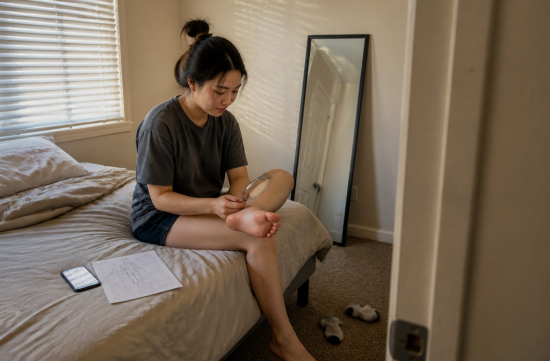
What do you do if you notice a new spot on your calf while showering? Most people probably think, "It's just a spot," and move on, right? I did too.
But when I saw the numbers, I couldn't ignore it. According to the American Cancer Society's estimates for 2026, there will be 112,000 new diagnoses of invasive melanoma in the U.S. this year, with 8,510 deaths.
What's even more shocking is the difference by stage. Based on diagnoses from 2015 to 2021, the five-year relative survival rate is over 99% for melanoma that is localized to the skin, 76% if it has spread to nearby tissues or lymph nodes, and 36% if it has spread to distant sites.
It's the same disease, but when you catch it makes a huge difference. That's why checking your spots is so important, even if it's a hassle.
Your location also matters. According to data from the Arizona Department of Health, there were an average of 2,789 diagnoses of invasive melanoma in the state from 2017 to 2021, which is 32 cases per 100,000 people. That's 28% higher than the rest of the U.S.
The state health department identifies Yavapai, Pima, and Maricopa counties as having the highest rates. Of course, the numbers can vary slightly depending on the source and year of aggregation, but the trend remains the same: it's higher than average.
The check method is the ABCDE method recommended by the American Academy of Dermatology (AAD). It's easy to remember since it's just five letters.
A stands for Asymmetry. If you imagine folding the spot in half and the two sides don't match, check it.
B stands for Border. If the edges are irregular, wavy, or blurred, check it.
C stands for Color. If a spot has multiple colors like tan, brown, black, white, red, or blue, check it.
D stands for Diameter. Melanomas are usually larger than 6mm, about the size of a pencil eraser. However, there are cases where they are smaller at diagnosis, so don't feel safe just because it's small.
E stands for Evolving. This refers to spots that change in size, shape, or color, or look different from other spots. Personally, I think this is the most important of the five.
There are melanomas that don't fit neatly into the ABCDE criteria. That's why it's also good to know about the ugly duckling sign, which indicates that a spot that looks different from the others on your body is the most suspicious.
The AAD advises that if you notice a new spot, a spot that stands out, or a spot that changes, it's best to schedule an appointment with a board-certified dermatologist. Not all new spots are cancerous, but that determination is up to the specialists.
This is a crucial point for the Korean community. Just checking sun-exposed areas isn't enough.
According to the AAD, people with darker skin tones can develop melanoma in areas that rarely see sunlight, such as the palms of the hands, soles of the feet, fingers, toes, and under the nails. A review paper noted that acral lentiginous melanoma is the most common type among Asians.
Data from a 2024 paper using SEER-22 also shows differences. The proportion of melanomas occurring on the legs and feet was 36.6% in Asians compared to 18.2% in whites.
The timing of discovery is also concerning. A 2021 conference presentation analyzing cancer registry data from 1990 to 2014 found that 82.9% of Asians were diagnosed at the invasive stage, compared to 72.2% of non-Hispanic whites.
Considering the earlier survival rates, this is an unwelcome disparity.
Why the delay? It's because people don't usually examine their soles or toenails, and neither do general practitioners. There are cases where it's mistaken for warts, corns, calluses, or fungal infections.
Bob Marley was diagnosed with this type of melanoma in 1977 after noticing a dark lesion on his toe, and he passed away in 1981. Hearing this made me look at my own soles for the first time.
Check your nails separately. If you see a black line or a wide brown band on your nails that doesn't grow out like a bruise, check it. If the surrounding skin darkens, you need to act quickly.
Of course, not all black lines on nails are cancerous. Many are benign. However, if it's new, only appears on one nail, or is getting wider and darker, it should be evaluated in a clinical setting.
Self-examination isn't difficult. You just need a full-length mirror and a hand mirror. Look at your front and back, raise your arms to see the sides.
Then check the insides of your arms, palms, fingernails, backs of your legs, between your toes, toenails, and soles. Use the hand mirror to check your neck, back, and buttocks, and part your hair to check your scalp.
The AAD provides a body mole map for recording. I would also take photos with my phone. If you place a ruler next to the spot and take the picture from the same angle, it makes it much easier to monitor changes.
If you have concerns, don't delay. The AAD advises to mention that you've noticed symptoms of suspected skin cancer when making an appointment. Don't just say you're going in for a spot check.
Some people might think they don't need to get tested after seeing the 2023 recommendations from the U.S. Preventive Services Task Force (USPSTF). However, that means there's insufficient evidence for routine screening in asymptomatic individuals. Those with changing spots are not included in that recommendation.
Diagnosis is made through a biopsy, not through photos or apps. The ABCDE method is not a diagnostic tool but rather a guideline for deciding whether to visit a doctor, so be sure to discuss your situation with a physician.
Prevention is straightforward. The state health department advises taking protective measures when the UV index is 3 or higher and recommends avoiding indoor tanning regardless of the index.
Honestly, I'm a bit frustrated that the conversation only revolves around sunscreen. I believe we should increase the tree shade at bus stops and sidewalks. It's an investment that reduces both heat and UV exposure.
Tonight, take off your socks and check your soles. It only takes a few minutes, but the difference between 99% and 36% is too significant. Am I the only one who finds this scary?
 BeginnerGame






 United States Army |

 premium |

 The Emperor Must Grow |

 squidogame |

 daddyyo |

 Arizona Cowboy |
 AZ Road Master |

 Who's watching? |

 TOTO Together |
 You Turn Me On |
 seouljung |
 Project Tomorrow |
 meadow |
 compass |
 Roman Pan |
 citrus pop |
 DO Main TODAY |
 korvex93 |
 tacobunny |
 B.I.G. Victor |
 Conflite Teacher |
 cyvera80 |
 Springs Korea |
 Runner Kim |
 Physical Laws and Science |
 Lansinger |
 honey honey |
 dictionary |
 silverleaf |