
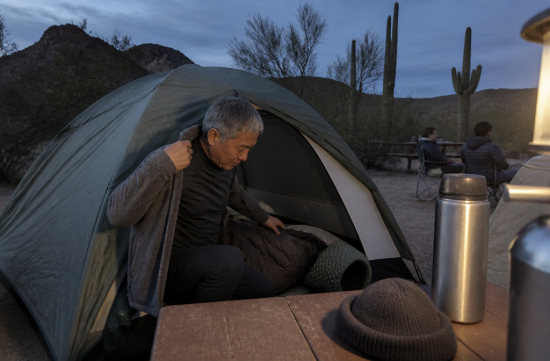
Today, I'm writing a letter to you, who is reading this, on the last day of October. During the day, it's still warm enough to wear short sleeves, but once the sun sets, the air changes dramatically.
Recently, I've noticed more people around me wanting to try fall camping. After being cooped up in the heat all summer, I completely understand that desire. Around this time, I find myself opening my car trunk for no reason.
However, there's a common regret I hear from first-time campers: "I couldn't sleep at all because it was too cold at night."
It's easy to think that nights in the desert will be warm. But when you look at the actual numbers, your perspective might change.
According to the National Weather Service (NWS), the average high temperature in Tucson for November from 1991 to 2020 is 75.1°F. However, the average low temperature is 47.9°F.
That's a difference of over 27 degrees in a single day. If you pack based only on daytime temperatures, you're bound to struggle at night. This is just an average, and on windy days, it feels much colder.
The desert has dry air and few clouds, so when the sun sets, the heat accumulated during the day quickly escapes into the sky. That's why the temperature swings are so significant.
Things change when you head up into the mountains. Data from the Western Regional Climate Center (WRCC) shows that the average low temperature for November near Summerhaven on Mount Lemmon is 29.7°F.
That's below freezing. Just by driving up from the city, it feels like winter at night. I was skeptical when I first saw that number.
In fact, most high-altitude campgrounds are already closed or closing at this time of year. According to the Forest Service, Spencer Canyon Campground operates only from April to October.
Even in October, they may close early without notice depending on the weather, so be sure to check before you go. You can visit recreation.gov or the Coronado National Forest website for more information.
On the other hand, there are places that open around this time. Molino Basin Campground, located below Catalina Highway, closes in the summer due to heat but operates from late fall to spring.
However, there is no drinking water available here. You need to bring plenty of water with you. Considering drinking water, washing water, and a little extra just in case, it adds up to more than you might think.
If it's your first camping trip, I would recommend starting with a desert campground that operates year-round. Gilbert Ray Campground in Pima County or Catalina State Park Campground are good options.
Both are at lower elevations, so they're less cold than the mountains. Still, you should prepare for temperatures to drop into the 40s at dawn. Having restrooms and water nearby is also a significant advantage for beginners.
So, what should you pack? First and foremost, I hope you check the label on your sleeping bag.
Most sleeping bags these days indicate temperature ratings based on the ISO 23537 international standard. Typically, you'll see three numbers: Comfort, Lower Limit, and Extreme.
This is where many people get confused. Extreme refers to the survival limit at that temperature, not a comfortable sleeping condition.
I would choose based on the Comfort number. If it's about 10 degrees lower than the expected minimum temperature, you'll feel more at ease.
Just as important as the sleeping bag is the sleeping pad. The cold ground can sap your body heat overnight, and this is measured by a number called R-value.
The higher the number, the better the insulation. Many people find themselves waking up cold because they tried to tough it out with just a thin summer air mattress on a fall night.
Layer your clothing as well. Cotton clothes don't dry well when wet from sweat or dew, making you feel colder. A thin moisture-wicking base layer, a fleece, and a windbreaker on top is a solid combination.
Make sure to pack a warm hat and a thick pair of socks. A beanie for sleeping can make a surprisingly big difference.
And never use a gas heater or charcoal inside your tent. Carbon monoxide is odorless and can become dangerous without you realizing it. You should block the cold with clothing and your sleeping bag, not with fire.
Have a warm dinner early, and place a warm water bottle at the foot of your sleeping bag before bed. It's an old trick, but it still works wonders.
No one is going to pack for you, so you need to prepare for your own body. Just knowing a few numbers can turn your first camping trip from a struggle into a memory.
The stars in the night sky seem to shine brighter on cold nights. If you prepare warmly, there's no better gift than a desert night in this season.
When checking the forecast, don't just look at the city forecast; pinpoint the campground location. You can click on the map on the weather service website to see the forecast for that specific spot, allowing you to gauge temperature differences due to elevation.
Please don't overdo it, and check the weather forecast one more time before you head out. See you in the next letter.
 EscapeReal
 LoudSilence




 Anjollinya Blog |

 Kitchen Ideas |

 Spaghetti Flying Religion |

 Giant Squid and Sweet Potato Soup |
 choi family |
 Arizona Cowboy |

 AZ Road Master |

 TOTO Together |
 ssome |
 skykong |
 Shining Our Own World |
 gardener 007 |
 golfmaster |
 Nanana Nanana Nanana |
 Who's watching? |
 endone |
 RockStar |
 Casa Mia |
 You Only Live Once |
 Hardworking CPA |
 Joyce 77 |
 Runner Kim |
 My Town My Way Blog |
 My Miami Stories |
 Entip |
 Tony Park |
 Jean Claude Bundang Blog |
 DJ DC BLOG |