
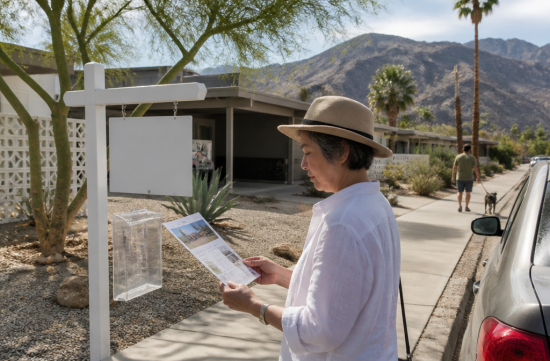
To summarize the Palm Springs housing market in October, asking prices remain high while actual transaction prices have decreased compared to last year. Listings have started to increase again, and rental prices vary between stable and declining depending on the source.
First, it's important to note that the official transaction statistics from the local real estate association for October have not yet been released.
Therefore, today's article will look at the most recent confirmed transaction statistics and the listing data from late October to early November. Mixing numbers from different timeframes can lead to a misunderstanding of the market.
Let's start with transaction prices. According to the July Desert Housing Report from Greater Palm Springs Realtors, the median price for single-family homes in Palm Springs was $1.13 million.
This is a 5% decrease compared to a year ago. Condominiums, like townhomes, saw a drop to $419,000, down 6%.
The trend was similar in the previous June report, with single-family homes at $1.17 million, down 6%, and townhomes at $434,000, down 4%.
While prices have decreased, transactions have not come to a halt. Up until July, there were 137 transactions in Palm Springs, the highest in the valley, and slightly more than last year.
The speed of sales has also increased. The average time to sell is now 52 days, shorter than the 61 days during the same period last year.
We also need to consider inventory. At the beginning of July, there were 592 listings in Palm Springs, which is 69 fewer than a year ago. This indicates that transactions continued while inventory was low until summer.
From my experience observing this market, this combination is familiar. Homes priced realistically sell quickly, while those priced too high tend to linger.
Now, let's look at the listings after October. According to Altos Research's weekly single-family home data, as of October 27, the median asking price was $1.13 million, with 360 listings.
By November 9, the median asking price had risen to $1.145 million, with listings increasing to 384. This means over twenty new listings in just two weeks.
On the same day, 30% of the listings had reduced their prices at least once. There were no listings that had increased their prices.
The median time on the market is 84 days. This suggests there is a gap between asking prices and actual sale prices.
The median asking price for newly listed homes is higher at $1,272,500. This reflects a seasonal trend where more expensive homes come to market ahead of the winter peak season.
There are always key points to watch during this season. High-priced listings that come to market can raise the median asking price, so one should not assume the market is improving based solely on asking prices.
Interest rates are also a crucial factor. According to Freddie Mac's weekly survey, the average 30-year fixed mortgage rate was 7.32% on October 22 and 7.24% on October 29.
While it has decreased slightly, the 7% range remains burdensome. Although this area has many cash buyers and second-home demand, which lessens the impact of interest rates, it still significantly affects buyers in the median price range.
Now, let's move on to rentals. According to RentCafe data as of October 30, the average rent in Palm Springs is $2,160.
This is nearly the same as last year's $2,156. Studio apartments average $1,486, one-bedroom units $2,014, and two-bedroom units $2,396.
Zumper presents a different picture. As of early November, the median rent was reported at $2,495, which is 14% lower than a year ago.
One-bedroom units are at $1,650, down 7%, and two-bedroom units at $2,500, down 9%. This discrepancy arises from statistics based on existing apartments versus newly listed rentals.
If you are considering investing for rental income, you should look at both figures. Existing tenant contracts are holding steady, but the market for new tenants has weakened.
So, who benefits in the current market? Altos' market index is at 30, indicating a slightly favorable position for sellers, but the rate of price reductions shows there is definitely room for negotiation.
If I were a buyer, I would prioritize homes that have been on the market for over 60 days and have had their prices adjusted, rather than newly listed high-priced homes. I've seen many successful negotiations in such cases.
Sellers should objectively assess the gap between the transaction prices from July and the current asking prices. It has proven more effective to price homes correctly from the start rather than setting a high initial price and then reducing it.
The official transaction statistics for October are expected to be released by the association around mid-month, following the usual announcement pattern. The comparison of the median price for single-family homes to last October will serve as a benchmark for assessing the winter market.
In summary, transaction prices are down about 5% compared to last year, listings are increasing, and rents are stable to weak. While it's not a rush market, it's a good time to choose homes with favorable conditions.
 Fruity Pebble








 B.I.G. Victor |

 Amber H |
 uplifted |
 Dr. Kelso |

 silents |

 Sarah's Blog |

 Casa Mia |

 Famous Attractions in the United States |

 US Regional Information Local News |

 strawberry |
 USA Business News |
 Blondee |
 E whisper |
 Potato House |
 freshmint |
 Ansaso |
 Golado |
 babybay |
 honeycom |
 French Macarons |
 Exploring American Life Information |
 Sunshine Blog |
 Community Cross |
 Sayonara H |
 What can make money? |
 Information Search LifeMAN |
 morvex37 |
 neontrail |