
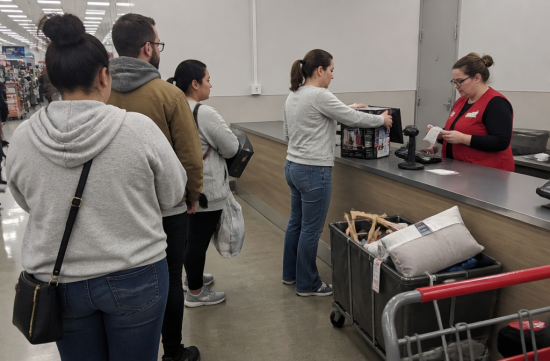
I still remember the first day I went to return something after coming to America. I brought a blender that I had already opened, and the employee refunded me without even asking why.
It was a real culture shock at that moment. In Korea, I learned that once you open the packaging, that's it.
It was also fascinating to see people standing in line for returns next to the checkout, as if it were completely normal. It didn't seem like a shameful act but rather just part of the shopping process.
For a while, I believed that as long as you had a receipt, you could return anything in America. But after living here for a few years, I realized that this is only half true.
First, let's clarify the facts. There is no general law in the U.S. that requires stores to accept returns.
Most of the time, it's not a law but rather the policy of each store. Some states only require that return policies be posted in advance, and the specifics of those policies are often up to the store's discretion.
So, generous returns are more of a service than a right. It's a promise that stores make to avoid falling behind in competition.
So why do they go to such lengths to accept returns? I think it's about building trust.
A customer who has a pleasant refund experience is likely to return to that store. The costs incurred at the return counter can be viewed as a type of marketing expense.
If returns are easy, people add items to their carts without hesitation. If it fits, they keep it; if not, they return it, which lowers the barrier to purchase.
As online shopping has grown, this principle has become even stronger. Since you can't try things on before buying, returns need to be easy to encourage clicks.
However, the cost of this is quite significant. According to a 2025 report from the National Retail Federation (NRF) and Happy Returns, the expected return amount that year was $849.9 billion.
This means that 15.8% of annual sales are returned. For online sales alone, that figure is even higher at 19.3%.
Honestly, I was a bit shocked when I saw those numbers. It means that for every five items purchased online, nearly one is returned.
Not all returned items are restocked. There are costs associated with inspecting, repackaging, and shipping, and if the condition is questionable, they may be discounted.
What's even more disheartening is that the same report estimated that 9% of all returns were fraudulent. Methods like returning empty boxes or swapping fake items have reportedly increased.
This trend has led to some symbolic changes. L.L.Bean, known for its lifetime return policy, changed its policy in 2018.
Now, returns are only accepted within one year of purchase, and a receipt is required. The company cited that some customers were interpreting the warranty far more broadly than intended.
These days, more places are starting to charge return fees. In-store returns may be free, but returning by mail often incurs a cost, which can vary depending on the method. I've been surprised when I thought I was getting free returns only to find a label fee deducted.
And this is something many people don't know: some stores ask for your driver's license when you return items. It may not just be for simple identity verification.
Companies like The Retail Equation analyze return frequency, amounts, and timing, and if you hit their store criteria, they can help deny returns. There have even been reports of returns being blocked for a year.
I find this aspect a bit uncomfortable. While preventing fraud is certainly necessary, it feels unfair when an ordinary customer gets caught without knowing the criteria.
Fortunately, you can request your return record report. If you've been denied, it's a good idea to check what record caused the issue instead of just letting it go.
So what can you do? Here are some habits I actually follow.
First, before making a purchase, I always check the return policy on the back of the receipt or on the website. I confirm the time frame, fees, and whether open box returns are allowed.
Second, I take a photo of the receipt with my phone or request an email receipt. Paper receipts can disappear faster than you think, and thermal paper fades quickly.
Third, for electronics or seasonal items, the return period is often shorter, so I write down the deadline on my calendar. It's also good to check if there are extended periods for holiday gifts.
Fourth, I don't throw away tags and packaging until I'm sure about my decision. The better the condition, the more room there is for negotiation.
Fifth, I don't return items as a habit. Double-checking reviews and size charts before buying is ultimately the biggest savings.
Buying multiple sizes and keeping just one is convenient, but if records pile up, it could block you when you really need it later.
In the end, American return culture seems to rest on the premise of mutual trust. If someone abuses that, the costs will ultimately come back to everyone in the form of higher prices and stricter rules.
I hope this generosity lasts a long time. For that to happen, stores need to transparently disclose their denial criteria, and customers should only use what they truly need.
 SourPickle








 Art patch |

 Rice Shop Uncle BLOG |

 Noodle Noodle |

 Chino Min |

 Glow Yo |

 creamcat |

 Potato House |

 kiwifox |

 puffpanda |

 strawberry |
 US Regional Information Local News |
 USA Business News |
 Blondee |
 E whisper |
 freshmint |
 Ansaso |
 Golado |
 babybay |
 honeycom |
 French Macarons |
 Exploring American Life Information |
 Sunshine Blog |
 Community Cross |
 Sayonara H |
 What can make money? |
 Information Search LifeMAN |
 morvex37 |
 neontrail |