
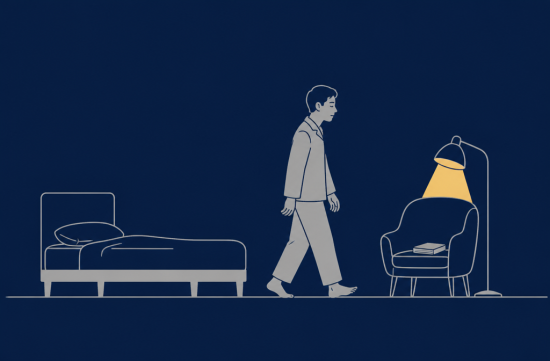
Have you ever found yourself lying awake staring at the ceiling at three in the morning? I certainly did last winter. I couldn't turn off my mind thinking about work, and eventually, I got a prescription for sleeping pills.
At first, it was honestly convenient. I could fall asleep right away, and I wondered why I hadn't started taking them sooner.
But after a few weeks, I started to feel anxious. It felt like I was forgetting how to sleep without medication.
So, I asked my doctor, and the first term I learned was CBT-I. Cognitive Behavioral Therapy for Insomnia, which is insomnia cognitive behavioral therapy.
Upon researching, I found out that this isn't just an alternative treatment. The American College of Physicians (ACP) recommended CBT-I as the first-line treatment for chronic insomnia in their 2016 guidelines.
The recommendation level was strong. The evidence level was marked as moderate, but it was noted that there are fewer concerns about side effects compared to medication.
The same guidelines suggest that medication should be considered in consultation with a doctor if CBT-I is ineffective. They also recommend using medication for a short duration, ideally within 4 to 5 weeks.
Speaking of medication, one more thing: in April 2019, the FDA mandated boxed warnings for zolpidem, eszopiclone, and zaleplon, which are the strongest warning labels.
The reason was due to complex sleep behaviors. This includes walking, driving, or doing things while asleep, which can lead to serious injuries.
The FDA reviewed 66 cases, of which 61 involved zolpidem. While the numbers may seem low, I found this part quite chilling.
Of course, this doesn't mean that medication is inherently bad. There are definitely people who need it short-term, and that's a decision for a doctor to make. However, relying on it long-term is something to reconsider.
So, what does CBT-I actually involve? According to Harvard Health, it typically takes place once a week for 30 to 60 minutes over 6 to 8 weeks.
The core concepts are surprisingly simple. It involves changing your thoughts about sleep and altering your sleep habits.
The most well-known technique is sleep restriction. This means reducing the time you spend in bed to match your actual sleep time.
When I first heard this, I thought it didn't make sense. Why would I reduce my time lying down when I'm already sleep-deprived?
But once I understood the principle, it made sense. Reducing the time spent tossing and turning in bed helps re-establish the connection between your bed and sleep.
The second technique is stimulus control. If you can't sleep, don't force yourself to lie in bed; instead, get out of bed and return when you're sleepy.
Additionally, you keep a sleep diary to record what time you go to bed and what time you wake up. This record helps the therapist adjust your schedule for the following week. Even though it can be a hassle, this record is essential for visualizing your sleep patterns.
The thought-changing part was surprisingly helpful too. It's an exercise where you analyze worries like "If I don't sleep tonight, tomorrow will be ruined," and when you write them down, you realize many of them are exaggerated.
There are practical concerns as well. Finding a sleep specialist in the U.S. isn't easy, and insurance coverage varies by plan. So, it's best to check directly with your insurance company before starting.
The ACP guidelines also state that CBT-I can be conducted in various formats, including in-person, group, phone, online, or through self-help books. This means you don't necessarily have to go to a clinic every week.
There are also free options to try. The VA has created an app called CBT-i Coach, which is available on both iOS and Android.
However, this app is primarily designed to assist those undergoing CBT-I with a therapist. For those not receiving treatment, the VA recommends a separate self-care app called Insomnia Coach.
From my experience, the first week of sleep restriction was really tough. I felt like I drank twice as much coffee during the day.
If I wasn't sleepy by 11 PM, I would read a boring book on the living room sofa. I intentionally kept my phone far away, which turned out to be quite important.
However, by the second week, I started to feel sleepy as soon as I lay down in bed. This might vary from person to person, but it was quite a fascinating experience for me. It was a sensation I hadn't felt in months.
And I want to emphasize this: if you're taking sleeping pills, don't stop suddenly on your own.
The method for tapering off can vary depending on the type of medication, so it's essential to consult with a doctor or pharmacist to create a plan.
In summary, medication is quick, while CBT-I is slower but focuses on changing habits.
If I were you, even if I were on medication, I would bring up CBT-I with my doctor first. If you're someone who finds yourself staring at the ceiling every night, ask about it during your next appointment.
 SaveToBroke
 MeadowMedia







 fruitflash |
 Anjollinya Blog |

 United States Army |

 premium |

 The Emperor Must Grow |

 Choco Choco Star |

 Conflite Teacher |

 Tracking 60 Minutes News |


 Good Karma |
 strawberry |
 US Regional Information Local News |
 USA Business News |
 Blondee |
 E whisper |
 Potato House |
 freshmint |
 Ansaso |
 Golado |
 babybay |
 honeycom |
 French Macarons |
 Exploring American Life Information |
 Sunshine Blog |
 Community Cross |
 Sayonara H |
 What can make money? |
 Information Search LifeMAN |
 morvex37 |
 neontrail |