
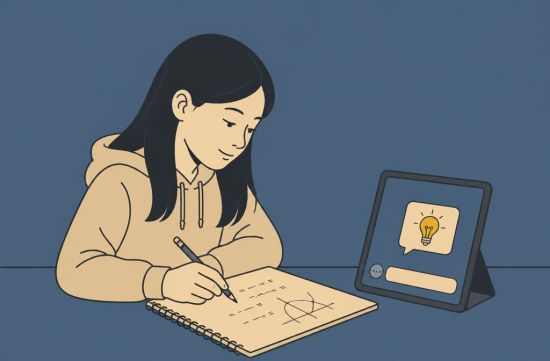
These days, there's a recurring question at parent meetings: can't we just install an AI tutor app instead of paying for tutoring?
Honestly, I was tempted too. I tend to look at specs and price tags first, just like when choosing a car, so I started by searching for data.
To cut to the chase, the evidence that apps can completely replace tutoring is still weak. However, research clearly shows that the results can vary significantly depending on how they are used.
The most notable finding comes from a working paper published by NBER this year. It was a randomized experiment conducted over two years in 18 middle schools in Tennessee.
The subjects were middle school students who were behind in math for their grade level. They were required to use Khan Academy and the AI tutor Khanmigo during daily math remediation sessions, set up to provide coaching without giving answers.
The results were positive. Students improved by about 1.3 percentile points each semester.
However, the researchers' explanation is intriguing. This level of improvement is similar to what students achieved practicing with Khan Academy alone, without AI.
The real issue was usage. The median student only sent messages to the tutor on about one-third of the days they practiced.
Among the sessions where they got answers wrong, only 17 percent involved asking the tutor for help. The tool was designed for students to ask questions when they were confused, but they didn't do so.
The researchers concluded that getting access is less important than actually using the tools. I nodded in agreement at this point.
However, there is a fair point to address. The version used in the experiment was from 2023, and Khan Academy has since stated that they have integrated the tutor directly into the interface.
The Tennessee experiment was not designed to isolate the effects of Khanmigo, as the entire practice program changed, making it difficult to determine the specific contribution of the AI tutor.
There's another study worth noting. An experiment involving nearly 1,000 high school students was conducted in a Turkish high school and published in PNAS in 2025.
The group that used GPT-4 scored 48 percent higher on practice problems, while the group using a tutor version with learning safeguards saw a 127 percent increase. At first glance, that sounds impressive.
However, the results were different on the actual exam without AI. The group that used GPT performed 17 percent worse than the group that didn't use it at all.
They mistakenly thought they were improving by just copying down answers. The researchers likened this to relying on crutches.
In contrast, the tutor version reportedly eliminated most of these drawbacks. Ultimately, whether you provide answers or encourage critical thinking is the key distinction.
To put it in automotive terms, even if the autonomous driving assistance is good, you still need to hold the steering wheel to develop driving skills.
So what's the logic behind tutoring? Human teachers can read students' expressions, identify where they are stuck, and take responsibility for ensuring homework is completed.
The logic behind apps is also compelling. You can ask questions at 11 PM, repeat the same question ten times without annoyance, and, most importantly, the cost difference is significant.
The subscription for Khanmigo for parents is listed at $4 per month or $44 per year. This plan is only available in the U.S., and prices may change, so be sure to check the official site before subscribing.
The Washington State Office of Superintendent of Public Instruction (OSPI) has also proposed the principle of Human-AI-Human, where a person asks questions, AI assists, and the final judgment is made by a person.
Middle school math is particularly important for this principle. Concepts like fractions, proportions, and linear equations form the foundation for the next level, so if students just get the right answers and move on, they can struggle later.
So, my recommended approach is this: first, let them try to solve problems on their own, and if they get stuck, have them ask AI for hints instead of answers.
After they solve the problems, they should explain to me why they solved them that way, not just to AI. If they struggle to explain, it means they haven't fully grasped the concept yet.
Once a week, I review the conversation logs between my child and AI. This isn't about surveillance; it helps identify which concepts they frequently struggle with, providing useful information to share with a tutor.
I believe it's best to avoid general-purpose chatbots that show answers immediately during homework time. Choosing an app with a coaching mode is my first filter.
Deciding whether to continue tutoring should depend on the child's state. If they can ask questions independently, the app can be a sufficient aid; if they aren't asking questions at all, human intervention is still necessary.
My conclusion is that it's not about replacement but rather combination. Reducing the number of tutoring sessions and filling the gaps with apps seems to be the most realistic choice based on current data.
Apps are like cars with good engines, but the child needs to hold the steering wheel. I'd love to hear how you are using AI tutors in your home in the comments.
 CardDueSoon
 CocoHello





 rissa |

 Gomo Nim |

 lattepop |

 Well Done Sir |

 butter 90 |

 Living in Washington State |

 kimchi warrior |
 French Macarons |


 dynamico |
 strawberry |
 US Regional Information Local News |
 USA Business News |
 Blondee |
 E whisper |
 Potato House |
 freshmint |
 Ansaso |
 Golado |
 babybay |
 honeycom |
 Exploring American Life Information |
 Sunshine Blog |
 Community Cross |
 Sayonara H |
 What can make money? |
 Information Search LifeMAN |
 morvex37 |
 neontrail |