
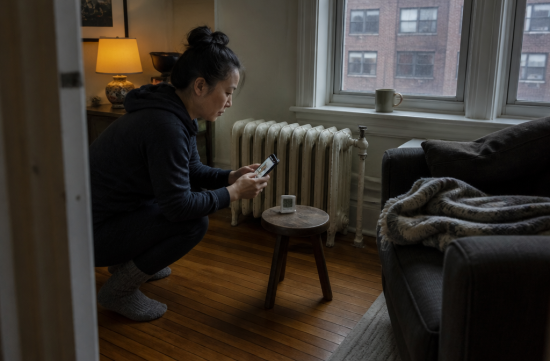
As we move into mid-November, inquiries from tenants in the Bronx have significantly increased. Most of them ask the same question: Is the lukewarm radiator worth reporting?
To put it simply, the standards are defined by numbers. It's not a matter of tolerance; it's something that should be checked with a thermometer.
New York City designates the heating season from October 1 to May 31 each year. This season will start on October 1, 2026, and continue until May 31, 2027.
During the day, from 6 AM to 10 PM, if the outside temperature drops below 55°F, the indoor temperature must be maintained at a minimum of 68°F. This is a legal obligation for landlords.
From 10 PM to 6 AM, regardless of the outside temperature, the indoor minimum is 62°F. Many people overlook this part.
This means that even if the outside temperature is around 50°F at night, if it's below 62°F inside, it does not meet the standard. Just remember that only the daytime standard has conditions attached.
Hot water must also be maintained. According to the city's housing department, hot water must be at least 120°F year-round, regardless of the season.
So what should you do if the standards are not met? First, notify the superintendent or landlord, and if that doesn't resolve the issue, you can report it to 311.
You can report to 311 by phone, online, or through an app. The reported cases are forwarded to the New York City Department of Housing Preservation and Development, commonly referred to as HPD.
HPD will first contact the building owner or management company. If the heating is still not restored, an inspector will visit the building to verify the situation.
If a violation is confirmed on-site, a violation notice will be issued. Heating and hot water issues are classified as an immediate danger, rated as Class C, meaning the landlord must fix it right away.
The fines are not light. According to HPD's official page, violations issued after December 8, 2023, will incur fines ranging from $350 to $1,250 per day.
If the same issue occurs again, the fines will increase to between $500 and $1,500 per day. This is a significant increase from the previous fines of $250 to $500 per day.
If another heating violation occurs during inspections after the first two within the same season, an additional fee of $200 per violation will apply. This can be quite burdensome for habitual offenders.
However, there are cases where landlords do not fix the issues. In such cases, HPD's emergency repair program can assign a contractor to make repairs directly and bill the landlord for the costs.
If you live in a rent-stabilized apartment, there's one more option. You can apply for a rent reduction due to service reduction through the state's Division of Housing and Community Renewal (DHCR).
However, the conditions and procedures vary by building, so it's advisable to check DHCR's guidelines directly or consult with a tenant organization before applying.
To see real results, keeping records is key. Write down the date, time, and indoor temperature, and take photos with the thermometer visible.
The thermometer should be placed in the middle of the room, not by the window or right next to the radiator. This way, there won't be any discrepancies later.
You can also report anonymously. However, in this case, the inspector may randomly select units to inspect within the building, which means the actual problem unit might be missed.
Therefore, I recommend that several neighbors report together. When multiple reports are filed, the perspective on the building as a whole changes.
Conditions can vary significantly even within the Bronx. Well-managed co-ops in Riverdale and older pre-war buildings in South Bronx often have different boiler conditions.
Large buildings built around the 1920s, like those near Grand Concourse, often have aging steam pipes, leading to significant temperature variations between floors. It's not uncommon for one apartment to be hot while another is cold in the same building.
If you're planning to move, check the HPD violation history for that address before signing a lease. You can find past heating violation records by entering the address in HPD's online lookup system.
I would advise the same to those looking at buildings for investment purposes. Buildings with repeated heating violations often face higher costs for boiler replacements than the fines themselves.
From a landlord's perspective, I would add that having the boiler inspected and the pipes maintained at the beginning of the season is ultimately the most cost-effective approach. Accumulated tenant complaints can affect renewal rates and vacancy periods.
The severe cold has not yet arrived. If it's lukewarm now, it's likely to get worse in January.
The era of enduring discomfort is over. The standards are 68°F during the day, 62°F at night, and 120°F for hot water. If these are not met, record it and report to 311.
The standards and fine amounts in this article are based on HPD's official guidelines as of November 2026. Please check the city's housing department page again before reporting, as specific regulations may change.
 OceanDream91
 BlueHarbor86





 B.I.G. Victor |

 Amber H |
 uplifted |
 Dr. Kelso |

 silents |
 Belgray Miscellany |

 Another Eden Channel BLOG |

 Round and Round Children's Song Kingdom |


 babybay |
 strawberry |
 US Regional Information Local News |
 USA Business News |
 Blondee |
 E whisper |
 Potato House |
 freshmint |
 Ansaso |
 Golado |
 honeycom |
 French Macarons |
 Exploring American Life Information |
 Sunshine Blog |
 Community Cross |
 Sayonara H |
 What can make money? |
 Information Search LifeMAN |
 morvex37 |
 neontrail |