
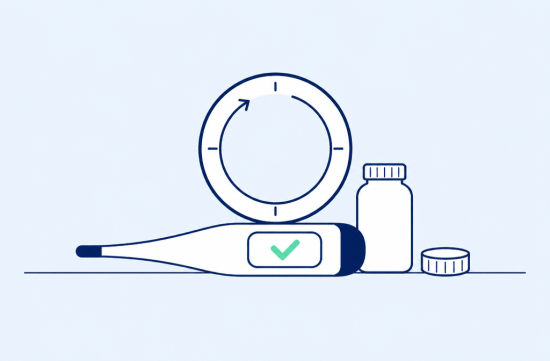
At seven in the morning, I touched my child's forehead and it felt warm. Since they took fever-reducing medication last night and fell asleep, it's expected that they don't have a fever now, but the question is whether we can consider them recovered.
Every winter, the same question pops up in parents' group chats: Can I send my child to school if their fever has gone down?
So today, I want to carefully outline the 24-hour fever rule that many schools use. Since this is a common question, I took the time to look up the official guidelines again.
First, let's clarify the numbers. According to U.S. school health guidelines, a fever is typically defined as a temperature of 100.4°F (38°C) or higher.
The key point here is that the condition is not just about the 24-hour timeframe but also about not having taken fever-reducing medication. If the fever has dropped due to medications like Tylenol (acetaminophen) or ibuprofen, that does not count.
So if you gave fever-reducing medication at 10 PM last night, the normal temperature this morning is likely just a sign of the medication's effect. You need to go a full day without medication for the clock to start ticking again.
The CDC updated its respiratory virus guidelines in March 2024, grouping COVID-19, influenza, and RSV under one standard. The previous method of isolating COVID-19 for five days is no longer in place.
The new guidelines emphasize two main points: symptoms should be improving overall, and there should be no fever for 24 hours without medication.
Both conditions must be met. If there is no fever but a worsening cough, it's better to stay home.
Returning to school is not the end of the story. The CDC recommends additional precautions like handwashing, ventilation, and wearing masks for about five days after returning.
What happens if the fever returns? According to various school health office guidelines, you start counting the 24 hours from the beginning again.
For example, if the last fever occurred at 6 PM on Tuesday and no fever-reducing medication was given afterward, you must wait until after 6 PM on Wednesday to meet the criteria.
This means realistically, your child will likely need to stay home on Wednesday and can return on Thursday morning. Just because the criteria are met by evening doesn't guarantee safety for the next morning, so it's advisable to check their temperature again overnight.
What about other symptoms? According to the American Academy of Pediatrics and various school guidelines, if there is no fever and only mild symptoms like a runny nose, light cough, or headache, it's generally okay to attend school.
Many children have runny noses throughout winter, so sending them home for just that would lead to excessive absences. I believe this is a realistic standard.
On the other hand, vomiting or diarrhea requires special attention. Many schools require students to stay home for 24 hours after the last episode of vomiting or diarrhea, and some may even require 48 hours.
Conjunctivitis with redness and discharge, as well as unexplained rashes, often have specific regulations at different schools. In such cases, obtaining a return-to-school note from a pediatrician can provide peace of mind.
I want to emphasize that the information provided here reflects common trends in CDC guidelines and various school districts, but it does not represent the specific rules of your child's school.
School policies can be stricter than medical guidelines. Therefore, it's best to directly check the health or attendance section of the student handbook.
If you have trouble finding it, a quick call to the school health office or office can help. If you're concerned about language barriers, just jot down when the fever occurred and when medication was given, and a brief question will suffice.
It's also good to know how absences are handled in advance. Most schools recognize absences as excused if there is a parent contact or a doctor's note, so getting into the habit of contacting the school in the morning is helpful.
For working families, this 24-hour period can feel very long. If you keep them home for another day, it can affect work, but sending them might feel unfair to other families.
Still, I firmly believe that sending a child who is only partially recovered can lead to them being sick for three days, while letting them rest for one more day at home is ultimately less harmful.
Winter is a season when both influenza and RSV circulate, making it easy for one child's cough to spread to the entire class. Allowing our child to rest for one more day also helps protect other children.
I recommend taking your child's temperature three times a day—morning, afternoon, and before bed—and recording the times. Noting when fever-reducing medication was given will make calculating the 24-hour period much easier.
If a fever lasts more than three days, if they have difficulty breathing, or if they can't drink fluids, you should go to the hospital without worrying about the rules. If you're uncertain, calling the pediatric nurse consultation line can also be a good first step.
In summary, if there has been no fever for 24 hours without medication, symptoms are improving, and the additional conditions in the school handbook are met, then it's time to send them back.
I hope that this winter, the time spent worrying about temperatures each morning will be a little less. May you have a warm bowl of soup ready and enjoy a winter where both children and adults can rest well.
 LatteDreamer



 rissa |

 Gomo Nim |

 lattepop |

 Well Done Sir |

 butter 90 |

 U.S. Weather Bureau News |

 greenloop |

 pixel77 |



 Choco Mint Creator |
 strawberry |
 US Regional Information Local News |
 USA Business News |
 Blondee |
 E whisper |
 Potato House |
 freshmint |
 Ansaso |
 Golado |
 babybay |
 honeycom |
 French Macarons |
 Exploring American Life Information |
 Sunshine Blog |
 Community Cross |
 Sayonara H |
 What can make money? |
 Information Search LifeMAN |
 morvex37 |
 neontrail |