
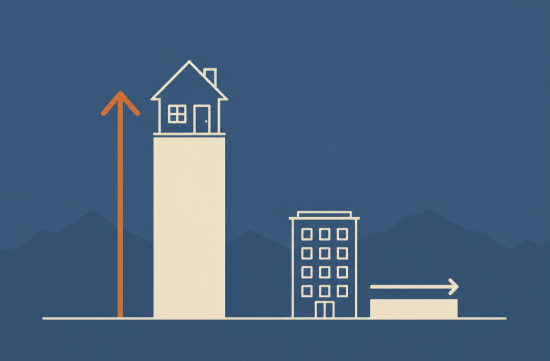
These days, the first question that comes up during consultations is, "Should I hold out with renting, or should I buy a house now?" As we move into October, I thought it would be good to summarize the Salt Lake market with some numbers.
First, let me clarify the reference point. As of the time of writing this article, Redfin's October data has not yet been confirmed.
Therefore, I used the most recent confirmed month, September, for sales figures from Redfin, while rental data is based on quarterly reports released this year. Once the official October figures are out, I plan to revisit whether the trends have changed significantly.
According to September Redfin data, the median sale price in the Salt Lake City area was $635,000, which is nearly an 11% increase from a year ago.
I was a bit surprised when I first saw this number. Given the high interest rates, a double-digit price increase is not something to overlook.
However, looking at the transaction volume changes the picture. In September, 963 homes were sold, which is a decrease of 122 homes, or 11.2%, compared to a year ago.
This means that while transactions have decreased, the median price has increased. In such cases, it is reasonable to think that higher-priced homes are driving the median price up.
So, it's difficult to definitively say that my home value has increased by 11% over the past year. Monthly figures can fluctuate significantly based on the composition of transactions.
For reference, even in September, MLS-based brokerage sites report different figures than Redfin due to varying data collection ranges. When comparing multiple sources, it's best to check if the geographic scope and reference month are the same.
To get a broader perspective, quarterly data is more useful. According to the Salt Lake Board of Realtors, the median price for single-family homes in the county for Q2 this year was $645,000.
This represents a 4.88% increase from a year ago, marking the highest quarterly figure on record. During the same period, single-family home transactions also increased by 4.62%, totaling 2,334 sales.
In contrast, condos moved in the opposite direction. The median price for condos decreased from $430,000 to $417,900, a drop of 2.81%.
This difference is significant for those considering condos as their first home. Judging based on single-family homes and condos together can cloud the decision-making process.
The speed at which homes are selling is also noteworthy. According to Redfin's first-half data, the median time a property stayed on the market was 47.7 days, which is 4.8 days longer than a year ago.
This indicates that the atmosphere is not as competitive as it used to be, where multiple offers would come in immediately. Buyers now have room to negotiate for repair requests or closing cost assistance.
Next, many people ask about interest rates. According to Freddie Mac's weekly survey, as of October 22, the average rate for a 30-year fixed mortgage was 7.32%.
This is up from 6.19% at the same time last year. This means that even if you buy the same house, your monthly payment burden has increased significantly, making interest rates a larger variable than price.
Now, let's look at the rental side. The atmosphere here is quite different from sales.
According to CoStar, last year, asking rents for apartments in this area decreased by 2.2%, marking three consecutive years of decline. The influx of new apartments in recent years has had a significant impact.
According to the Northmark report, the average asking rent for Q1 this year was $1,582 per month, which is 1.0% lower than a year ago. The vacancy rate was 7.3%.
Apartment List's August report tells a similar story. The year-over-year change in downtown rents was lower than both the Utah average (-1.7%) and the national average (-1.1%).
What's good news for tenants are the various incentives. The Utah rental housing industry association reported that it has become common for new developments to offer 8 to 12 weeks of free rent.
It's advisable not to just look at the monthly rent stated in the contract but to calculate the actual burden considering the free period. Even within the same complex, conditions can vary significantly depending on the timing of the lease.
However, it remains to be seen how long this trend will last. CoStar predicts that new supply will drop to its lowest level in 10 years this year.
Northmark also forecasts that the average rent by the end of the year will be around $1,570, nearly flat. If supply decreases, the tenant-favorable market may gradually come to an end.
Now, let's return to the initial question. Whether to rent or buy ultimately depends on how long you plan to stay.
If you're looking to stay for less than three years, I believe it makes sense to take advantage of rental benefits while waiting. With interest rates in the 7% range and additional closing costs, the math for buying and reselling in a short time doesn't add up well.
If you're looking for a home to stay in for five years or more and have found a property that meets your school district or commuting needs, the situation is different. The current market, where properties are staying longer, may actually be a good time to negotiate.
Personally, I would keep a close eye on the duration and price adjustment history of properties in my areas of interest until the official October figures are released. Numbers always come out a bit late, but those who don't miss the trends ultimately make the best choices.
 shaquilleoatmeal
 DevotedSis







 B.I.G. Victor |

 Amber H |
 uplifted |
 Dr. Kelso |

 silents |

 tredolo |
 morvex37 |

 KGOMIO Blog |

 nrixa |

 Tan Sol |
 strawberry |
 US Regional Information Local News |
 USA Business News |
 Blondee |
 E whisper |
 Potato House |
 freshmint |
 Ansaso |
 Golado |
 babybay |
 honeycom |
 French Macarons |
 Exploring American Life Information |
 Sunshine Blog |
 Community Cross |
 Sayonara H |
 What can make money? |
 Information Search LifeMAN |
 neontrail |