
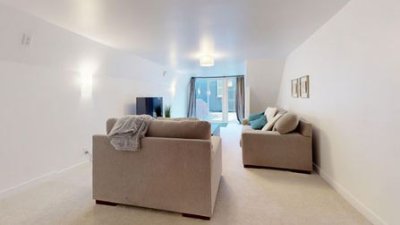
Choosing between a studio and a 1-bedroom, or prioritizing between a 2-bedroom and a 3-bedroom, depends on your budget and lifestyle. Let's compare the numbers side by side by unit type.
The average rent for a studio is $1,837, with an area of 484 square feet. This is lower than the overall average rent in Washington DC of $2,289, making it a popular choice for single-person households working in government agencies or law firms.
A 1-bedroom averages $2,327, with an area of 698 square feet. This is $490 more than a studio. Many professionals who want a separate workspace for remote work often transition to this category.
The average rent for a 2-bedroom is $3,111, with an area of 996 square feet. This is an increase of $784 compared to a 1-bedroom. This unit is typically chosen by two roommates sharing or dual-income families with one child.
A 3-bedroom averages $3,655, with an area of 1,196 square feet. There are not many 3-bedroom listings in downtown Washington DC, so families with multiple children often look at nearby Maryland or Virginia for more spacious options.
- Studio: about $1,837 / 484 sqft
- 1-bedroom: about $2,327 / 698 sqft
- 2-bedroom: about $3,111 / 996 sqft
- 3-bedroom: about $3,655 / 1,196 sqft
Recently, new developments in the downtown area tend to have a higher proportion of studios and 1-bedrooms. This reflects a development strategy aimed at maximizing the number of units on limited land, with 3-bedrooms being more common in suburban areas than in the city.
The rent difference between units tends to increase as the number of rooms increases. The difference is $490 when moving from a studio to a 1-bedroom, but it widens to $784 when moving from a 1-bedroom to a 2-bedroom. This suggests that the decision to increase the number of rooms in the city can lead to a larger budget burden than expected.
For Korean households, it may be worth considering two options side by side. If prioritizing accessibility to the city, you can narrow down to a 1-bedroom or 2-bedroom to fit your budget. If prioritizing space and school districts, comparing 3-bedrooms in nearby Maryland or Virginia may be more realistic than in downtown Washington DC.
Washington DC is a market where the rent gap tends to widen with each additional room, so it is safer to set a budget cap before deciding on a unit.
 UrbanCore72
 OceanDre








 moo moo |
 ultron78 |
 garlic bread |

 urbanmint |
 El Dorado |
 washington mom |
 American Travel Cruise Information |
 Eldorado 88 |
 Another Eden Channel BLOG |
  Community Cross |
  journey |
  heeve |
  leman |
  corner kick |
  treasure |
  strawberry |
  Augusta Univ |
  B.I.G. Victor |
  Victory 1988 |
  Swift Falcon |
  venture |
  SPAM 101 |
  choi family |
  zoryan |
  cloud0 |
  SKy Face |
  wonder |
  Dragon Lee |
  productionblog |