
Since October began, I've noticed that my eyes feel dry more often when I turn on the monitor in the morning. It was a bit surprising at first, especially with the rain outside and my eyes feeling like a desert.
Upon investigating the cause, I found the answer indoors. When the heater is on, the indoor air becomes dry, and when looking at a screen, the frequency of blinking decreases, leading to dryness.
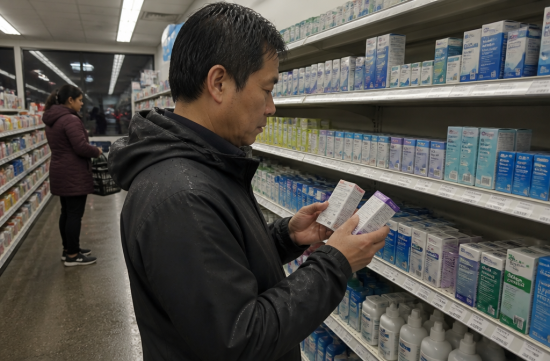
I went to the pharmacy's eye drop section, and the entire shelf was filled with artificial tears. The names are similar, and the prices vary, so I ended up just grabbing any one of them.
This time, I looked up quite a bit of official and ophthalmology-related information. Following my engineering habits, I organized a few criteria for selection into several variables.
The first variable is the presence of preservatives. Most artificial tears in multi-dose bottles contain preservatives to prevent bacterial growth, with the most common being benzalkonium chloride, abbreviated as BAK.
The issue arises when BAK is used frequently over a long period. Clinical reviews indicate that prolonged use can lead to stinging, burning, and corneal surface damage.
As a result, many ophthalmology sources consider four times a day as a baseline. If you need to use it more frequently, the general advice is to opt for preservative-free products.
People who wear contact lenses or have allergies to preservatives are also recommended to use preservative-free options. I don't wear lenses, but since I use it three to four times a day, I find myself on the borderline.
The second variable is the type of container. Preservative-free options are mainly divided into single-use vials and multi-dose preservative-free bottles.
Single-use vials do not require preservatives by design. However, the principle is to use it the same day once opened, but many people tend to close the cap and reuse it if there's leftover.
This should be avoided. Since there are no preservatives, once opened, the container is exposed to contamination.
Multi-dose preservative-free bottles solve the problem through design rather than chemicals. They use a one-way valve or filter in the nozzle to prevent the liquid from flowing back into the bottle after it has been dispensed.
I personally found this aspect the most interesting. It's essentially solving a software problem with hardware design.
However, the usage period after opening varies by product. Some products have a relatively short usage period, so be sure to check the duration indicated on the box.
The third variable is the reliability of the product itself. This cannot be overlooked, especially since there was a significant incident in 2023.
In February 2023, the FDA warned against buying or using EzriCare and Delsam Pharma artificial tears, and the manufacturers recalled all lots that were still within the expiration date. It was pointed out that these products were made in multi-dose bottles without sufficient preservatives.
This incident, investigated by the CDC, was linked to a cluster infection of drug-resistant Pseudomonas aeruginosa. There were reports of fatalities and cases of vision loss, so it was not something to take lightly.
In October of the same year, the FDA recommended discontinuing the use of 26 over-the-counter eye drops. This included private label brands from major chains like CVS, Rite Aid, and Target, due to hygiene issues at manufacturing facilities.
At that time, the FDA stated that there had been no reports of infections related to these products. Still, it was quite shocking that even major chain brands were not exempt.
So my criteria are simple. I avoid suspiciously cheap products from unfamiliar online sellers and check if they are listed on the FDA recall list before purchasing.
The fourth point is that you should not confuse redness-relieving eye drops with artificial tears. Many people put in redness-relievers when their eyes are red, but these are medications that constrict blood vessels, not solutions for dryness.
The American Academy of Ophthalmology (AAO) explains that using these drops can lead to rebound hyperemia, where the eyes become even redder once the effect wears off. Therefore, they advise not to use them for more than 72 hours.
According to the same sources, many ophthalmologists recommend starting with preservative-free artificial tears. If the redness is caused by dryness, it can sometimes be resolved with just artificial tears.
The final variable is the living environment. Artificial tears are ultimately a supplementary measure, so addressing air quality and habits is necessary for effectiveness.
I keep a small humidifier next to my desk and adjust the direction of the heater so that the air doesn't blow directly on my face. I'm also trying to develop the habit of blinking my eyes more frequently while working on the screen.
In summary, the order is as follows: if using more than four times a day, go for preservative-free; if using daily, choose a multi-dose preservative-free bottle; if occasionally, opt for single-use vials; and ensure the product has a reliable source.
For office use, I would choose a multi-dose preservative-free bottle, and for travel or outings, I would pack a few single-use vials. Even if the price is a bit higher, I wouldn't want to skimp on something I put in my eyes daily.
However, if symptoms persist despite using artificial tears, or if there is pain, discharge, or blurred vision, the situation changes. In such cases, do not make judgments on your own and consult a doctor or pharmacist.
Especially if you are already using other eye drops like glaucoma medications, it's important to check the intervals for using artificial tears. Asking at the pharmacy counter usually yields surprisingly helpful information.
 MagicTrail93


 Dragon Lee |
 Churros Train Conductor |

 Tora Tora |

 neroyo |

 nivex85 |

 element |

 eclipse |

 Always Dreaming of Big Success |


 kimchi warrior |

 Seattle - Emerald City |
 Swift Falcon |
 venture |
 SPAM 101 |
 choi family |
 zoryan |
 cloud0 |
 SKy Face |
 wonder |
 productionblog |
 What can make money? |
 Oklahoma Hoya OK |
 prixon74 |
 Roman Pan |
 USALATU BLOG |
 Sunshine Blog |
 Minnesota Small Business |
 Strawberry Pancake Warrior |
 amolayo |
 korvon |