
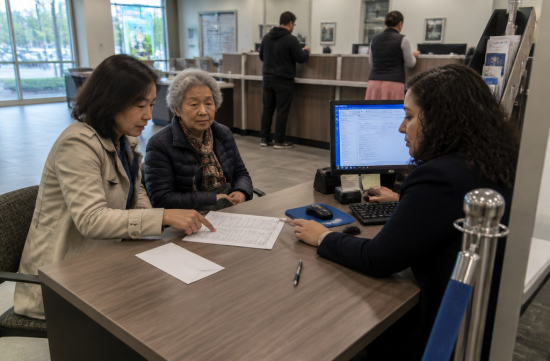
I won't beat around the bush. If your parents are starting to show signs of dementia and you don't have a financial power of attorney, you, as their child, do not have the legal authority to access their money.
Many people think that since we are family, it should be fine. They believe that if they go to the bank and explain the situation, it will be handled automatically.
The reality is different. If the account is in the name of the parent and there is no one authorized, the bank will politely refuse.
The same goes for a house; only the owner or someone authorized by the owner can sell it.
Let's imagine a scenario. Your mother needs to enter a care facility, but to cover the costs, you need to sell the house.
Your mother is already in a state where she finds it difficult to understand the documents. At this point, the only option for the children is to go to court.
Washington State has been applying the Uniform Guardianship Act since 2022, and the relevant provisions are found in RCW 11.130. Here, the person who manages money and property is called a conservator, while the person responsible for personal care is called a guardian.
Without a power of attorney, family members must file a petition with the county superior court. The state court form for this is called GDN C 102.
The petition must include details about your parents' assets and income, the current caregiver, and any other methods you have tried and why they were insufficient. It requires much more detail than you might expect.
The court will appoint a court visitor, an investigator who will meet with your parents and review medical opinions before reporting back to the judge.
One surprising aspect is that a single dementia diagnosis is not enough. You must provide clear and convincing evidence of what they are unable to do on their own.
The court will first look for less restrictive alternatives. Therefore, instead of granting full authority, they may issue a protective order that only grants partial authority or allows a specific transaction.
Your parents also have the right to oppose this. They can hire a lawyer, and if they cannot afford one, a public attorney will be appointed.
Costs cannot be overlooked. The hourly rate for the court visitor is set by court order and is generally paid from your parents' assets.
If finances are really tight, the county may cover some costs. Conversely, if the petition is deemed insincere or unjust, the petitioner may have to pay.
In addition, there are attorney fees, court fees, and costs for medical evaluations. It's hard to guarantee that the process will be completed in just a few weeks, and during that time, a buyer for the house may back out.
Even after receiving authority, it's not the end. The conservator must submit an inventory of the assets to the court within 90 days of their appointment.
After that, they must continue to submit reports detailing income, expenses, and changes in assets according to the schedule set by the court. If required by the court, they may also need to post a bond.
In summary, what could have been resolved with a single power of attorney turns into a lengthy legal process with years of reporting obligations. Honestly, this is a hassle that can be avoided.
So, what can you do in advance? The key is to create a financial power of attorney while your parents still have decision-making capacity.
There's an important point to keep in mind in Washington State. According to various legal resources, a power of attorney here becomes ineffective the moment the person loses their decision-making ability unless it explicitly states otherwise.
Therefore, the durable language must be included to ensure it remains effective even if they lose decision-making capacity. If you miss this, it will just be a piece of paper when you need it most.
The signature must be from your parents, along with the date, and then it should be notarized or witnessed by two individuals. However, caregivers like home care providers cannot be witnesses.
Medical decisions are a separate matter. Having only a financial power of attorney does not allow you to consent to treatment at a hospital, so it's safer to specify medical authority separately.
If they are already in the early stages of dementia, it's not too late to act. Just because they have been diagnosed doesn't mean they can't sign; the key is whether they understand the content at that time, so the sooner you consult a lawyer, the more options you will have.
Social Security benefits need to be considered separately. The SSA does not accept general powers of attorney and instead operates a representative payee system.
If there is a joint account, it can provide immediate relief for living expenses. However, it won't resolve issues like selling a house or making major decisions, so relying solely on that can be problematic.
If you are considering Medicaid long-term care, you must check the eligibility impact before transferring or selling assets. If you make a mistake in the order of operations, it can be difficult to reverse.
This is general information and may vary based on individual circumstances, so please consult a professional like an elder law attorney in Washington State. To find free resources, you can start by visiting WashingtonLawHelp.org or your county court information desk.
My position is clear. Even if it feels awkward to bring this up with your parents, if you're going to do it, it's best to do it right away.
When your family gathers for Thanksgiving or the end of the year, set aside just one hour to get the paperwork in order. It's a hundred times better than getting caught up in court procedures later.
 CookieSurvive


 Burbank Lee |

 vibranto |

 sparkling |

 oh my salami |

 saffronroute |

 crystalx |

 Seattle - Emerald City |

 US Home Buying Information Home Insurance |

 mystery |

 harvest |

 Community Cross |
 journey |
 heeve |
 leman |
 corner kick |
 treasure |
 strawberry |
 Augusta Univ |
 B.I.G. Victor |
 Victory 1988 |
 Swift Falcon |
 venture |
 SPAM 101 |
 choi family |
 zoryan |
 cloud0 |
 SKy Face |
 wonder |
 Dragon Lee |
 productionblog |