
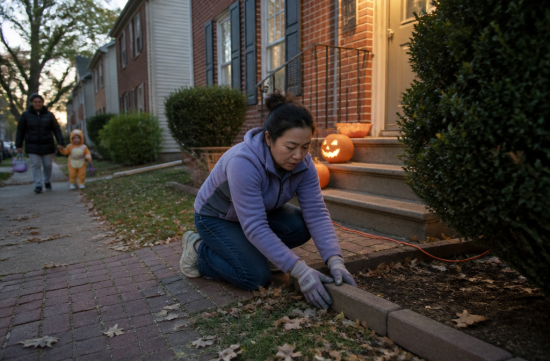
This Halloween falls on a Saturday. Since it's the weekend, kids will likely start coming out before sunset, and there will be many more footsteps going up and down the front steps than usual.
However, during consultations, there's one question that always comes up at this time of year: if a child comes to our house for candy and gets hurt in front of it, who is responsible?
Let's follow a specific scenario from start to finish. This is based on the structure of homeowner's insurance policies and principles outlined in Maryland case law, and I want to clarify that the final judgment on individual incidents rests with the insurance company and lawyers.
On Halloween evening around seven o'clock, the porch lights are on, and there's a basket of candy at the door. However, the decorative pumpkin lights next to the stairs are off, and a child, excitedly stepping down, trips over a loose flower bed border and falls.
The child scrapes their knee and sprains their wrist, prompting the parents to take them to the emergency room. A few days later, the parents cautiously bring up the topic of medical expenses.
The first document to review is the summary page of the homeowner's insurance claim, commonly referred to as the declaration page. This page contains the two key points of today's discussion.
One is Coverage E, which refers to personal liability, and the other is Coverage F, which covers medical expenses for others. Although the names sound similar, they operate quite differently.
Coverage F pays for medical expenses when someone who has permission to enter another's home gets injured, regardless of fault. The advantage is that the injured party can directly claim from the homeowner's insurance without needing to go to court.
However, the limits are low. Since this varies by policy, you should check the numbers on your own page.
So, in this case, the cleanest first step is to inform my insurance company about the incident and have them handle the hospital bills under Coverage F. This is the most practical way to prevent the situation from escalating.
Here's an interesting point regarding the porch lights. According to industry explanations, leaving the porch lights on is often interpreted as a signal that it's okay to come in.
Conversely, if a child enters a house with the lights off and the door closed, it may be argued that they were not considered a permitted visitor. If you don't intend to hand out candy, it's better to keep the lights off as a clear indication.
However, if the parents demand not only the hospital bills but also the full treatment costs and damages, then we enter the realm of Coverage E. The issue becomes whether the homeowner had legal negligence, and the insurance company will also cover legal fees.
Maryland case law categorizes visitors as invited guests, permitted visitors, or trespassers, and views the homeowner's duty of care differently for each category. The more someone is considered a guest, the broader the scope of care the homeowner must provide.
If a house has its lights on and candy out on Halloween, I believe it can be seen as effectively inviting children in. However, I couldn't find a Maryland appellate ruling that directly addresses this issue.
When determining negligence, we look at whether the homeowner created a dangerous condition, neglected it knowingly, or should have been aware of it. If the loose border has been like that for weeks, it would be unfavorable for the homeowner.
Maryland also has a unique rule known as the contributory negligence principle, which makes it very difficult for the injured party to receive compensation if they have any fault at all.
However, in cases involving children, the assessment is based on their age-appropriate judgment, so it doesn't end as simply as adult cases.
Therefore, it's not wise to rely solely on this rule. In fact, there have been reports of lawsuits arising from Halloween incidents where someone tripped over a flower bed border.
If you're a tenant, the situation is a bit different. Most renter's insurance policies, or HO-4, include liability and medical expense coverage, so you should check your own policy first.
However, if the injury occurred in areas like stair structures or common pathways managed by the homeowner, the responsibility may shift to the property owner. Depending on whether it's a single-family home or a townhouse complex with an HOA managing common walkways, the contact point may differ.
Let's also outline what to do immediately after the incident. First, check the child's condition, take photos to document the scene and lighting, and determine whether the accident occurred in your area or a common area, and get the parents' contact information.
And it's best to refrain from saying things like "I'll take full responsibility" at that moment. While it's important to express your sympathy, it's better to leave the determination of fault to the insurance company.
Reporting to the insurance company is better done sooner rather than later. Policies often have clauses requiring prompt notification of incidents, and delaying for weeks can complicate the claims process.
In fact, the best scenario is to avoid accidents altogether. Before Halloween weekend, you can check if the porch light is working, if the handrails are secure, and if there are any dips in the grass.
Long decorations with wires or smoke machines can easily trip a child. Switching to LED lights for jack-o'-lanterns is also a safer option to prevent fire hazards.
If you have a dog, it's best to keep them in a room away from the front door that evening. Even a gentle dog can become anxious with strangers constantly ringing the doorbell, and dog bites are a significant concern in liability claims.
Finally, take a look at your liability coverage limits. Many basic policies start at $100,000, but if your home has accumulated value and savings, it may be worth considering $300,000 or more, or an umbrella policy.
If I were a homeowner, I would check the limits of Coverage F on my insurance page this year and consider addressing the porch lighting and flower bed border. If a few dozen dollars in repairs can prevent a conflict with a neighbor, that's an investment worth making.
 mooncitywalker2017








 moo moo |

 ultron78 |

 garlic bread |

 Sugar Cream Door Bulletproof Noodles |

 urbanmint |

 maryland park |

 strawberry |


 Annapolis NSA |

 treasure |
 Augusta Univ |
 B.I.G. Victor |
 Victory 1988 |
 Swift Falcon |
 venture |
 SPAM 101 |
 choi family |
 zoryan |
 cloud0 |
 SKy Face |
 wonder |
 Dragon Lee |
 productionblog |
 What can make money? |
 Oklahoma Hoya OK |
 prixon74 |
 Roman Pan |
 USALATU BLOG |