
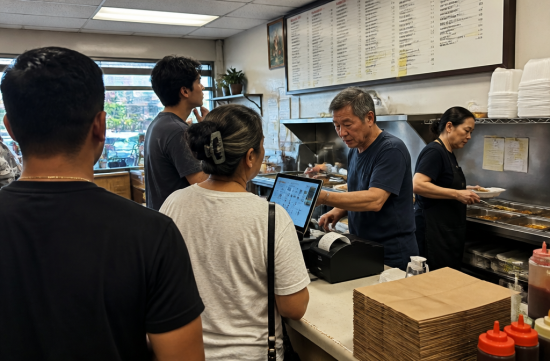
I stopped by my favorite local restaurant and noticed that the menu prices had changed again. The price of a plate lunch has noticeably increased over the years.
Looking back, running a restaurant on this island has always been a battle with calculations. Ingredients come in at double the cost, rent is significant, and customer traffic fluctuates with tourism. On top of that, the minimum wage keeps rising incrementally.
First, let's clarify the facts. Hawaii's minimum wage is gradually increasing according to Act 114, which was passed by the state legislature in 2022. It rose to $12 per hour in October 2022, $14 in January 2024, and $16 in January 2026.
The final step will be $18 on January 1, 2028. This means that for 2026 and 2027, the wage will remain at $16, and then an additional $2 will be added at the beginning of the following year. This is not tied to inflation; it's a set schedule established by law.
When you look at the numbers, it's quite heavy. From $12 in 2022 to $18 in 2028, that's a 50 percent increase over six years. Time flies, but for restaurant owners, it likely feels even faster.
So, what does a $2 increase mean for restaurants? For an employee working 40 hours a week for 52 weeks a year, that totals 2,080 hours. Multiplying that by $2 results in an additional $4,160 per year for each employee.
In terms of annual base salary, at $16 per hour, that's $33,280, and at $18, it becomes $37,440. This calculation does not yet include the employer's burden of taxes and insurance on salaries.
Let's consider an example. Suppose there's a restaurant with eight employees working minimum wage, each working 30 hours a week. In this case, the increase in 2028 alone would add $24,960 annually.
However, the actual burden doesn't stop there. During the 2024 increase, the Hawaii Restaurant Association indicated that member establishments could see labor costs rise by as much as 10 percent that year. If starting wages go up, existing employee wages must also be adjusted accordingly.
It's also important to note the regulations regarding tipped employees. Hawaii recognizes tip credits, and as of 2026, that amount is $1.25 per hour. Therefore, the minimum hourly wage for servers becomes at least $14.75.
However, there are conditions. The combined amount of the hourly wage paid by the employer and tips must exceed the minimum wage by at least $7 to utilize this credit. This means that, as of 2026, the total must be at least $23 per hour.
In 2028, the tip credit will increase to $1.50. Subtracting this from the minimum wage of $18 means that the direct hourly wage for tipped employees will be at least $16.50.
Another unique burden in Hawaii is health insurance. The Prepaid Health Care Act, established in 1974, requires employers to provide health insurance for employees working more than 20 hours a week for four consecutive weeks.
The employee's share of the insurance premium cannot exceed 1.5 percent of their wages. The remainder is the employer's responsibility, so if insurance premiums rise, the restaurant owner bears the full cost.
Reflecting on our ancestors who came over as sugarcane workers brings a sense of nostalgia. In January 1903, the first Korean immigrants arrived at Honolulu Harbor aboard the Gallic. They pooled their earnings under the blazing sun to open businesses and educate their children.
Among the paths chosen by their descendants and subsequent immigrants, one of the most common has been running restaurants. Therefore, discussions about minimum wage are not just someone else's issue for our Korean community.
So how are restaurants managing to survive? From what I've seen and heard, the methods can be broadly categorized into a few strategies.
The first is reducing the menu. By eliminating labor-intensive and less popular items, both ingredient waste and cooking staff can be minimized.
The second is changing the ordering process. More restaurants are adopting counter service where customers order and pick up their food themselves, or using kiosks and mobile ordering. This reduces front-of-house staff, but it also means less interaction with customers, which is a bit disappointing.
The third is adjusting operating hours. Closing during slow afternoon hours or late-night service and concentrating staff during lunch and dinner peak times is one approach.
The fourth is to raise prices gradually and frequently. A large increase all at once can shock regular customers and drive them away. Therefore, many establishments seem to increase prices by a few cents once or twice a year.
Finally, retaining employees for a long time is also an important calculation. Frequent turnover can lead to higher costs for hiring and training than one might expect.
I don't view the minimum wage increase itself as entirely negative. Considering the cost of living and grocery prices on this island, $18 per hour is not necessarily a generous wage. There's truth in the idea that if workers can't make ends meet, neither can the businesses.
However, I do have some concerns about pushing through a set schedule regardless of economic conditions. If a downturn in tourism coincides with the increase, small businesses may be the first to collapse. The law sets the numbers, but ultimately, it's the local business owners who have to manage those numbers.
If you run a restaurant, I hope you don't let the time until 2028 pass by without action. Take a moment to calculate how much more you'll be spending per month if the hourly wage increases by $2 based on your current employee wages and hours.
For the most accurate and up-to-date regulations, you can check the wage standards on the Hawaii Department of Labor and Industrial Relations (DLIR) website. For complex conditions like tip credits, it's advisable to consult with an accountant or labor expert.
Today, that restaurant owner smiled as usual while handing over change. I now have a better understanding of how many calculations lie behind that smile. Instead of complaining, visiting more often may be the best way to support local businesses.
 SolidStone99



 Tonky |

 My NYC |

 coloradoman |

 Living Economy Information Blog |

 Tomato Health Club blog |

 HAWAII Korean Church News |

 victoria 68 |

 Hawaii Tourist Information |


 TEX MEX STAR |
 venture |
 SPAM 101 |
 choi family |
 zoryan |
 cloud0 |
 SKy Face |
 wonder |
 Dragon Lee |
 productionblog |
 What can make money? |
 Oklahoma Hoya OK |
 prixon74 |
 Roman Pan |
 USALATU BLOG |
 Sunshine Blog |
 Minnesota Small Business |
 Strawberry Pancake Warrior |
 amolayo |
 korvon |
 Que Buena |