
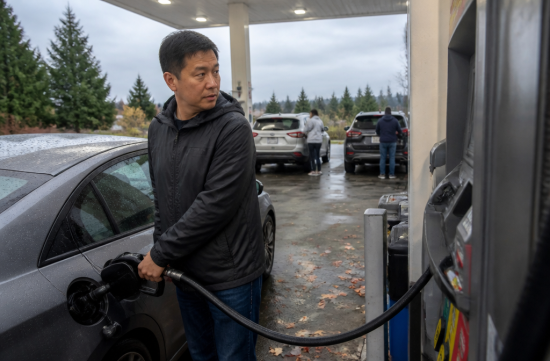
Last week, while filling up my tank at the gas station and looking at the receipt, I paused for a moment. It was surprising to realize that a price in the mid-$5 per gallon range has become a number that no longer shocks me.
So this weekend, I decided to calculate the commuting costs that I had only sensed before. Maybe it's an engineer's habit, but I feel more at ease when I have a bill rather than just a vague feeling that it's expensive.
First, let's summarize the rankings. There has been a lot of talk about Washington State having the second-highest gas prices in the nation, but that was actually a story from last fall.
In October 2025, Washington held the second position for a few weeks, surpassing Hawaii, right after California. However, according to a report from October 13 citing AAA data, it is now in third place.
As of October 12, the average price for regular gasoline in Washington State was $5.45 per gallon. California, in first place, was at $6.31, and Hawaii, in second, was at $5.62.
Whether it's second or third, the feeling is not much different. This becomes clearer when compared to the national average.
The national average announced by AAA on October 8 was $4.36 per gallon. This means Washington's average is over a dollar higher.
AAA stated that this is the first time this year that the national average has exceeded $4 in October. They also mentioned that the rise in international oil prices, which have gone back above $90 per barrel, has had an impact.
The Seattle area is even more expensive than the state average. According to AAA data from October 2, the Seattle-Bellevue-Everett region had an average price of $5.67 per gallon, making it the most expensive area in the state.
On the same day, the state average was $5.49, which is 96 cents higher than a year ago. The highest recorded price in Washington State was $5.79 on May 20 of this year.
So why is Washington always so expensive? The most visible reason is taxes.
The state fuel tax increased by 6 cents per gallon in July 2025, bringing it to 55.4 cents. The same law mandates an automatic increase of 2% each year starting from July 1 of this year, meaning the first increase of 1.1 cents will raise it to 56.5 cents.
According to the U.S. Energy Information Administration, this level is only surpassed by California and Pennsylvania. There are criticisms regarding the fact that it increases every year without a vote.
It's understandable that money is needed for roads and bridges. However, if it's an automatic increase, I believe there should be more transparency about where that money is being spent.
Now, here's my calculation. I assumed a round trip of 30 miles with a car that gets 25 miles per gallon for commuting.
That's 1.2 gallons per day, and with 21 working days in a month, it totals 25.2 gallons. Multiplying that by the Seattle area average of $5.67 gives a monthly gas cost of $142.88.
If the price per gallon increases by $1, that adds an extra $25.2 each month for the same distance. That's over $300 a year. If there are two cars in the household, that burden quickly doubles.
When you add parking fees, insurance, and bridge tolls, the cost of operating one car becomes much larger. Gas prices are just the most noticeable item among those costs.
For comparison, I also looked at public transportation. Starting August 30, 2024, the adult fare for Sound Transit Link light rail will change to a flat rate of $3, regardless of distance.
A round trip of $6 for 21 days totals $126. When looking only at gas prices, it's not much different from driving, but the absence of parking fees is a significant advantage.
Of course, considering the distance to the station or transfer times, it's not the right answer for everyone. Since fares can change, it's a good idea to check the official Sound Transit website before riding.
Many companies also support ORCA cards. If you open the benefits guide from the HR department, you might find it surprisingly easily.
If you must use a car, it might be worth changing your fueling habits. There can be quite a price difference between gas stations even within the same area.
Using apps like GasBuddy to identify cheaper gas stations along your commute can be convenient. Warehouse store gas stations are also worth comparing if you're a member.
Checking tire pressure and removing unnecessary items from the trunk can also help improve fuel efficiency. While it may seem small, it adds up when done weekly.
Just adding one more day of remote work can have a clear effect. Reducing one day from a five-day work week can simply cut commuting gas costs by 20%.
Gas prices have been gradually decreasing this fall. The average in Washington State is reported to be 11 cents lower than a month ago.
However, due to winter demand and international oil prices, they could rise again at any time. Instead of feeling secure when prices drop, I believe it's better to reassess the current structure now.
My conclusion is simple. If I were in your shoes, I would commute via Link two days a week and only use the car on days with heavy rain or when I have a lot of stuff to carry.
Why not calculate your own commuting numbers this weekend? The vague burden can turn into a surprisingly clear choice.
 skycoastbuilder1954

 SKy Face |

 gleeful |
 forevergee |

 mortrix |

 cherrydino |

 PETRO Vatican Shrine |


 Bald Eagle Brothers |

 Real Estate Agent USA |

 Bacon King Blog |

 sunrise |
 treasure |
 strawberry |
 Augusta Univ |
 B.I.G. Victor |
 Victory 1988 |
 Swift Falcon |
 venture |
 SPAM 101 |
 choi family |
 zoryan |
 cloud0 |
 wonder |
 Dragon Lee |
 productionblog |
 What can make money? |
 Oklahoma Hoya OK |
 prixon74 |
 Roman Pan |
 USALATU BLOG |