
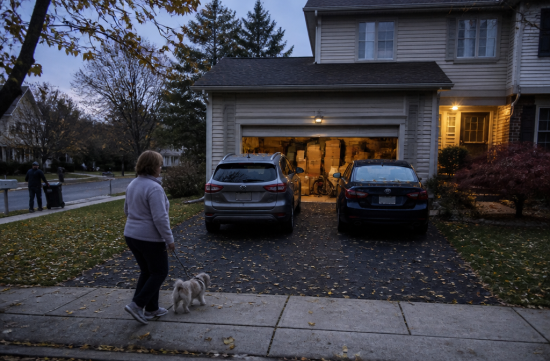
While taking an evening walk, I came across a house that caught my attention. The garage door was half open, and instead of a car, it was packed to the ceiling with boxes.
Meanwhile, the two cars from that house were parked side by side in the driveway, with a few leaves stuck to the windshield.
Feeling like I was staring too much, I quickly turned my head, but that scene stuck in my mind. It's a bit funny to think that a room made for cars has none in it.
So, when I got home, I opened my laptop to look it up. I was curious if I was the only one who found this strange or if everyone lived like this.
A survey conducted by the tool brand Craftsman in 2022 revealed that 36% of American garages are so cluttered that they can't fit a car at all. That's more than one in three homes. It turns out this is a much more common sight than I expected.
In a 2015 survey by the garage storage brand Gladiator, one in four respondents said they couldn't fit even one car in their garage. Both surveys were conducted by companies, so I should take them with a grain of salt, but the trend is similar.
Yet, homes continue to be built with larger garages. According to an analysis by the National Association of Home Builders using Census Bureau data, 65% of newly constructed single-family homes in 2024 will have garages for two cars.
Garages that can hold three or more cars also accounted for 15%. There's likely to be something piled up in those spaces too.
Out of curiosity, I traced the word back. The English word "garage" was first used around 1902 and comes from the French verb "garer," which means to protect or store.
So, its original meaning was simply a place to put something. Knowing this made me chuckle, as a garage full of boxes seems to align more with its etymology.
Originally, garages were separate from homes. Until the 1930s, they were mostly small sheds located in backyards or on the side, resembling storage for carriages.
The first attached garage is often cited as being in the Robie House in Chicago, designed by Frank Lloyd Wright. However, the exact details and dates vary across sources.
Attached garages became common after World War II during the suburban housing boom. As lots got smaller and families acquired more cars, garages naturally became part of the home.
After reading this, my question shifted. Instead of asking why cars are left outside, I wondered why there's so much stuff to store.
American homes have basements and attics, yet it seems that's still not enough. Industry data shows that there are over 50,000 self-storage facilities in the U.S.
More than one in ten households rent separate storage units. Seeing that number made me exclaim softly, as it's surprising to think that even with a garage, people still rent storage.
Imagining what's piled up in garages gives a rough idea. Christmas decoration boxes, bikes that kids have outgrown, and chairs that were meant to be fixed someday.
These aren't all useless items. They're things that are too valuable to throw away but have no space to use, so they end up in the garage.
So, perhaps garages are like a procrastination room for homes. They're places to temporarily store things that don't need immediate decisions. Keeping the inside of the house tidy while moving the clutter just one door away.
The problem is that this temporary storage can last for years. I have a box in the corner of my room that I haven't opened in a year, so I can't say I'm any different.
Korean homes have a slightly different scene. When I visit friends, I often see houses with kimchi refrigerators or large freezers in one corner of the garage.
There are also bags of rice and containers of gochujang, as well as large tubs used for making kimchi. The garage becomes half a storage space and half a back kitchen.
From that perspective, leaving cars outside doesn't seem to be just about disorganization. It could be a choice to keep something more important inside.
Of course, winter is a problem. On snowy mornings, scraping ice off the windshield with cold hands might make that choice feel a bit regrettable.
In summer, the inside of the car heats up under the blazing sun. Yet, the fact that people rarely think about opening the garage door suggests that what's inside is that precious.
It seems that emptying a garage is not as easy as one might think. Each item carries a bit of the past me.
If it were me, I wouldn't try to empty it all at once. One box per season seems manageable and less burdensome.
When I open a box, I can sort items into things to throw away, things to keep, and things to give away. If I donate them to a local charity, the items from my procrastination room might find new life in someone else's home.
Since that day, I've been paying more attention to garage doors while walking. The boxes visible through the open doors feel like stories belonging to the people in those homes.
The cars are outside in the rain, while memories are sheltered from the rain inside the garage. It's a strange paradox, but somehow, I find it a bit endearing.
Today, I think I'll finally open that box that's been sitting in the corner for a year. Not too grandly, just lightly, like a cloud, maybe just one.
 PorkLaser


 Conflite Teacher |

 SEVEN SEVEN |

 Korean Mom |

 novapixel |

 Peter Pan Pet |

 forestcloud |

 andrew park |

 Living in New Jersey blog |


 Lemon Kim |

 shaket |
 choi family |
 zoryan |
 cloud0 |
 SKy Face |
 wonder |
 Dragon Lee |
 productionblog |
 What can make money? |
 Oklahoma Hoya OK |
 prixon74 |
 Roman Pan |
 USALATU BLOG |
 Sunshine Blog |
 Minnesota Small Business |
 Strawberry Pancake Warrior |
 amolayo |
 korvon |
 Que Buena |
 virexo |
 silverpath |