

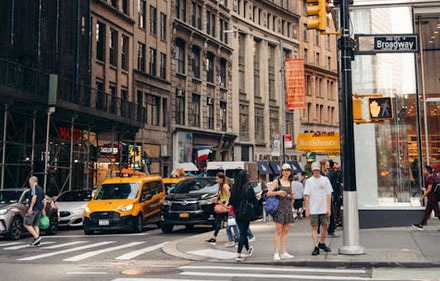
When people think of New York real estate, they often picture skyscrapers worth billions, towering over 30 or 40 stories.
However, the conversations that frequently circulate within the Korean community revolve around small commercial buildings, typically ranging from $3 million to $5 million, funded by retirement savings and contributions from a few acquaintances. This is what is known as the New York version of a small building.
As of 2026, the New York commercial real estate market remains hot yet simultaneously cautious.
In particular, Flushing, which is a hub for the Korean community, presents a completely different investment landscape compared to other parts of New York.
Flushing boasts a robust commercial sector, driven by both Korean and Chinese capital. Buildings that can be accessed with a budget around $3 million are mostly mixed-use structures of two or three stories. Typically, the first floor is used for restaurants or retail, while the upper floors serve as offices or residences.
The greatest strength of Flushing lies in the power of its first-floor retail spaces. With a high volume of foot traffic, concerns about vacancies are relatively low. Prime first-floor retail spaces often attract tenants as soon as they become available. This creates a more comfortable situation for landlords.
However, there are clear risks involved. In recent years, prices have risen too quickly. As of 2026, it is common to find buildings with yields dropping to the low 4 percent range. It is more accurate to say that the focus has shifted from generating rental income to preserving asset value.
The situation in Manhattan is quite different. Finding a commercial building for under $5 million is not easy. Small buildings located in the back alleys of Chelsea or the Lower East Side are the primary targets. It is akin to searching for hidden treasures.
With the rise of remote work, large office spaces are struggling. Conversely, small buildings that can accommodate boutique offices, local cafes, or specialized clinics are becoming scarce. Especially if the structure allows for residential conversion, there is potential for long-term value appreciation.
There are also significant practical issues. Taxes and insurance premiums in Manhattan can be quite high. On the surface, it may seem like the rental income is substantial, but after deducting property taxes and skyrocketing building insurance costs, the actual money left in hand can be surprisingly low. Thus, investing in Manhattan often becomes a battle of endurance.
The New York commercial real estate market in 2026 is experiencing extreme polarization. Interest rates have stabilized somewhat at their peak, and more investors are taking a breather through refinancing. At the same time, retail and residential sectors are quickly filling the void left by declining office demand.
Now, buildings that can be transformed into spaces where people actually gather are the ones that will survive, rather than those simply intended for office rentals. Structures that can accommodate businesses closely tied to daily life, such as restaurants, hospitals, and wellness facilities, are much more favorable.
A noticeable trend recently is the consolidation of Korean capital. Instead of individuals taking on the burden alone, it has become standard for families or a few trusted acquaintances to form LLCs to purchase buildings in the $4 million range. This strategy allows for risk-sharing and is based on the premise of long-term holding.
If you are considering a $3 million building in New York, the first thing to calculate is the actual money that will leave your pocket. In recent years, there have been many cases where commercial building insurance premiums have jumped by 20 to 30 percent. This cost must be deducted first when calculating rental income.
Maintenance costs cannot be overlooked either. Buildings over 100 years old are common in New York. If a boiler breaks down or there are roof issues, the profits for that year can vanish. Inspections to ensure the structural integrity of the building are crucial, even more so than its outward appearance.
Finally, more important than location is the tenant. Whether there is a reliable tenant who pays rent on time and takes care of the property can significantly influence actual profits. A strong tenant can often uphold the value of the building.
In conclusion, the era where small commercial buildings in New York automatically appreciate in value simply by being purchased has passed. Nevertheless, the vitality of Flushing and the symbolism of Manhattan remain attractive assets. If backed by thorough due diligence and realistic calculations, the dream of becoming a landlord in New York in 2026 can still be a viable strategy.






 ultron78 |
 garlic bread |
 Sugar Cream Door Bulletproof Noodles |
 urbanmint |
 |
| 
 Whisper |
 MintO |
 nova nova |
 TwinBee |
 Living in the Eastern United States |
  manchester |
  constant |
  Leapfrog Move |
  vibranto |
  Tora Tora |
  yellowbutter |
  Dolly |
  US Embassy |
  NYC saladbar |
  Finding Superfoods |
  lightyear |
  song bang |
  vexomo |
  Indiana Jones |
  meloncat |
  novapixel |
  mortrix |
  Esther 1983 |
  fortbliss |
  Moscow Kim |