

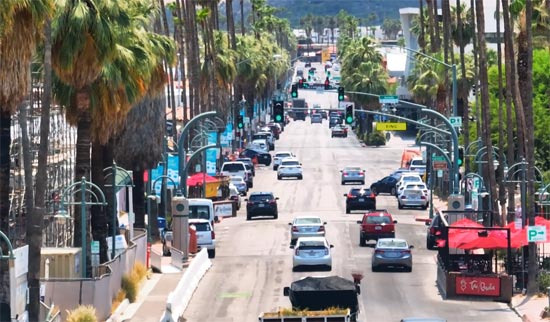
When buying a home in Palm Springs, the first question that often comes up is, "How much are the property taxes?"
However, when you receive your property tax bill for the first time, you may be surprised by a number that is different from what you expected.
California's property tax is known to have a basic rate of 1%, but the actual amount you pay can be much higher. This is especially true in the Coachella Valley area, including Palm Springs, where the funding methods for school districts are complex.
Let's start with the basic structure of California property taxes. According to Proposition 13, passed in 1978, the basic property tax rate is capped at 1% of the assessed value. The assessed value is based on the purchase price at the time of acquisition, and there is a limit of 2% on annual increases. This means that even if home prices rise, property taxes do not increase significantly. However, when various assessments and bonds are added, the effective tax rate changes.
The main items that increase property taxes in Palm Springs are first, the bonds related to the Palm Springs Unified School District (PSUSD). PSUSD issues bonds approved by voter referendum to fund facility improvements and educational program expansions, and the costs of repaying these principal and interest amounts are added to property taxes. Many past bond measures are still in repayment.
Second, there is the Mello-Roos Community Facilities District (CFD), which primarily applies to new development areas, where residents bear the costs of infrastructure such as roads, schools, and parks. Some newly developed areas in Palm Springs are subject to Mello-Roos.
Third, additional assessments from the Desert Water Agency (DWA), trash collection, and local lighting and landscaping districts are included.
How should we view the effective tax rate? For major residential areas in Palm Springs, the effective tax rate is approximately 1.1% to 1.4%. Areas without Mello-Roos, such as Old Las Palmas and Movie Colony (historical districts), are around 1.1%, while new development areas can rise to 1.2% to 1.4%. For example, for a home purchased at $700,000, with an effective tax rate of 1.25%, the annual tax would be $8,750, which is about $729 per month. This amount is added to the mortgage payment, so be sure to calculate the expected property tax before purchasing. You can check recent property tax payment history by entering a specific property address on the Riverside County Assessor's website (assessor.rivco.org).
Let's also look at the funding structure for PSUSD's education budget. California public school funding comes from three main sources: state aid, local property taxes, and federal grants. PSUSD is a regional school district that encompasses parts of Palm Springs, Cathedral City, Desert Hot Springs, and Sun City in Riverside County, with a high percentage of low-income students, many of whom attend schools that receive federal Title I funding. For the latest information on school facility improvement bonds related to property taxes, refer to the 'Budget & Finance' section on the PSUSD website (psusd.us). The most reliable way to ensure you have all assessment items for a property is to request them in writing from your realtor or title company during the escrow phase before purchasing a home.
 TidyEarnTdy
 EgenMan01




 Round and Round Children's Song Kingdom |
 new sugar |
 Way to easy |
 Magic Cabbage School of Martial Arts |
 Vacation on Hawaii |
 USA Hyundai Kia |
  Palm 1000 |
 US Regional Information Local News |
 Star Blog |
 Where is a really nice neighborhood? |
  Real Estate |
  Forest Gump |
  Real Estate Investment Korean American |
  Dollydori, Lover of Movies |
  dmzline |
  travelo |
  American Food Information & Calories |
  Splendid Mission |
  sparklingo |
  Watch Walker |
  Soy Angelino |
  autumn |
  K-POP TV News |
  cortiva6 |
  Nevada Teppanyaki |
  aerion99 |
  Golado |
  Maximum Pro |
  Joyce blog |