
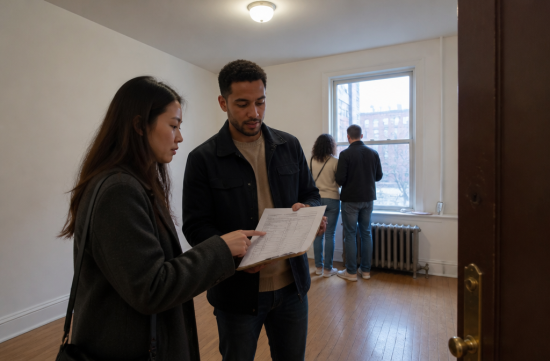
I went to see an apartment, and the agent asked for one month's rent as a fee before signing the contract. This used to be a common scene in New York. Now, things are different.
To put it simply, tenants are no longer obligated to pay fees to brokers representing landlords. However, free services are not guaranteed in all cases. Knowing the exact boundaries is key.
The basis for this is New York City's FARE Act. Its official name is the Fairness in Apartment Rental Expenses Act, which took effect on June 11, 2025.
The essence of this law is straightforward. Brokers representing landlords cannot charge tenants a broker fee. In simple terms, the party that hires the broker is the one who pays.
There is a point here that many find confusing. Even if there is no formal contract with the landlord, if a broker has permission from the landlord to list the property, they are equally prohibited from charging fees.
The responsibility also falls on the landlord. If the listing agent hired by the landlord or permitted to post the property violates the law, the landlord is also held accountable.
So when do tenants pay fees? It is when tenants hire their own broker directly. If I ask someone to help me find a place, then I cover that cost.
So, when you first meet an agent, ask this right away: Are you representing the landlord, or are you representing me? This one question clarifies most situations.
It's not just the fees that have changed. All rental listings must disclose all costs that tenants are responsible for.
Landlords must provide a written itemized list of all costs that tenants will incur before signing the lease. This means it cannot just be casually mentioned verbally.
Background check or credit check fees can still be charged. These are costs permitted by law, so they are not an issue.
Be cautious about costs that have different names. Even if the word "fee" is not in the contract, if there is money going to the landlord's broker, you should question it again. What matters is not the name but who the money is going to.
Violations can result in fines. According to the New York City Department of Consumer and Worker Protection (DCWP), the first violation incurs a fine of $750, and if repeated, it can go up to $2,000.
Honestly, this amount seems a bit weak. In a market where a month's rent fee can be several thousand dollars, a first fine of $750 is not likely to scare many people.
Reports can be made by calling 311 or visiting nyc.gov/consumers. Tenants also have the legal right to file a civil lawsuit directly.
When reporting, evidence is everything. The city advises keeping text messages, screenshots, receipts, and the broker's name and contact information.
But what is the reality? According to reports from March of this year, the DCWP received over 1,400 complaints about illegal fees since the law took effect and issued 50 summonses.
Cases that resulted in refunds were much fewer. As of reports released by spring, only two confirmed refund orders or settlements were noted. One was for a refund of $4,480 with a fine of $750.
These numbers show that having a law does not automatically mean money will be returned. Reporting is easy, but getting a refund takes time. Therefore, it is best not to pay from the start.
Many are asking about the possibility of the law being overturned. The Real Estate Board of New York (REBNY) has filed a lawsuit, but in June 2025, a federal court denied the request for a temporary restraining order to stop its implementation.
In July of this year, the Second Circuit Court of Appeals upheld the lower court's ruling, dismissing claims of free speech violations and state law preemption. The law remains in effect even during the lawsuit.
However, the lawsuit is not completely over. The association has stated it will seek other legal avenues. While it seems unlikely that changes will happen immediately, it is important to keep an eye on developments.
It is also fair to mention potential side effects. There have been concerns that if the fee burden shifts to landlords, they will simply raise rents accordingly.
StreetEasy estimated in a report last December that this law has impacted average asking rents by increasing them by 1.1%. Compared to a month's fee, it is still a better deal for tenants.
From my long-term observation of this market, costs ultimately shift somewhere. Still, it is a clear change that moving in on the first day requires less upfront cash. This is especially significant for those settling in for the first time.
To summarize, if you are dealing with a landlord's broker, you do not need to pay a fee, and if you hire your own broker, you do. Be sure to get a written list of costs before signing.
However, there can still be ambiguous situations. This occurs when a broker claims to represent both sides or when the contract language is unclear. In such cases, I recommend checking the DCWP guidance page first and contacting 311.
If I were you, I would move the conversation to text the moment the fee discussion arises. Having a record will give you leverage later. With this level of preparation, the chances of losing out in the current market are greatly reduced.
 BreadPito








 moo moo |

 ultron78 |

 garlic bread |

 Sugar Cream Door Bulletproof Noodles |

 urbanmint |

 lightyear |

 Franco Family |

 Starbucks Reserve Roastery Closure |

 newyorker 101 |

 river9 |
 pet dog |
 toodin |
 rosed |
 DeArizona Blog |
 ollege Mom |
 Pronunciation Yo |
 nuvex11 |
 Living in Florida |
 axelon47 |
 lumbus |
 Texas Migration Story |
 Scade Studio |
 love ya |
 biscuit90 |
 chicpo |
 Helpful Life Stories |
 Kitchen Ideas |
 Diana Blues |
 Agenda Center |