

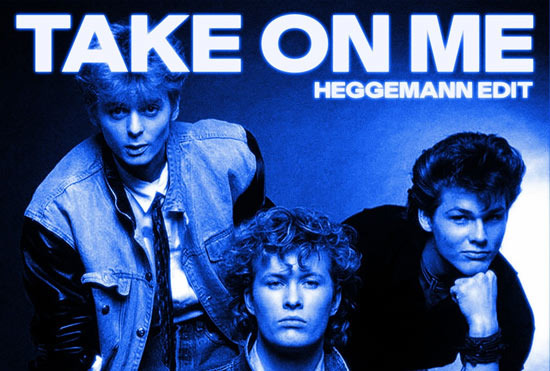
This song is a must-mention when talking about 1980s pop music!
Released in 1985, this song became a massive hit worldwide and is still referenced as a representative track of the 80s music scene.
Notably, its unique music video, which combined pencil sketches with live-action footage, generated a lot of buzz.
It was played almost daily on MTV, which helped the song gain fame quickly.
The music video depicted a woman meeting a cartoon man who tries to come into the real world.The technique of mixing pencil-drawn animation with live-action footage was very innovative at the time.
Thanks to this video, it is known that the song won several awards at the MTV Video Awards.
So, what does the title "Take On Me" mean?
The English expression "take on" has several meanings, but in this song, it is often interpreted as "please accept me".
Interestingly, the lyrics of this song do not sound completely clear even to English speakers.
The reason is simple. a-ha was a Norwegian group, and the songwriters were not native English speakers. Therefore, the lyrics were written in a somewhat poetic manner and did not follow completely natural conversational structures.
As a result, the lyrics feel a bit poetic, and some expressions may seem unusual for Americans in everyday use.
Here are a few representative examples:
"We're talking away"
This expression sounds a bit awkward in American English. While "talk away" is possible, people usually say it like this.
We're talking / We're chatting
"I don't know what I'm to say"
This sentence uses a structure that is rarely used in modern English. People typically say it like this.
I don't know what to say / I don't know what I should say
"what I'm to say" sounds a bit like old English or a literary expression.
"Today is another day to find you"
This sentence is understood in meaning but feels vague in context. A more natural way for Americans to say it would be like this.
Today I'll try to find you again / Today's another day for me to find you
"I'm odds and ends"
This phrase sounds quite strange to English speakers. "odds and ends" usually refers to miscellaneous items. It is rare for someone to describe themselves as "I'm odds and ends." Therefore, many Americans find it difficult to interpret the exact meaning of this part, often understanding it as something like "I'm a bit of a mess."
"Say after me"
In American English, people tend to use Repeat after me more often than Say after me. While "say after me" is not incorrect, it sounds a bit less natural.
"It's no better to be safe than sorry"
This sentence seems to intentionally alter a famous English proverb. The original proverb is It's better to be safe than sorry.
However, the lyrics state It's no better to be safe than sorry, which makes it sound like a deliberate twist of meaning. Thus, this part is also perceived as somewhat poetic in English-speaking contexts.
Therefore, many Americans say they did not fully understand the lyrics of this song as a story but rather felt it in terms of "atmosphere and emotion." In fact, many pop songs from the 80s had this style of lyrics. It was an era where expressions that matched rhythm and emotion were often used over perfectly literary sentences.
Interestingly, despite the lyrics not being completely clear, the song achieved tremendous success.
It topped the Billboard charts in the U.S. and was a hit in most European countries. It remains a song that frequently appears on the radio, in movies, and in advertisements.
 HumbleTour







 HAWAII Korean Church News |
 Gorama Round |
 LIZ Legal Information Blog |
 Egg Steamed Pot |
 novapixel |
 garlic bread |
 Popular Song Exciting Song |
 Burbank Lee |
 Yo Lock Me Up |
 Community Cross |
  journey |
  heeve |
  leman |
  corner kick |
  treasure |
  strawberry |
  Augusta Univ |
  B.I.G. Victor |
  Victory 1988 |
  Swift Falcon |
  venture |
  SPAM 101 |
  choi family |
  zoryan |
  cloud0 |
  SKy Face |
  wonder |
  Dragon Lee |
  productionblog |