
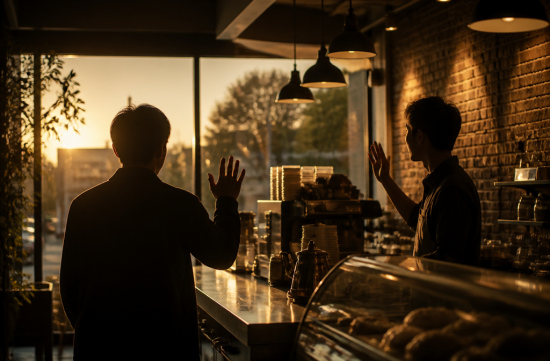
As I open the door to my favorite café, the barista comes out from behind the counter with open arms. In that moment, I freeze, unsure whether to extend my hand or lean in for a hug, and my mind goes blank for half a second. Ultimately, I end up in an awkward position, half-hugging and half-shaking hands, which is the uncomfortable clash that everyone experiences at least once when starting life in America.
There are also the opposite situations. During a business meeting, I politely extend my hand, only to find the other person already approaching with open arms, resulting in my fingertips accidentally brushing against their side. Just like how a one-second delay in pulling an espresso shot can lead to over-extraction and a bitter taste, the timing of greetings can completely change the atmosphere.
Curious about why this confusion exists, I found that the principles are surprisingly simple. A handshake is the standard greeting when meeting someone for the first time or in formal settings, and even then, it's usually only during the first encounter; afterward, it's common to greet each other verbally without shaking hands. Hugs are a natural form of greeting that occurs among friends or family who have already established some level of familiarity.
However, the boundaries of these greetings vary slightly from city to city, generation to generation, and industry to industry. In some café alleys, hugs have become a natural greeting between regular customers and baristas, while just a few blocks away in an office building, a handshake remains the only acceptable form of greeting. Even within the same city, the way people greet each other can differ based on the environment.
According to cultural guides from American universities, it's advised to maintain a personal space of about 18 inches, roughly the length of an arm, during conversations. This sense of distance is ingrained in people, so even when hugging, it tends to be brief and light, while holding hands for an extended period or fully embracing someone can feel burdensome for many.
Interestingly, contact itself is not viewed solely in a negative light. A study published in the journal Emotion in 2010 found that light physical contact among team members can enhance trust and lower stress hormone levels. However, the key factor is when, with whom, and in what context that contact occurs.
Gender and hierarchy also subtly play a role. It's rare for a man to initiate a hug with a female colleague or for a junior to ask a senior for a hug; typically, it's the person in a higher position or the one who feels more comfortable in the relationship who opens their arms first. Therefore, when in doubt, it's much safer to observe whether the other person extends their hand or opens their arms rather than making the first move.
As I brew coffee for a long time, I learn through intuition that the timing for pouring water varies with each type of bean and roast level. Greetings seem to be similar. It's not something that can be memorized from a manual; it requires developing a sense of the temperature of the city, the person, and the situation to feel natural.
In regions like the Midwest or South, people are often more open to giving space to strangers, while in the Northeast urban areas, there's definitely a tendency to draw clear lines with newcomers. Regardless of political leanings, this is simply a matter of regional differences, and there's no right or wrong side to it.
Ultimately, after nearly ten years of visiting cafés in various cities and meeting people, I've developed my own set of principles: if the other person opens their arms, I embrace; if they extend their hand, I shake; and if it's ambiguous, I simply make eye contact and smile. I've learned that as long as there's sincerity in any greeting, that's enough, especially after experiencing days where I focused too much on perfecting my latte art and ended up spilling the cup instead.


 lavender |
 logger |
 Conflite Teacher |
 Unknown Dog Walk blog |
 Khan Film Blog Production |
 Tennis City |
 K-POP TV News |

 Dolly |

 BIODOCTOR NEWS |
  Gold Bar |
  Tamfa Fan |
  Jenny's Mom blog |
  Karina's Blog |
  Best Frozen Yogurt |
  Victory 1988 |
  Coding Elf |
  Infinite Style |
  Mr Cleveland |
  Sugar Cream Door Bulletproof Noodles |
  novapixel |
  macan 08 |
  Goroke Geureoke News |
  colo colo |
  U.S. Weather Bureau News |
  Dragon Lee |
  American Food Information & Calories |
  zephyrs |