

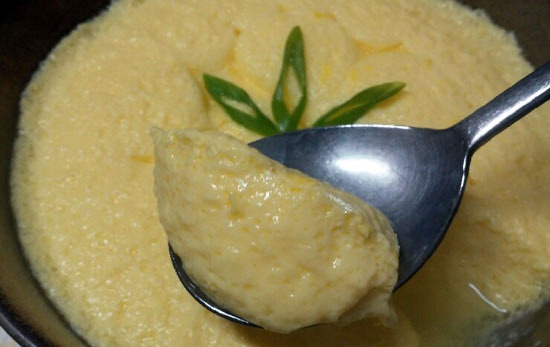
After turning 30, I've been cooking more at home, and one of the surprisingly difficult dishes is egg custard.
It seems like all you have to do is crack the eggs, mix in some water, check the seasoning, and put it on the heat, but the results vary every day, haha.
Anyone who has tried this will understand. Some days you get a sponge-like custard with holes, and other days it turns out runny like egg soup. On some days, the bottom is firm but the top is watery, making it hard to eat.
So when I see egg custard like the ones in Japanese restaurants, it feels like there must be a secret technique, like a hidden artisan's craft.
However, after a few failures, I realized it's not about the ingredients but rather the mindset while making it.
The secret is heat control, ratios, and a calm approach; just stick to these three things.
Three eggs are just right. It's a quantity that's not too much for one person and not too little to share with another.
For the water, use double the volume of the eggs, so a ratio of 1 egg to 2 parts water is the most stable.
If this ratio is off, the texture will be compromised.
Using water that has been lightly steeped with kelp or a light bonito broth instead of plain water will change the flavor significantly.
From this point, it shifts from home-style egg custard to a more restaurant-style egg custard.
Don't be greedy with the seasoning. A tiny bit of salt and a few drops of soy sauce are enough. If you season too heavily at this stage, the flavor may become strong, but the pudding-like texture will disappear immediately.
How you beat the eggs is also important. If you whisk them like you're making foam, you're already heading towards failure.
Gently mix with chopsticks, just enough to combine the yolks and whites. The less foam, the better. If you do get foam, it's worth straining it through a sieve, as this one step can really change the outcome.
It's best to finely chop only the white part of the green onion and add it at the end. If you add it from the start, it will smell good but the moisture can disrupt the texture.
The safest cooking method is steaming. Bring water to a boil in a pot, then reduce the heat to just the point where steam is rising, and place the bowl with the egg mixture inside. Don't cover it completely; leave it slightly open or cover it with a cloth to prevent steam droplets from falling directly onto the custard.
Keep the heat low, and the key is to wait. It's tempting to open the lid and stir, but the more you do that, the worse it gets.
After about 15 minutes, the surface will be slightly wobbly. If clear liquid doesn't come out when you poke it with chopsticks, you're almost there.
Turn off the heat and eat it while it's warm; it melts smoothly in your mouth, and if you refrigerate it and eat it cold, it pairs perfectly with rice.
The green onion flavor remains subtly present, so it's enjoyable whether warm or cold.
Looking back, the reason egg custard was difficult for me was not the eggs but my own personality.
The impatience to see quick results and the urge to keep fiddling with it were the problems. Lowering the heat and giving it time allows the egg custard to turn out like a proper dish.
These days, when the egg custard turns out well, it somehow makes me feel like the rest of my day goes well too, haha.
 WhenISeeHer







 Moscow Kim |
 Seattle - Emerald City |
 self-evaluation |
 Sandiego Auntie |
 Karina's Blog |
 Gold Bar |
 Day by day |
 Dolly |

 US Embassy |
  Korean Mom |
  My NYC |
  moo moo |
  Mr Oh |
  forevergee |
  festival |
  manchester |
  constant |
  Leapfrog Move |
  vibranto |
  Tora Tora |
  yellowbutter |
  NYC saladbar |
  Finding Superfoods |
  lightyear |
  song bang |
  vexomo |
  Indiana Jones |