

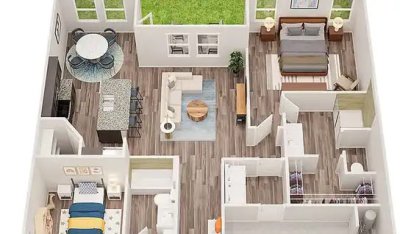
Having observed the rental market in Baltimore for nearly thirty years, I've noticed that the life cycle of tenants is clearly reflected in the unit types. Let's take a look at the rent and square footage from studios to three-bedroom apartments.
Studios average 500 square feet, with rents around $1,350 to $1,400. They are concentrated in new constructions near downtown, such as Federal Hill and Harbor East, and due to their proximity to hospitals and universities, there is a steady demand from single-person households related to Johns Hopkins.
One-bedroom apartments are about 750 square feet, with rents ranging from $1,550 to $1,600. Although they come with a nearly $200 premium compared to studios due to the separation of rooms, this type is most sought after by young professionals and couples looking for independent living spaces.
Two-bedroom apartments are 1,050 square feet, with rents climbing to around $1,850 to $1,950. They are often occupied by families with one child or two roommates, and Korean families newly settling in Baltimore typically consider this type first.
Three-bedroom apartments average 1,300 square feet, with rents estimated at $2,200 to $2,300. Over the past decade, new developments in Baltimore have increased the proportion of two-bedroom units, while the supply of three-bedroom units has relatively decreased.
The price gap between studios and two-bedrooms is consistently around $200 per room, but the gap widens when moving from two-bedrooms to three-bedrooms. From my long-term observation, family tenants feel the shortage of available listings most acutely in this range.
- Studio: $1,350 to $1,400 per month, average 500 sqft
- One-bedroom: $1,550 to $1,600 per month, average 750 sqft
- Two-bedroom: $1,850 to $1,950 per month, average 1,050 sqft
- Three-bedroom: $2,200 to $2,300 per month, average 1,300 sqft
I have seen several Korean families looking for three-bedrooms expand their search to the outskirts of Baltimore due to school issues for their children. Instead of insisting on a three-bedroom near downtown, considering slightly longer commutes to explore outer developments can significantly widen their options.
The flow of demand and supply by unit type ultimately serves as an indicator of which demographics are congregating in the city, a realization I've come to after observing this market for a long time.
 blueseawalker1995
 SsamjangAlien






 moo moo |
 ultron78 |
 garlic bread |
 Sugar Cream Door Bulletproof Noodles |
 urbanmint |
 maryland park |

 Onion Ring |
 mygoddess blog |
 frostpup |
  treasure |
  strawberry |
  Augusta Univ |
  B.I.G. Victor |
  Victory 1988 |
  Swift Falcon |
  venture |
  SPAM 101 |
  choi family |
  zoryan |
  cloud0 |
  SKy Face |
  wonder |
  Dragon Lee |
  productionblog |
  What can make money? |
  Oklahoma Hoya OK |
  prixon74 |
  Roman Pan |
  USALATU BLOG |