
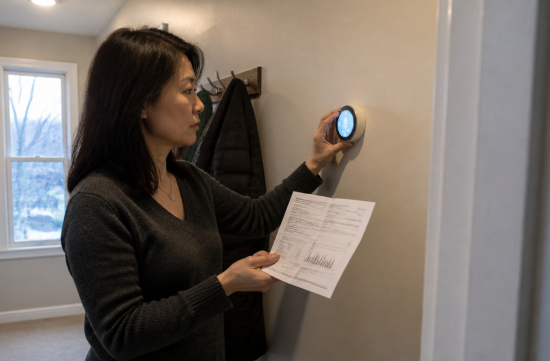
Last week, I set down a cup of coffee and compared my electric bill to the one from the same time last year. The amount of electricity used hasn't changed much, but the bill was definitely higher. I thought it might just be my imagination, so I checked the numbers one by one.
According to data released by Dominion, the rate for a typical household using 1,000 kWh per month was $149.92 on July 1, 2025. By July 1, 2026, that rate will rise to $180.79.
Calculating the difference shows an increase of $30.87 per month, which is just over a 20% increase. I often heard people in the neighborhood say, "It's gone up about $20," but based on the 1,000 kWh standard, it's actually more than that.
Of course, this figure assumes a consistent usage of 1,000 kWh each month. Depending on the size of the home or heating methods, the actual experience may vary.
I looked into why this increase has occurred. The first reason is the increase in the base rate.
The Virginia State Corporation Commission (SCC) approved Dominion's base rate increase in November 2025. For a typical household, the base rate will increase by $11.24 per month in 2026 and by $2.36 per month in 2027.
Dominion's materials state that this is the first base rate increase since 1992. It was also reported that the approved amount was lower than what the company initially requested.
The second reason is fuel costs. Starting July 1, 2026, the fuel cost component will increase, adding about $8 per month for a household using 1,000 kWh, according to Dominion.
The significant rise in natural gas and external power purchase costs during the cold snap last January is cited as the reason. Fuel costs are said to be passed on directly without any profit margin added by the company.
The remainder consists of various rider fee adjustments. Items related to offshore wind, transmission, and nuclear costs are separately listed on the bill.
Breaking down the $180.79 rate as of July 2026, the fuel cost alone is $40.55. The unavoidable rider bundle for customers is $26.73, and the fixed basic customer charge is $7.58 per month.
Seeing this honestly felt a bit frustrating. The rates themselves are something individuals cannot change. So ultimately, the only things we can control are the amount used, the timing of usage, and the payment method.
First, let's talk about timing. Dominion offers an Off-Peak Plan with different rates depending on the time of day.
During the summer months (from May to September), peak hours on weekdays are from 3 PM to 6 PM. According to the summer rates posted on Dominion's page, the peak rate is $0.229495 per kWh, while the super off-peak rate is $0.099429 per kWh, which is more than double the difference.
In winter, peak hours are split between morning and evening, and the rates differ. I recommend checking the current schedule and rates on Dominion's site before signing up.
This plan is suitable for homes that are empty during the day and can run laundry or dishwashers at night. Conversely, if your home runs the air conditioning or heater heavily throughout the afternoon, it may not be beneficial.
The second tip is regarding thermostats. Dominion offers a rebate of $50 for each ENERGY STAR certified smart thermostat purchased. You must be a residential customer in Virginia and submit a receipt.
I recommend scheduling heating to match the morning hours before leaving for work. Lowering the temperature during the day when the house is empty and raising it just before returning home can reduce unnecessary running time.
The third tip is about the payment method. By applying for Budget Billing, you can pay the same amount each month based on the average of the past 12 months' bills.
This doesn't reduce the total amount, but it helps prevent sudden spikes in bills during the coldest winter or hottest summer months, making household budgeting much easier.
If you know a neighbor who is suddenly struggling financially, it would be good to inform them about the EnergyShare program. This program assesses based on financial hardship rather than income criteria.
Heating assistance applications can be submitted from October 1 to May 31, with a maximum of $600 available. Cooling assistance is available from June to September, with a maximum of $300, and if approved, the funds go directly to the utility company.
Finally, there are small habits to adopt. Changing heat pump filters on time, closing doors to unused rooms, and replacing old bulbs with LEDs are all effective measures.
Each of these actions may only save a few dollars, but they add up over time. I've made it a habit to check my bill usage every first week of the month.
Usage can be viewed by date on the Dominion account. If you notice a sudden spike on a particular day, recalling what you did that day can often help identify the cause.
Additionally, there is already a schedule for another base rate increase in 2027. If you establish good habits this winter, you'll be less surprised when the bill arrives next year.
If it were me, I would first adjust the thermostat schedule and apply for Budget Billing before the winter bill arrives. It's not too late to decide on the Off-Peak Plan after observing our household patterns for a month.
While we can't stop the rate increases, we can prepare for them. I hope this winter will be one where we look at the numbers first instead of sighing in front of the bill.
 Smart Yo






 SKy Face |

 gleeful |

 forevergee |

 mortrix |

 cherrydino |
 tervox95 |

 berion88 |

 Next Year, Let's Become Rich |

 American Hardcore Band |

 james kim |
 All About Cars |
 lomira98 |
 calmbridge |
 oneonly |
 Brighto |
 racuse |
 Total Beauty |
 crystal |
 Good Hotels |
 raspberry7 |
 Que que |
 Well Done Sir |
 dance dance |
 sweetpepe |
 vegas mom |
 Olivia's Blog |
 cathywhite |
 heartbreaker |
 Giant Squid and Sweet Potato Soup |