
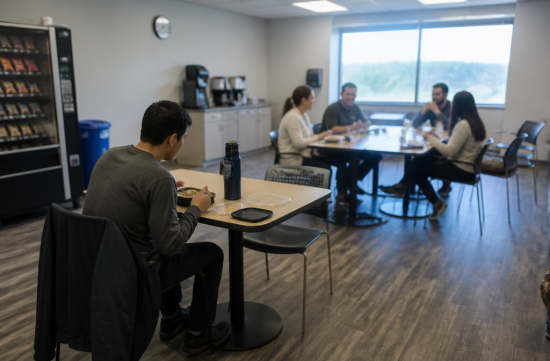
Sitting next to the company break room fridge, wearing earbuds, and eating lunch alone is a common sight in many offices.
If you find yourself in that position, you might feel a bit guilty, but the truth is that this is quite a common scene among American workers.
According to ezCater's fourth annual lunch report conducted in 2025 among full-time U.S. employees, 33 percent reported that they usually eat lunch at their desks.
Only 35 percent said they make it a point to step away from their desks during lunch. In other words, the rest either vary their lunch habits day by day or don't go out at all.
There were also a significant number of people who skip lunch altogether. Fifty-one percent reported skipping lunch at least once a week, and 33 percent said they skip it more than twice a week.
You might think it's just because they're busy, but an interesting statistic from the same survey shows that 84 percent reported feeling irritable due to hunger.
Furthermore, 88 percent acknowledged that their work performance declines when they are hungry. Additionally, 25 percent said they tend to avoid conversations with colleagues when they are hungry.
This last statistic is particularly noteworthy. The habit of hastily eating meals doesn't just affect one's condition; it also subtly distances them from others.
In American corporate culture, lunchtime plays a much larger role than one might expect. Conversations that never happen in the conference room often take place over cafeteria tables.
Information about how other team projects are going, rumors about who is leaving soon, and insights into the new manager's style are typically shared informally during meals.
One of the items Gallup has tracked for a long time in their workplace satisfaction surveys is whether employees have close friends at work. Only about three out of ten employees worldwide strongly agree with this statement.
Gallup has long concluded that organizations with lower scores in this area tend to show disappointing results in metrics like safety incidents and turnover rates. While a single lunch may seem insignificant, it can be the starting point for becoming one of those three.
KPMG's 2025 survey results on workplace friendships are also eye-opening. The percentage of respondents who reported feeling lonely at work rose to 45 percent, nearly doubling from 25 percent a year earlier.
Ironically, during the same period, the percentage of respondents who said they value close relationships at work increased from 81 percent to 87 percent. This indicates that while loneliness is on the rise, the need for connection is also growing.
Notably, the percentage of male respondents who reported feeling lonely was 48 percent, higher than the 42 percent of female respondents.
Perhaps the most interesting statistic is that 57 percent of respondents said they would accept a salary 10 percent lower than the market rate if it meant they could work with close colleagues.
Conversely, this implies that they would not join a company that offered a salary 10 percent higher than the market rate if there were no such relationships. Ultimately, this shows that people value that time enough to equate it with money.
This isn't just a recent survey finding. A study by Cornell University researchers examining over fifty U.S. fire stations found similar patterns.
Fire stations where personnel cooked and ate together had better teamwork and actual job performance. This suggests that shared meal times are not just about eating but about building trust.
It might seem odd to compare fire stations to offices, but the principles are not that different. Information sharing and trust generally grow around the dining table.
It's also true that remote work and hybrid work have made this aspect more challenging. In the same survey, 41 percent of remote workers reported eating lunch at their desks.
For office workers, that percentage was relatively lower at 28 percent. The natural decrease in opportunities to meet physically leads to this difference.
However, this doesn't mean we should all rush out for group restaurant tours every day. That would be exhausting and quite a burden for introverted individuals.
I believe that a minimal investment of one or two times a week, such as having a coffee or lunch with someone from another team, is sufficient. Such low-pressure interactions can lead to significant differences later on.
Eating lunch alone doesn't lead to immediate disaster. However, that time is a subtly significant informal currency in American workplace culture, so occasionally using it can ultimately be a worthwhile investment.
 PeelStealth







 coloradoman |
 pintos |
 mapsina |
 Mr. Largo |
 Victory 1988 |
 U.S. Weather Bureau News |
 Holey Moley |
 El Dorado |

 washington mom |
 Eldorado 88 |
  butter 90 |
  Lando Mao |
  Washington Denzel DJ |
  LIZ Legal Information Blog |
  vegas mom |
  Sandiego Auntie |
  Premium Gas Camp |
  Things to know |
  TEXAS Fishing Boat |
  AUTO OK |
  aaoaa |
  Florida King |
  Encyclopedia of New York and Surrounding Areas |
  Study Abroad Life Know-How Tips |
  Conflite Teacher |
  Silent Sea |
  Montgomery Mom |
  Franco Family |
  lumora |