
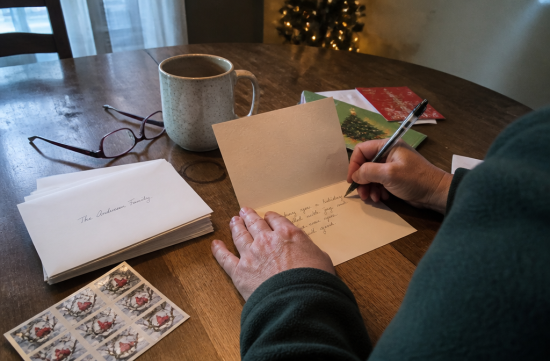
Last week, I opened my mailbox and found an envelope with familiar handwriting among the bills. When I opened it, it was a Christmas card, and I felt a mix of surprise and joy at the thought that someone still sends these in today's world.
In an age where everyone sends a quick text or a message on KakaoTalk to check in, it's fascinating that there are still people who go to the post office, buy stamps, and handwrite addresses to send cards.
I used to think it was just an old habit. However, I found that this tradition runs deeper than I expected.
In the U.S., it is said that 1.1 billion Christmas cards are sold and sent each year. That's quite surprising given how common text messages are these days.
However, this number has decreased significantly compared to the past. In 2002, 2.9 billion cards were sent in a year, averaging ten cards per person, which is incomparable to today.
By around 2015, that number had dropped to 1.4 billion cards, or about four per person. As email, text messages, and social media became more prevalent, handwritten letters gradually lost their place.
Yet, it's interesting that they haven't completely disappeared and are still exchanged in the millions. We should explore why this inconvenient method has survived.
If we trace the origins of Christmas cards, we go back to 1843 in England. A civil servant named Henry Cole found it cumbersome to write individual letters to friends, so he printed illustrated cards to send out.
Coincidentally, this was around the time when postal rates in England had just been significantly reduced. The very concept of cards was born alongside the affordable postal system.
It's remarkable to think that this tradition has continued for over 180 years. That's a much longer lifespan than most trends.
Interestingly, there is a clear generational divide in who sends these cards. Research shows that older adults send cards by mail more than twice as often as teenagers.
It seems that younger generations prefer the convenience of sending a text or message with just a few taps. In contrast, older generations tend to stick to the tradition of using paper and stamps.
I believe this difference is not just about technological adaptability. The act of handwriting carries a different weight of sincerity.
Text messages are fleeting; they disappear as soon as they are sent. In contrast, cards are items that can be displayed on a mantel or refrigerator for weeks.
Messages posted on social media quickly get buried under other posts. Meanwhile, cards can be tucked away in a drawer and rediscovered years later.
Considering this difference helps us understand why people choose to endure the hassle of mailing. The weight of a momentary message versus a tangible item that stays with you is fundamentally different.
It's honestly surprising that people still buy and send cards despite the rising cost of stamps each year. After all, they could easily send a text to save a few dollars.
From the perspective of someone who values cost-effectiveness, this doesn't seem like a rational expense. Yet, the fact that many people don't mind this spending suggests there are other values at play that can't be measured in money.
These days, cards featuring pet photos instead of family pictures are also becoming popular. It seems that more households are sending cards with their dogs or cats featured prominently.
Some parents are teaching their children how to write cards, using it as an opportunity to learn how to write by hand and affix stamps. In that sense, this tradition doesn't seem so bad.
However, I can't help but feel a bit skeptical. Surely, there are people who mechanically churn out cards each year from a list.
Those who receive both heartfelt cards and those sent out of obligation can surely tell the difference. Still, from the recipient's perspective, it seems that any card is a welcome surprise.
Ultimately, I think the reason this tradition has survived can be summed up in one phrase: as digital communication becomes more prevalent, the value of analog methods has increased. A handwritten letter is likely to be remembered longer than a hundred text messages.
I may not manage to send cards to everyone each year, but I still handwrite cards for a few people I truly want to reach out to. It's not about convenience; it's because I believe it's the right way to express my feelings.
How many cards have you handwritten this year? Taking a moment to reflect might give you the answer.
 InfoUncle



 Florida King |
 AH LALA |
 Victory 1988 |
 Panorama Kstar |
 Giant Squid and Sweet Potato Soup |
 You Turn Me On |
 You Only Live Once |

 Rainbow Bridge to the Sky |

 butter 90 |
  Lando Mao |
  Washington Denzel DJ |
  LIZ Legal Information Blog |
  vegas mom |
  Sandiego Auntie |
  Premium Gas Camp |
  Things to know |
  TEXAS Fishing Boat |
  AUTO OK |
  aaoaa |
  Encyclopedia of New York and Surrounding Areas |
  Study Abroad Life Know-How Tips |
  Conflite Teacher |
  Silent Sea |
  Montgomery Mom |
  Franco Family |
  coloradoman |
  lumora |