

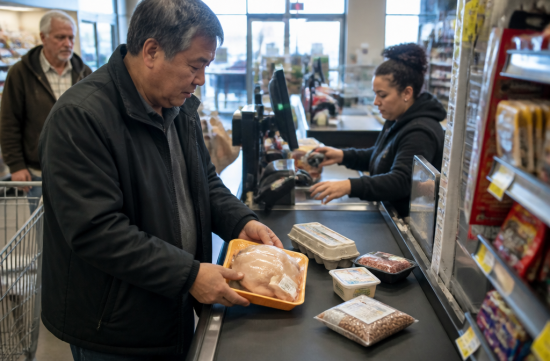
Today's takeaway is this: a meatless dinner can be just as filling and surprisingly delicious.
Last week, I picked up a pack of ground beef at the grocery store and put it back down several times. I was stunned when I saw the price tag for a 2-pound family pack. I rubbed my eyes in disbelief, wondering if this was really the price for ground beef.
Curious, I looked up the national average prices published monthly by the Bureau of Labor Statistics (BLS) when I got home. In February of this year, 100% ground beef was priced at $6.74 per pound.
That wasn't the end of it. In May, it was around $6.75, and by August, it had risen to $6.92.
Last August, it was $6.32, meaning it has jumped over 60 cents in just a year. In percentage terms, that's more than a 9% increase.
The reason for this high price is that the number of cattle raised in the U.S. is historically low. With fewer cows, supply is tight, and prices remain high.
Ground beef used to be considered a staple for the average person. It was the meat we casually added to hamburgers, meat sauces, stir-fries, and dumpling fillings.
Now, I find myself thinking twice, or even three times, before adding it to my cart. My income hasn't changed, but the price of meat keeps climbing, which honestly feels a bit unfair.
So, I've slightly adjusted my approach. I'm not saying to cut out meat entirely, but rather to use less while still eating well. I'm definitely not suggesting you become a vegetarian.
Using the same BLS data, I looked at the prices of other proteins as of August, and the comparison is quite interesting.
Boneless chicken breast was priced at $4.17 per pound. That's about $2.75 cheaper than ground beef, so even buying just 3 pounds saves over $8.
Whole chickens are even more surprising. Fresh whole chickens are around $2.01 per pound, which is less than a third of the price of ground beef.
Buying a whole chicken and preparing it yourself yields breast, thighs, and wings, and you can use the bones to make broth. It takes a bit of effort, but that's part of the fun of cooking.
Eggs were priced at $2.27 for a dozen Grade A large eggs. That's less than 20 cents each.
Remember when eggs were as expensive as gold? It seems they've returned to being the king of protein value.
The cheapest option is dried beans. Regardless of whether they're black beans, pinto beans, or kidney beans, the average price was $1.63 per pound. That's less than a quarter of the price of ground beef.
Soaking a pound of dried beans overnight expands their volume significantly. A single bag can provide several days' worth of side dishes, and if you have leftovers, just cook and freeze them.
This is where the advantage of Korean cuisine comes into play. We are naturally strong in bean dishes.
From seasoned beans, bean soup, to steamed tofu, just one of these on the table makes me think less about meat.
Cold noodle soup made with bean broth is considered a summer dish, but I enjoy it in the fall too. It's refreshing, nutty, and most importantly, inexpensive.
These days, I often make a mixture of half ground beef and half tofu for my patties. The amount of meat is halved, but the texture is even softer.
I do something similar with meat sauce. By adding lentils or finely chopped mushrooms to half a pound of ground beef, I double the quantity and deepen the flavor. The mushrooms absorb the meat juices, giving a satisfying texture that feels quite meaty.
Instead of just frying eggs, try making a baked egg dish or a thick omelet as a main dish. Adding some chopped green onions and a bit of fish roe can make a bowl of rice disappear.
I recommend chicken thighs. They are less dry than chicken breasts, and if you marinate them overnight in soy sauce for bulgogi, you hardly think of beef. The leftovers can be used in kimbap the next day for another meal.
I couldn't find specific price statistics for tofu, but everyone knows that a block of tofu is less burdensome than a pack of meat at Korean or regular grocery stores. It can be used in stews, braises, or pancakes.
One tip for shopping: buy meat on sale and portion it out to freeze. Buying small amounts at full price is the biggest waste.
Also, try designating two days a week as meatless days. At first, it might feel empty, but you'll quickly get used to it, and you'll see the numbers on your receipt change.
I call this not just saving money, but a menu adventure. It's about taking a detour from the usual path.
Just like listening to the same songs can get boring, sometimes your meals need a complete playlist change. An unexpected dish could become a new favorite.
No one can predict when beef prices will drop. It takes years to rebuild a reduced cattle herd, so it will take time for the number of cattle to recover.
So rather than waiting, it's more comforting to change my own table first. If it were me, I'd start this week by buying a bag of beans and a whole chicken.
There are no right answers, so try what suits your taste. Don't let meat prices dictate your meals; you decide what goes on your table.
 FamilyGlory
 MagicTree


 novent |
 Silent Sea |
 Pointy |
 Idaho's Sumi's House |
 holy cheese |
 Smile Face |
 Plastic Rose |
 golfmaster |

 bongo |
  savannah choi |
  Successful Manager Kim's Team |
  crystalo |
  Canvas Pro Blog |
  Time Management Enthusiast |
  Cap Com |
  nixxon |
  kevin Kim |
  beerdreamer |
  Kims Spring |
  White bunny |
  Kansas City Representative Singer |
  shadow 007 |
  sun walker |
  Choco Choco Star |
  midnight blue |
  honeypot |
  summer |
  adventure77 |