
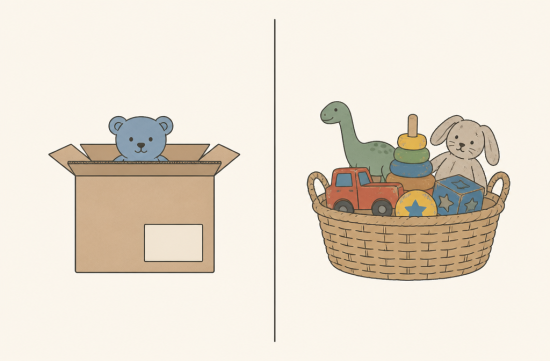
While organizing the toys in my child's room, I was momentarily taken aback when I saw three boxes completely full. I was a bit surprised to realize there were so many.
Half of them had hardly been touched, and the other half were character dolls whose names I could barely remember. I started to feel a bit of regret about the money spent.
Around that time, a mom I know mentioned a toy subscription service. She said that new toys arrive every month, and if you get tired of them, you just return them.
It sounded appealing. I wouldn't have to store them at home, and my child would be excited about new items every month. I thought this might finally end the stress of organizing toys.
However, when I looked at the price tag, it was more than I expected. I had thought it would be just a few dollars a month, but after crunching the numbers, the reality was different.
The well-known KiwiCo starts at $18.50 per month if you pay for a year upfront, but if you pay monthly, it goes up to $24. For different age groups, there's a product called Panda Crate that requires a separate payment of $42 every two months.
When calculated for a year, it comes to at least $222, and if you pay monthly, it can go up to $288. The difference is quite significant.
The Toy Library service has a slightly different structure. By paying $24.99 a month, you can borrow two toys worth up to $80. They say you can exchange them anytime if you don't like them.
When calculated for a year, that comes to $299.88, almost $300. That's quite a hefty amount for just two toys.
What's important here is that this is based on one child. If there are siblings, the costs multiply. If you have two kids, it could easily exceed $400 or $500 a year.
So this time, I also looked into used toys. In the U.S., there's a chain called Once Upon a Child, which has over 400 stores nationwide.
According to their website, you can buy items for up to 70% off the retail price. If I can buy the same brand of toys at this price, I thought there was no reason not to go.
What's even more interesting is that if you sell your unused toys, you can get cash on the same day, and if you buy something else that day, you get a 15% discount. I learned this for the first time this time around.
When you combine the money from selling and buying, the actual amount spent decreases. I found this part the most appealing.
Prices for used toys vary by store and brand, so it's hard to say exactly how much each one costs. However, just visiting a few stores gives you a rough idea of the market price.
In each neighborhood, there are seasonal children's secondhand markets that open, where toys are often sold at very low prices along with clothes, so it's worth keeping an eye on.
Even if you estimate the price at about 30% of the retail price, you can fill up on used toys much more generously than the cost of a subscription service for a year. For $250, you could buy several times more good-quality used toys instead of paying for twelve months of rental fees.
Of course, that doesn't mean subscription services are necessarily bad. The fact that you can use them right away, clean and without hygiene concerns, is definitely a strong advantage.
Especially for baby toys, many parents prefer new ones since they often go in their mouths.
On the other hand, used toys require an extra step of disinfecting and checking their condition. Honestly, this part can be a bit of a hassle.
Still, I think this level of effort is worth it. If I can save over $200 a year, doing one more disinfection is definitely a better deal.
Subscription services often come with return deadlines and damage policies. If your child tends to be rough with toys, you should consider this in advance.
Once you buy used toys, they are completely yours, so there's no burden at all. Whether they break or get scribbled on, it's entirely our household's situation.
The younger the child, the quicker their attachment to toys tends to fade, so I think used toys are more advantageous. Conversely, when they reach elementary school age, they may have a preference for certain brands, and at that point, the desire for new toys might sneak in.
On the local Facebook Marketplace, there are consistently posts for free toy giveaways or sales for just a few dollars. If you keep an eye on it, you can lower costs even further.
Some libraries also run toy lending programs, so it's a good idea to check your local library's website. Some places lend toys for free, so it's a no-risk situation.
After comparing the numbers directly this time, I found myself leaning more towards used toys.
However, if your child is particularly attached to a specific character or genre and wants something new every month, a subscription service might reduce stress for parents.
Ultimately, I think it's best to consider both the child's preferences and the household budget.
For now, I plan to visit used toy stores first and only buy new ones for things I really can't find.
After all, toys often get pushed out of interest after a few months.
If I can spend less money and still make my child happy, that's ultimately the best deal, right?
 SoupCircus

 Silent Sea |
 Pointy |
 Idaho's Sumi's House |
 holy cheese |
 Michigan Enthusiast |
 Mr. Largo |

 Round and Round Children's Song Kingdom |
 Belgray Miscellany |
 See It |
 chicpo |
  monorama tone |
  Good News Good Thoughts |
  Kentucky Fried Chicken |
  bloomberg |
  morninpo |
  my town K blog |
  bravik31 |
  Various Knowledge and Information in the USA |
  orvik90 |
  San Gabriel Mountains |
  quanta7 |
  Fransco Family |
  leonee |
  Augusta 90 |
  Project Tomorrow |
  DOCTOR MED |
  Say IT Now |
  Alpha and Omega World |
  Always Dreaming of Big Success |