
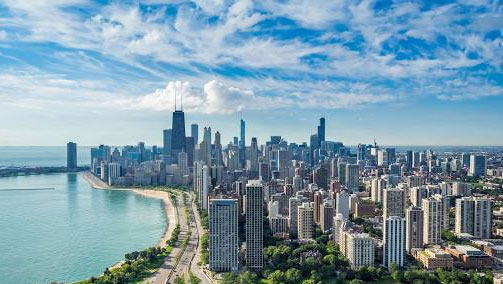
Chicago is well known for its unique climate and weather patterns, and it is also famous for the nickname "Windy City."
Did you know that this nickname is not just because it is windy?
In this article, we will take a closer look at the characteristics of Chicago's weather and the true origin of this nickname.
1. Characteristics of Chicago Weather
① Continental Climate
- Chicago falls under a continental climate with distinct four seasons.
- Summer: It often has hot and humid weather.
- Winter: It is cold with heavy snowfall, and severe cold can occur with strong winds.
② Average Annual Temperature
- Summer: Average high temperature is about 85°F(29°C)
- Winter: Average low temperature is about 20°F(-7°C)
- Spring and Fall: Relatively mild, but temperatures can change rapidly.
③ Precipitation and Snowfall
- Rainfall: Average annual is about 36 inches(91cm)
- Snowfall: Average annual is about 38 inches(96cm)
- In winter, the "Lake Effect Snow" caused by Lake Michigan can lead to heavy snowfall.
④ Lake Effect
- Chicago is adjacent to Lake Michigan and is greatly influenced by the lake.
- Summer: The lake breeze provides coolness, reducing the heat.
- Winter: Cold winds passing over the lake create snow, leading to heavy snowfall.
2. Why is Chicago Called 'Windy City'?
The nickname 'Windy City' can be explained by two main reasons.
① A City Where It Actually Winds a Lot
- Geographically, Chicago is located between Lake Michigan and the plains, making it a corridor for strong winds.
- Average wind speed: About 10mph(16km/h), which is moderate among major U.S. cities.
- When the lake breeze and the airflow from the plains meet, the wind often becomes stronger.
- In winter, strong northwesterly winds significantly lower the perceived temperature.
② Originating from Political Nickname
- The nickname 'Windy City' is believed to have originated from a political and social context rather than the weather.
- In the late 19th century, it is said to have stemmed from the boastful claims and exaggerated promotions of Chicago politicians.
- In particular, it is said that this nickname was born from criticisms by New York media regarding the exaggerated statements made by Chicago politicians competing for the World's Columbian Exposition in 1893.
3. Effects of Chicago Winds
① Summer
- The cool breeze from Lake Michigan refreshes the hot and humid summer weather.
- In urban areas, the wind helps to reduce the feeling of heat.
② Winter
- Cold winds drastically lower the perceived temperature, making the 'bitter cold' even more severe.
- "Wind Chill" is one of the biggest enemies of Chicago winters, making it feel much colder than the actual temperature.
③ Impact on Urban Design
- Chicago's high-rise building designs take into account the need to withstand high wind speeds.
- Many buildings in the Chicago skyline are designed to absorb and disperse the wind.
4. Tips for Enjoying Chicago Weather
Summer:
Visit Navy Pier or the Chicago Riverwalk to enjoy the cool breeze from Lake Michigan.Winter:
Prepare warm clothing and windproof coats. The perceived temperature can be much lower than the actual temperature.Spring and Fall:
It is advisable to prepare layered clothing due to rapid temperature changes.
Chicago's weather features distinct four seasons, and the wind plays an important role in city life.
While the nickname 'Windy City' is indeed due to the actual winds, it is interesting to note that it is also related to political boasting in a historical context!








 Khan Film Blog Production |
 Illinois Mom |
 Rice Shop Uncle BLOG |
 allstar realty |
 Enjoyable American Life Diary |
  Tonky |
  viroma |
  cookie |
  Live and that's it |
  Alright Twain |
  eatontown blog |
  HAWAII Korean Church News |
  Amore |
  linex |
  Balancework |
  laro90 |
  MEDBIO American Doctor Blog |
  SWAT TEAM BLK |
  DREAM BIG |
  frostbite |
  330 Forever My Love |
  El Dorado |
  dralix58 |
  Gorama Round |
  Skydiving |