
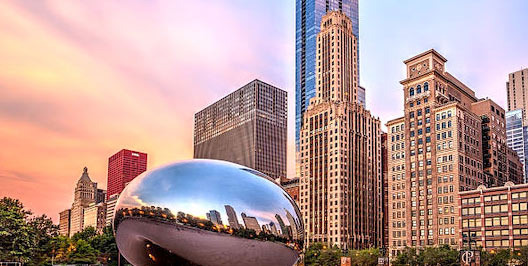
Chicago is one of the most important cities in the world today, boasting a rich history and diverse culture.
Starting as a small trading post in the early 19th century, this city developed into a major transportation hub and industrial center in the United States, witnessing significant moments in American history.
The Origins of Chicago
Early Settlements and Native Americans
- The name Chicago is derived from the Algonquin language, meaning "the field with wild onions," from Shikaakwa.
- Initially, the Potawatomi tribe settled in this area, and in 1673, French explorers Jacques Marquette and Louis Jolliet explored the region.
Early American Period
- In 1795, the area was secured by the U.S. government under the Treaty of Greenville.
- Subsequently, in 1803, the U.S. government built Fort Dearborn near the Chicago River to serve as a military and trading post.
19th Century: A Center of Transportation and Industry
The Founding of Chicago
- In 1833, Chicago was officially established as a town with a population of 200, and it was incorporated as a city in 1837.
- Thanks to its geographical advantage connecting Lake Michigan and the Chicago River, it grew rapidly.
Canal and Railroad Development
- In 1848, the Illinois & Michigan Canal was completed, connecting Lake Michigan and the Mississippi River, making Chicago a transportation and trade hub.
- That same year, the first railroad opened, establishing Chicago as the railroad hub of the American Midwest.
Grain and Livestock Market
- Chicago developed into a center for grain and livestock trading.
- In particular, the Chicago Board of Trade (CBOT) became a global center for grain trading, earning Chicago the nickname "the world's granary."
The Great Chicago Fire of 1871
- In October 1871, the Great Chicago Fire burned one-third of the city.
- About 300 people died, and over 100,000 lost their homes.
- However, after the fire, Chicago was quickly rebuilt and transformed into a larger, more modern city, marking the beginning of skyscraper design that laid the foundation for today's Chicago skyline.
20th Century: The Golden Age of Industry and Culture
Steel Industry and Immigrants
- In the early 20th century, Chicago grew as a center of the American steel industry, attracting immigrants from around the world.
- Large numbers of Germans, Irish, Poles, Italians, and African Americans contributed to the city's multicultural character.
Architecture and World Expositions
- In 1893, Chicago gained international attention by hosting the Columbian Exposition.
- This event earned Chicago the nickname "White City" and significantly influenced modern urban planning.
1920s-1930s: Prohibition and Gangsters
- During the Prohibition era (1920-1933), Chicago became notorious for gangsters like Al Capone.
- However, at the same time, jazz and blues music flourished, marking a cultural golden age.
Modern Chicago: A Leap to a Global Metropolis
Economic Center
- By the mid-20th century, Chicago established itself as a center for finance, manufacturing, and trade, with global financial institutions like the Chicago Board of Trade at its core.
- O'Hare International Airport opened, establishing Chicago as a global transportation hub.
The Chicago Movement
- In the 1960s, Martin Luther King Jr. and the Chicago Freedom Movement highlighted Chicago as a crucial center for the civil rights movement.
Culture and Architecture
- Since the 1970s, Chicago has emerged as a global architectural city.
- Willis Tower (formerly Sears Tower), John Hancock Center, and other modern skyscrapers adorn the city skyline.
- Sports teams, especially the Chicago Bulls and Chicago Cubs, have gained worldwide attention for their success.
Today's Chicago
Chicago continues to serve as the economic, cultural, and transportation hub of the American Midwest.
- Population: Approximately 2.7 million, making it the third-largest city in the United States.
- Cultural Diversity: With numerous cultural festivals and world-class museums, it is an attractive city for tourists.
- Economy: It plays a leading role in various fields, including finance, manufacturing, technology, and education.
Chicago symbolizes a unique American history, having grown from a small trading post to a global metropolis. It serves as a hub for transportation and industry, having undergone numerous challenges and reconstruction processes to reach its current state.
The history of Chicago itself tells the story of America's growth, and its dynamism and diversity remain attractions that are hard to find anywhere else in the world.







 Khan Film Blog Production |
 Illinois Mom |
 Rice Shop Uncle BLOG |
 Enjoyable American Life Diary |
 allstar realty |
  Anytime Journey |
  Mrs. Duluth |
  jaxter |
  Atlanta Mama |
  Baguette Blog |
  US Embassy |
  Korean Mom |
  My NYC |
  moo moo |
  Mr Oh |
  forevergee |
  festival |
  manchester |
  constant |
  Leapfrog Move |
  vibranto |
  Tora Tora |
  yellowbutter |
  Dolly |
  NYC saladbar |