
I was buying meat at the grocery store, and the label said 1.37 lb. I started to multiply by 0.45 in my head but gave up. Even after living in the U.S. for quite some time, this calculation still doesn't come easily to me.
This got me wondering. The whole world uses the metric system, so why does the U.S. still cling to pounds and miles? It turns out, it's a story that can't be summed up with just "stubbornness."
First, let me give you a twist. The metric system has never been illegal in the U.S. In 1866, Congress legally allowed the use of the metric system in contracts and transactions.
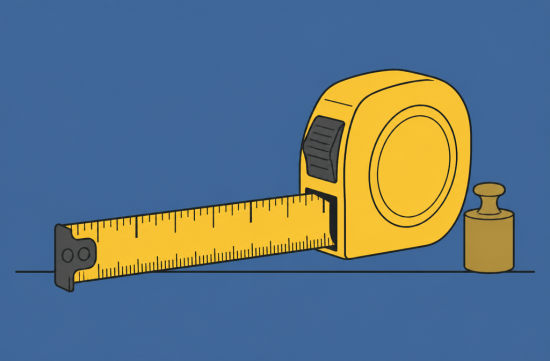
Going back further, we reach the year 1793. French botanist Joseph Dombey boarded a ship with a meter stick and a one-kilogram copper cylinder, intending to present them to then-Secretary of State Thomas Jefferson.
However, that ship never arrived. A letter Jefferson received in 1794 mentioned that Dombey had been captured and killed by a British privateer.
This led to the famous tale that "pirates caused America to miss out on the metric system." Honestly, it's such an entertaining story that I wanted to believe it too, but fact-checking sites like Snopes consider it an exaggerated piece of common knowledge. It's hard to believe that a single pirate incident could determine a nation's measurement system.
There's an even more interesting fact. Since the Mendenhall Order in 1893, the yard and pound in the U.S. have been officially defined based on the meter and kilogram.
In 1959, the U.S., the UK, and Canada agreed to define one yard as exactly 0.9144 meters. So, in a way, the U.S. measurement system is actually based on the metric system. It looks like inches on the outside but is fundamentally metric on the inside—like a half-and-half chicken, if you will.
The serious attempt to switch happened in 1975. President Ford signed the Metric Conversion Act, and the Metric Board was established.
However, the key word here is voluntary. There was no deadline, and no enforcement power. It was more of a suggestion that "it would be nice to switch."
Naturally, people didn't change. From a company's perspective, they would have to overhaul tools, blueprints, and production lines—who would want to spend money first?
In 1982, the Reagan administration abolished this board. The reason was federal budget cuts, and the remaining tasks were transferred to the Department of Commerce. The explanation at the time was that it wasn't so much about disliking the metric system but rather about financial issues.
That said, they didn't completely abandon it. The Trade Act of 1988 reaffirmed the metric system as the preferred unit for trade and commerce.
Federal agencies were required to use the metric system for procurement and grant activities by the end of the 1992 fiscal year. Of course, there was a caveat: "to the extent economically feasible."
In 1992, the packaging labeling law changed. From then on, packaged products had to display both metric and inch-pound units. The labeling we see, like "12 FL OZ (355 mL)," is a result of that change.
So, is America completely ignorant of the metric system? Not at all. In hospitals, medication dosages are in milligrams, and scientific laboratories operate entirely in metric. We see two-liter soda bottles every day, right?
Some road signs in Arizona still display distances in kilometers. Driving there might make you feel like you've briefly entered another country.
Of course, there have been accidents caused by mixing the two systems. The most famous case is NASA's Mars Climate Orbiter in 1999.
One team converted propulsion data to pound-force seconds, while the navigation software expected newton seconds. As a result, a $125 million spacecraft was lost on Mars. Who would have thought a single unit could be so costly?
Still, I don't think this leads to the conclusion that "we should have forced the change." The actual accident occurred due to mixing units, not because of using inches in the first place.
To summarize, the real reasons are this: the law has always been a suggestion, the costs of changing are high, and the immediate benefits of switching are low. Thus, people only use the metric system where necessary.
I think this approach is quite American. Instead of the government pushing from the top with "starting tomorrow, it's kilograms!", they let the necessary industries change on their own.
Industries like automotive, pharmaceuticals, and exports that are intertwined with the world are already operating in metric. Ultimately, where the market sees a need, change happens.
Conversely, a local carpenter has no reason to call a 2x4 board in metric. I believe this is much more realistic than forced reforms.
However, I acknowledge that it can be inconvenient for immigrants. I still have to pull out my phone calculator to convert an oven temperature of 350 degrees Fahrenheit to Celsius.
So my survival tip is simple: one pound is roughly a little less than half a kilogram, one mile is 1.6 kilometers, and 70 degrees Fahrenheit is short-sleeve weather. Just memorizing these three will help you get by.
In the end, America is less a country that rejected the metric system and more a country that operates with both systems simultaneously. It may be a bit cumbersome, but that's how this country functions.
Today, when I see the lb label at the grocery store, I'll try to smile instead of sighing. If I think about how that number hides Jefferson, pirates, and a Mars probe, even a pack of meat feels quite historical.
 VanillaMoto







 Conflite Teacher |
 SEVEN SEVEN |
 Korean Mom |
 novapixel |
 Peter Pan Pet |
 Mini Mee |
 Good Hotels |
 Korea Tiger News |
 Beauty, Health, Lifestyle Blog |
 Caribbean |
  Active |
  Cherokee Rose |
  Kor. Master |
  Holey Moley |
  Hodong Prince Over Flex |
  Mist inn |
  citrus pop |
  Onion Ring |
  phoenixia |
  viewtop |
  loverun |
  Kim Do Sun |
  yentra |
  Make My Day |
  Victory 1988 |
  Tonky |
  viroma |
  cookie |