
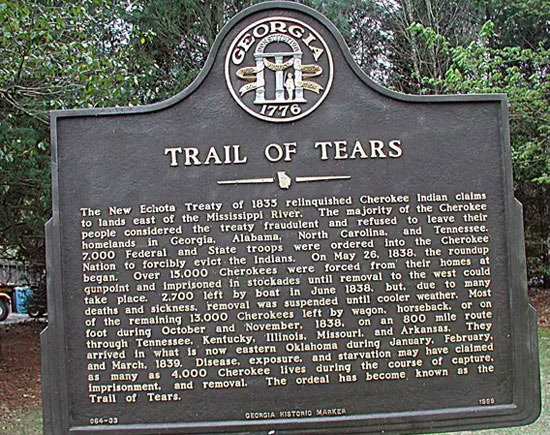
When people first hear the term Trail of Tears, they might think it refers to some tragic poem.
However, this name refers to the violent path of forced removal of Native American tribes like the Cherokee in the early 19th century.
The Cherokee forced relocation, known as the "Trail of Tears," began in earnest after the Indian Removal Act was enacted in 1830, with the actual large-scale movement occurring between 1838 and 1839.
At that time, the Cherokee, who had lived in Georgia and the surrounding southeastern region for about a year, were made to walk for months to Oklahoma, without the U.S. government even asking for their opinion.
The U.S. government seized their land, claiming gold had been discovered and that white people would develop it better, treating the Cherokee people like cargo. It was merely called "relocation," but in reality, it was an expulsion, akin to being told, "You cannot live here anymore."
During the journey, thousands froze to death, starved, and died from illness. Yet, referring to this as the "Trail of Tears" makes it sound like an inevitable fate, which is somewhat uncomfortable.
The government created this path under the guise of policy and law, using the military, and if we only associate the outcome with sadness, it obscures who is responsible.
The Cherokee did not leave voluntarily, nor were they seeking a new life or a better future. They were simply driven from the land they had lived on. Records left by them show that some had to hurry on after burying their parents, while others could not stop even when witnessing their children freeze to death.
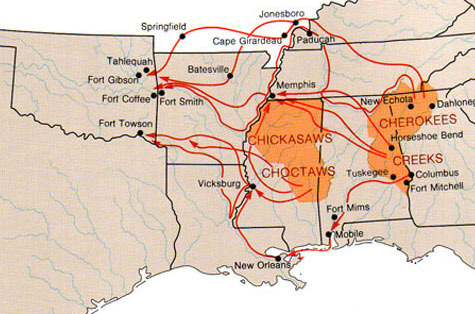
There are not many records of white people's reactions at that time. However, those who coveted Cherokee land because gold was found in Georgia supported the forced relocation, claiming, "We can use it better."
There was also hope that they could build new homes and farms in the Native American territories. Additionally, some politicians and newspapers justified it by saying legal procedures were followed.
However, not all white people shared the same perspective. Missionaries and some citizens tried to help the Cherokee and criticized the relocation policy. Yet, their voices were too small, and ultimately, the interests of the powerful pushed history forward.
Today, the way this story is handled in America is calm and quiet. Textbooks refer to it as a serious history but explain it too blandly, as if saying, "Such things happened."
They simply erect a monument, write a few lines, and say not to forget, while most people read it without much emotion and move on.
This is even more bitter. The pain of those who were forcibly removed fades over time into mere tragedy, while the realistic responsibilities and anger become vague.
Thus, the term "Trail of Tears" leaves an awkward feeling. Until we ask whose tears made them cry and why they had to shed those tears, this name sounds too beautiful.







 Cherokee Rose |
 Dingho and USA News |
 moonshine 7 |
 Gimmi207 Blog |
 Korean Mom |
  My NYC |
  moo moo |
  Mr Oh |
  forevergee |
  festival |
  manchester |
  constant |
  Leapfrog Move |
  vibranto |
  Tora Tora |
  yellowbutter |
  Dolly |
  US Embassy |
  NYC saladbar |
  Finding Superfoods |
  lightyear |
  song bang |
  vexomo |
  Indiana Jones |