
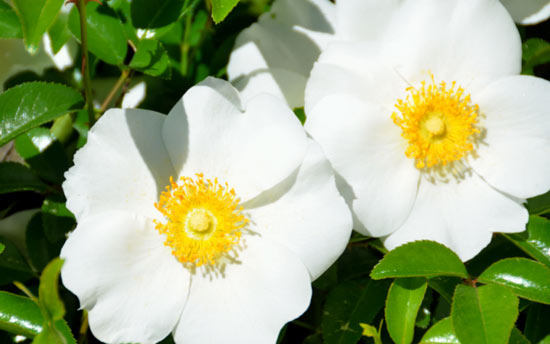
When you think of Georgia's state flower, you might expect something as vibrant and striking as a rose, right?
But when you actually see Georgia's state flower, it's the Cherokee Rose, which looks quite humble.
The petals are pure white, with a center that has yellow stamens, and from a distance, it appears to bloom shyly like a wildflower.
If no one labeled it as the "state flower," you might just pass by it indifferently.
However, learning why this flower became a symbol of Georgia reveals that it was not chosen just for its beauty, but because it carries a painful history.
The Cherokee Rose was designated as Georgia's official flower in 1916, symbolizing the 'Trail of Tears' during which the Cherokee were forcibly relocated.
There is a story that as the Cherokee people were driven westward, their sorrow settled like white petals along the path.
This area was originally the land of the Cherokee, but in the early 19th century, the U.S. government began forcibly removing them under the pretext of development and white settlement.
This process is known as the forced relocation called the 'Trail of Tears,' during which thousands lost their lives to cold, hunger, and disease while walking from northern Georgia to Oklahoma.
For the Cherokee, Georgia was not just land; it was the center of their lives, and they were forced to leave.
Today, there are historical sites and monuments throughout Georgia that remember this history.
Even just seeing a sign can evoke a quiet sense of the pain from that time.
So, the land of Georgia still bears the footprints and tears of the Cherokee people.
When people see this flower, they say it embodies their suffering and tears. Even more surprising is that this flower is not originally native to Georgia.
Its name is Cherokee, and it has a story tied to the Cherokee, yet it turns out to be an introduced species from Asia.
Isn't it ironic that a flower symbolizing the pain of the indigenous people living on American soil is not actually from that land?
Like the Cherokee people who were forced to live in a foreign land, this flower has also taken root and lived in a place that is not its home.
Perhaps that's why when I see this flower, I think, "It didn't become the state flower because it was beautiful, but because it endured."
There is no rule that a state flower must be flashy and proud, right? Looking at various states in America, there are many rugged and common flowers.
Even if they seem insignificant, they all hold the memories and stories of their regions.





 Cherokee Rose |
 Dingho and USA News |
 moonshine 7 |

 Gimmi207 Blog |
  US Embassy |
  Korean Mom |
  My NYC |
  moo moo |
  Mr Oh |
  forevergee |
  festival |
  manchester |
  constant |
  Leapfrog Move |
  vibranto |
  Tora Tora |
  yellowbutter |
  Dolly |
  NYC saladbar |
  Finding Superfoods |
  lightyear |
  song bang |
  vexomo |
  Indiana Jones |