

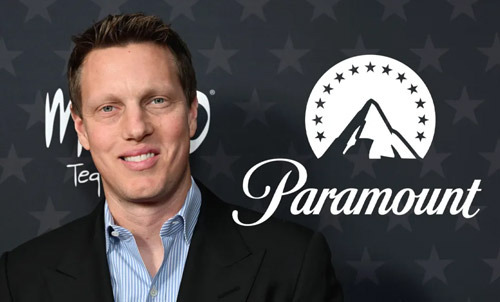
These days, when you watch the news in the U.S., the stories about Hollywood film companies are often more complicated than those about tech company mergers.
The acquisition plan of Warner Bros. Discovery by Paramount Skydance has a deal size of about $110 billion.
However, to understand this deal, you can't just look at Paramount; you need to see the name Ellison behind it.
The current CEO of Paramount Skydance is David Ellison, the son of Oracle co-founder Larry Ellison.
That said, it's not entirely accurate to simply explain it as "a rich son buying a company with his father's money."
David Ellison founded Skydance in 2006, growing the film production business, and later rose to prominence in media management through the merger with Paramount.
However, it is true that his father's wealth plays a significant role in this acquisition of Warner Bros. Discovery.
Larry Ellison provided a personal guarantee for $40.4 billion of the equity financing for the acquisition.
The issue isn't that this family has a lot of money.
The key point is how competition will change when such massive media assets are consolidated.
Warner Bros. Discovery includes not only the Warner Bros. film studio but also HBO, CNN, and Discovery-affiliated channels.
If Paramount's films, TV, and CBS-affiliated assets come under one company, it will create a media group with significant influence in the U.S. film and broadcasting industry.
For this reason, 12 states, including California, filed an antitrust lawsuit in July to block the merger.
They argue that if the two companies merge, competition in film distribution and the cable TV market will decrease, which could be detrimental to theaters, consumers, writers, and production workers.
On the other hand, there are valid points from Paramount's perspective. They argue that to compete with large platforms like Netflix and Disney, scale is necessary.
The logic is that it is better to combine content and streaming services to reduce costs and enhance competitiveness than for Paramount and Warner to fight separately.
In fact, the U.S. Department of Justice has already approved the deal, and many major foreign regulatory agencies have also granted approval.
So, it's not easy to conclude that this merger is simply "bad because it's monopolistic."
The problem lies in what happens after the merger.
When a company makes a $110 billion deal, it ultimately has to cut costs somewhere.
They will merge similar departments, streamline overlapping personnel, and reassess content investments.
For those working in Hollywood, the more realistic issue is the possibility of losing their jobs rather than the company name getting bigger.
Additionally, California Attorney General Rob Bonta canceled the merger negotiation meeting scheduled for August 23, claiming that Paramount leaked and distorted negotiation details.
Paramount is also taking a strong stance. They demanded a bond of about $1.88 billion from California and the 12 states, as well as the Writers Guild of America, citing costs incurred due to delays from the lawsuit. They claim that if the deal is delayed, a so-called ticking fee of about $7 million per day will start from October.
There are even discussions about relocating business operations to states like Tennessee or Texas if conflicts with California continue.
If this leads to a large-scale relocation, it wouldn't be a laughing matter for California.
By pushing hard on antitrust regulations, they could lose film and TV-related jobs and tax revenue to other states like Texas.
Ultimately, the real economic question is whether we need another massive media company to compete with Netflix and Disney, or if the company created in that way itself becomes a new monopoly issue.
For David Ellison, it's an opportunity to complete a media empire, but for regulators, it's a test to protect competition.
And for California, it's more complicated. Blocking the merger could lead to companies and jobs leaving, while allowing it could concentrate Hollywood's media power in a few large companies.
Therefore, I believe this struggle is a $110 billion showdown that shows how the U.S. media industry will be reshaped around whose money and platforms in the future.
 RunAround
 redsunwalker2001






 GOGO SING |
 Hajiwon Blog Hair Salon |
 tartbear |
 novapixel |
 NEXT ROUND |
 Reggae Party |
 DOCTOR MED |
 Information on All Regions of the United States |
 Breaking Bad Drama |
 Story Bank |
  Mau Nui |
  fixed |
  AL ALASKA |
  amola |
  History Repeats Itself |
  Doori Ark |
  Rainbow Bridge to the Sky |
  Sunny Fullerton |
  U.S. Weather Bureau News |
  Gold Bar |
  Banana Style Life |
  Tesla X |
  Old English |
  urbanmint |
  forestcloud |
  forever young |
  Arlington house |
  liquid asset |