
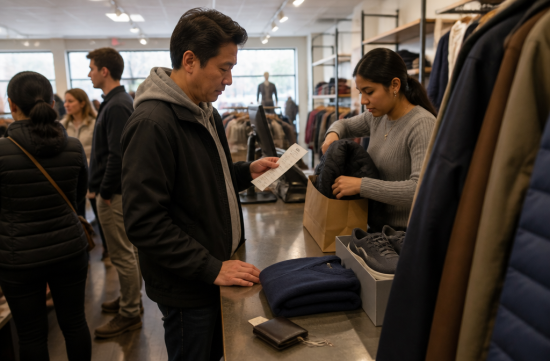
Last weekend, I picked up a winter puffer jacket and stood at the checkout. When I received the receipt, the tax line read 0.00. Even though I've seen that number for years living in New Jersey, it still makes me feel good every time I see it.
However, the wallet I bought as a gift that same day had tax added to it. Both items are worn, so why is one tax-free and the other taxable? I decided to sort this out before the year-end shopping season.
First, let's cover the basics. The sales tax rate in New Jersey is 6.625%, and this rate has been in effect since January 1, 2018. There is no local sales tax added by counties or cities.
According to state law (N.J.S.A. 54:32B-8.4), clothing and shoes worn by people are exempt from sales tax. This applies year-round, not just during limited-time sales.
The New Jersey Division of Taxation provides quite specific examples of exempt items. Coats, jackets, boots, sneakers, socks, underwear, gloves, hats, scarves, and ties are all included.
Belts, suspenders, swimsuits, slippers, suits, and wedding dresses are also tax-exempt. I learned for the first time that baby diapers and adult diapers are classified as clothing.
There's also a welcome item for the season. Halloween costumes are included in tax-free clothing. However, separately purchased masks or costume accessories are taxable, leading to the amusing situation where the costume itself is free of tax, but the mask incurs tax.
Now we get to the tricky part. The Division of Taxation has categorized clothing accessories as taxable items. Handbags, wallets, watches, jewelry, umbrellas, hair accessories like hairpins, handkerchiefs, and wigs fall into this category.
The secret behind my wallet receipt was this. No matter how fashionable the item, if it's considered an accessory rather than clothing, it incurs a 6.625% tax.
Sports equipment also requires caution. Cleats for soccer or baseball, skates, ski boots, shin guards, baseball gloves, ballet shoes, and tap shoes are taxable.
While regular sneakers that can be worn casually are tax-free, shoes used only in competitions are considered equipment. If you have a child starting winter hockey or skating at home, this could affect your budget.
Fur clothing is also an exception. Since 2009, fur garments have been classified as taxable items and are subject to the general sales tax. Although it's unlikely you'll be buying a fur coat at the end of the year.
So, how much of a difference does this actually make? For example, if you buy a puffer jacket for $150, sneakers for $90, and a coat for $200, the total is $440 with no tax.
If you add a $200 gift handbag, that bag alone incurs $13.25 in tax. Adding a $120 hockey skate brings an additional $7.95 in tax.
Therefore, when planning your year-end budget, it's easier to calculate clothing and shoes separately from other items. Clothing is at the listed price, while for other items, you multiply the price by 1.06625.
Comparing this to New York across the river makes the differences even clearer. In New York, only clothing and shoes priced under $110 are exempt from the state sales tax of 4%.
In New York City, items under $110 are exempt from city tax as well, but the moment the total exceeds $110, a combined tax of 8.875% applies. This means $109.99 is tax-free, while $110 is fully taxable.
So, if you buy a $300 winter coat in Manhattan, the tax alone is $26.63. If you buy the same coat at a New Jersey store, it's $0, making it quite a significant difference for just crossing a bridge.
Of course, considering bridge tolls and parking fees, that difference can quickly disappear. Conversely, it's now clear why friends living in New York would go out of their way to visit New Jersey outlets.
For those living in Bergen County, there's one more calculation to consider. It's about Sundays. Bergen County has a blue law that requires non-essential retail stores, such as clothing, furniture, and electronics, to close on Sundays.
New Jersey counties still adhering to this law are limited to Bergen, and its roots trace back to 1704. It's fascinating to think that a law over 300 years old is dictating my shopping routes.
Currently, a hot topic is the American Dream Mall. This mall is located in Bergen County but has been open on Sundays, leading the city of Paramus to file a lawsuit over it. As of 2026, the legal battle is still ongoing.
So, if you plan to shop on a Sunday, it's best to check the store hours in advance. I usually set aside Saturday mornings for shopping.
One more thing to add is that clothing services like alterations or dry cleaning are also exempt from sales tax in New Jersey. It's a small but appreciated benefit that there's no tax on shortening pants.
To summarize, here's the breakdown: clothing and shoes are tax-free.
Bags, wallets, watches, and jewelry are taxable. Sports shoes and protective gear are also taxable.
If you plan to buy clothing over $110 in New York, it's more advantageous to purchase it in New Jersey. Be sure to check the Sunday hours for Bergen County stores.
If it were me, I would focus my year-end shopping on clothing on Saturday and target days with significant discounts for accessories. There's no better discount than a receipt showing $0 in tax.
 NoodleStation

 kuku 100 |
 novent |
 Silent Sea |
 Pointy |
 Idaho's Sumi's House |
 shaket |
 springw |



 urbanmint |
  forestcloud |
  forever young |
  Arlington house |
  liquid asset |
  Who's watching? |
  eclipse |
  quietwave |
  Hajiwon Blog Hair Salon |
  hoosierdaddy |
  saffronroute |
  korvex93 |
  Mini Mee |
  Darnignac |
  vanilla |
  selvon |
  brownie |
  Star Blog |
  The Day the Sun Rises |
  sweetpop |