

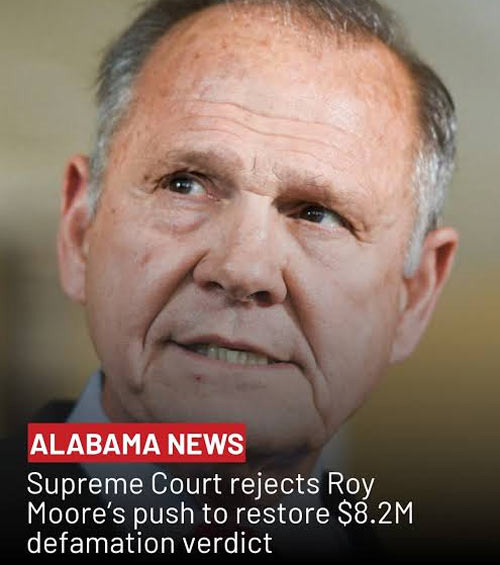
When following American political news, there are certainly cases that drag on for a long time.
The Roy Moore lawsuit began a decade ago, stemming from the 2017 Alabama Senate election, and ultimately the U.S. Supreme Court did not side with Moore.
The amount in question is $8.2 million, which translates to over 10 billion won in Korean currency.
This was a defamation damages amount that a jury had once decided should be paid to Moore, but now the path to receiving that money is effectively blocked. Haha.
Roy Moore is a conservative politician who previously served as the Chief Justice of the Alabama Supreme Court.
He is also known for his strong opposition to same-sex marriage and for advocating the display of the Ten Commandments in public places.
However, during his candidacy for the U.S. Senate in 2017, allegations related to his past interactions with underage women surfaced.
At that time, a woman named Leigh Corfman claimed that when she was 14 years old in 1979, she was subjected to inappropriate physical contact by Moore, who was then a 32-year-old assistant district attorney.
Other women also stated that Moore had either dated them or attempted to date them when they were in their late teens.
Of course, Moore denied the allegations.
In this context, a political action committee with Democratic leanings, Senate Majority PAC, funded a group called Highway 31 that launched a major TV ad campaign attacking Moore.
Ultimately, Moore lost the Senate election that year.
The Controversial TV Ad Aired 533 Times
What Moore's team took issue with was the content and editing style of the ad.
They argued that it pieced together statements and sentences from different newspaper articles to make it appear as though Moore had been accused of soliciting sexual relations with young girls in a shopping mall.
Moore's lawyers contended that no journalist had ever actually made such a claim, and that the ad created new allegations.
Moreover, the ad reportedly aired a staggering 533 times in Alabama during the final days of the election.
Considering how powerful political ads can be, that's a significant number.
Moore ultimately filed a defamation lawsuit against Senate Majority PAC, which funded the ad.
In 2022, a federal jury accepted Moore's claims and awarded him $8.2 million in damages.
At this point, it seemed like a complete victory for Moore. However, the case was overturned in the appeals court.
The 11th Circuit Court of Appeals ruled that Moore failed to prove actual malice on the part of the opposing group and canceled the damages ruling.
In the U.S., when a public figure like a politician files a defamation lawsuit, a higher standard of proof is applied than for an ordinary person.
Simply proving that the ad's content was false or inaccurate is not enough.
It must also be shown that the opposing party published the information knowing it was false or recklessly disregarded the truth.
This aspect became a decisive obstacle for Moore.
Even After Reaching the Supreme Court, the Outcome Remained Unchanged
Moore did not give up and requested the Supreme Court to rehear the case.
However, the Supreme Court declined to accept his request for a hearing on Monday. Earlier in June, they had also rejected an emergency request to stay the effectiveness of the appeals court's decision.
Ultimately, the appeals court's decision to cancel the damages ruling was upheld.
Conversely, it became a legal victory for Senate Majority PAC, which had claimed that the ad was based on truth.
One point to clarify here is that the Supreme Court did not rule that the content of the ad was entirely factual. They simply decided not to rehear the appeals court's judgment.
When following American political news, it often seems that the ads attacking opposing candidates during election season are quite harsh.
There are many moments where one might wonder if such ads would be acceptable in Korea.
However, the U.S. strongly protects freedom of expression under the First Amendment, especially regarding criticism of politicians, which is considered an important area in democracy.
Of course, just because it is a political ad does not mean that lies are automatically permitted.
However, for a public figure to receive damages for defamation, the legal threshold is quite high.
This case illustrates that difference.
Even if a jury recognizes a substantial damages amount of $8.2 million, if the appeals court determines that the legal proof standard was not met, the outcome can be completely overturned.
Ultimately, what remains is the significance of this precedent showing how strongly political expression is protected in the U.S., rather than just the figure of $8.2 million.
 LikeUSmiling
 ForestDream






 Hajiwon Blog Hair Salon |
 tartbear |
 novapixel |
 NEXT ROUND |
 Encyclopedia of New York and Surrounding Areas |
 AH LALA |
 Montgomery Mom |
 Samsung My My |

 Sunny Fullerton |
  U.S. Weather Bureau News |
  GOGO SING |
  Gold Bar |
  Banana Style Life |
  Tesla X |
  Old English |
  urbanmint |
  forestcloud |
  forever young |
  Arlington house |
  liquid asset |
  Who's watching? |
  eclipse |
  quietwave |
  hoosierdaddy |
  saffronroute |
  korvex93 |
  Mini Mee |