
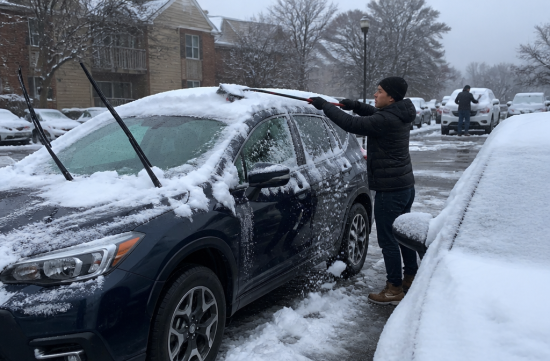
Last night around midnight, I took a drive around the neighborhood and saw cars parked in the lot. It's still early October, so there's no snow or even frost yet, but it suddenly reminded me of last winter.
There was a day when I was driving on I-270 and a whole sheet of ice flew off the roof of the car in front of me, and my heart really dropped. Luckily, it fell into the lane next to me, but ever since then, I've been keeping my distance from cars piled with snow.
However, starting this winter, this is no longer just a matter of courtesy. In Maryland, a law that fines drivers for not clearing snow and ice off their vehicles went into effect on October 1.
The official name is the Clear Before You Drive Act, House Bill HB 474. It passed unanimously in both the House and Senate this year, and Governor Wes Moore signed it on May 26.
First, let's clarify something. From the title, it might seem like this is a local ordinance created by the city of Gaithersburg, but in fact, it's a state law that applies to all of Maryland. This means it applies equally in Montgomery County and Baltimore.
The core of the law is simple. You cannot drive or tow a vehicle without making a reasonable effort to remove snow and ice that poses a threat to people or property.
The areas that need to be cleared are the hood, trunk, windshield, windows, and roof. For trucks, this includes the top of the cabin, and for trailers, the upper surface as well.
Honestly, most people scrape their windshields and windows. The problem is the roof. For shorter cars, it's a bit easier, but many people with SUVs or vans leave the roof untouched and just drive off.
The fines start at $25 for the first offense for regular passenger vehicles, $50 for the second, $100 for the third, and $200 for the fourth and subsequent offenses. These amounts are from the state legislative budget report.
For commercial vehicles, the fines are much steeper. They start at $75 for the first offense, then $150, $300, and $600, and from the fifth offense onward, it's $1,000.
The really scary part is if it leads to an accident. If flying snow or ice causes property damage, death, or serious injury, the fines for regular vehicles can range from $200 to $1,000, and for commercial vehicles, from $500 to $1,500.
Also, this violation is classified as a misdemeanor. Just looking at the $25 figure might make it seem light, but the label carries more weight than you might think.
So, do police just pull over cars with snow on them? Not exactly. This law is a secondary enforcement, meaning it can only be enforced if the vehicle is stopped for another reason, like speeding or running a red light.
However, there is an exception. If the violation contributes to property damage, death, or serious injury, then they can enforce the law based solely on that violation.
They've also prevented the same vehicle from being cited multiple times in one day. Even if violations occur, they cannot be processed as more than one violation within 24 hours.
There's a realistic exception clause as well. If clearing the snow would violate workplace safety regulations or threaten the driver's own health and safety, it does not apply.
For example, if you have to climb on top of a large truck to clear it, that's a situation where the law does not require perfect cleanliness, just a reasonable effort.
This law is said to be modeled after Pennsylvania's Christine's Law. Similar laws already exist in New Jersey and New Hampshire.
Personally, I think it's a bit late. Public safety ultimately starts with everyone being a little inconvenienced. Some say the secondary enforcement makes it less effective, but I believe that just having a standard will change the atmosphere.
I often go out early in the morning to pick up supplies for my store, so this law is not just someone else's problem for me. When I stand in front of my car the morning after it snows, I really feel like a bear that just came out of hibernation, unable to move.
So this year, I plan to prepare in advance. I'm definitely going to buy a long-handled snow brush that can reach the middle of the roof.
I'm also thinking of leaving about 10 minutes earlier than usual. If I start the engine and let the frost melt while I clear the roof, the timing will work out perfectly.
It's said that it's better to push the snow off the roof from the front to the back. That way, it doesn't fall back onto the windshield.
If the ice is thick, it's better not to force it off but to melt it a bit with the heater before removing it, as it's less stressful on the car.
It's the same when baking tarts. If there are clumps of flour left on the dough, they'll spill out in unexpected places while baking and ruin the shape. Clearing it off before starting is ultimately the fastest way.
I think driving is the same. Spending 5 minutes before you start can save the day for the driver behind you, or even more.
If your parents or older relatives are still unaware of this law, it would be good to let them know. There are quite a few people in the Korean community who think it's okay to drive off with snow on the roof.
This winter, let's clear the roof thoroughly like a bear and head out. Buying a warm slice of tart is much sweeter than a $25 ticket.
 ColaBoatCrew


 sun walker |
 Let's Be Like a Salt-like City Person |
 Springs Korea |
 US Legal Consultation on Trials |
 Study Abroad Life Know-How Tips |
 Thersburg Mrs |

 monkey |


 Samsung My My |
  bubblo |
  tartbear |
  Washington Monument |
  Forever Young |
  crystalx |
  Spaghetti Flying Religion |
  lunarpath |
  Another Eden Channel BLOG |
  sprinkletop |
  bongo |
  savannah choi |
  Successful Manager Kim's Team |
  crystalo |
  Canvas Pro Blog |
  Time Management Enthusiast |
  Cap Com |
  nixxon |
  kevin Kim |
  beerdreamer |